
Once a family has decided that a senior's home needs accessibility improvements, the next question is often the most confusing part of the entire process: what are the options, and how do they fit together? A quick Google search returns dozens of products — stair lifts, home elevators, walk-in tubs, grab bars, ramps, threshold ramps, vertical platform lifts, transfer benches. Which of these does the person actually need? Which can wait? Which are best done together?
This guide is an organised overview of the major home accessibility options available to NJ seniors, grouped by which area of daily living they address. It is written for families still in the research phase — not to sell any specific product, but to help you understand what exists, roughly what it costs, and when each option makes sense. If you have already read our companion post Signs It's Time to Improve Home Accessibility, this is the natural next step.
How to Think About Home Accessibility
Before listing options, it helps to think about accessibility as covering four distinct daily-living challenges rather than one general category:
- Vertical access: Moving between floors of the home (stairs)
- Bathroom safety: The most frequent site of home falls for older adults
- Entry and exit: Getting into and out of the home, including outdoor stairs
- Interior mobility: Moving through the home safely — doorways, thresholds, flooring, lighting
Each of these areas has different options. Most seniors need modifications in two or three of these areas — rarely just one. Understanding the full picture from the start allows you to plan a coherent solution rather than addressing each issue as an emergency when it arises.
1. Vertical Access — Moving Between Floors
Vertical access is often the largest accessibility challenge in a multi-level home. Three main options address it, with different capabilities, costs, and installation requirements.
Stair Lifts
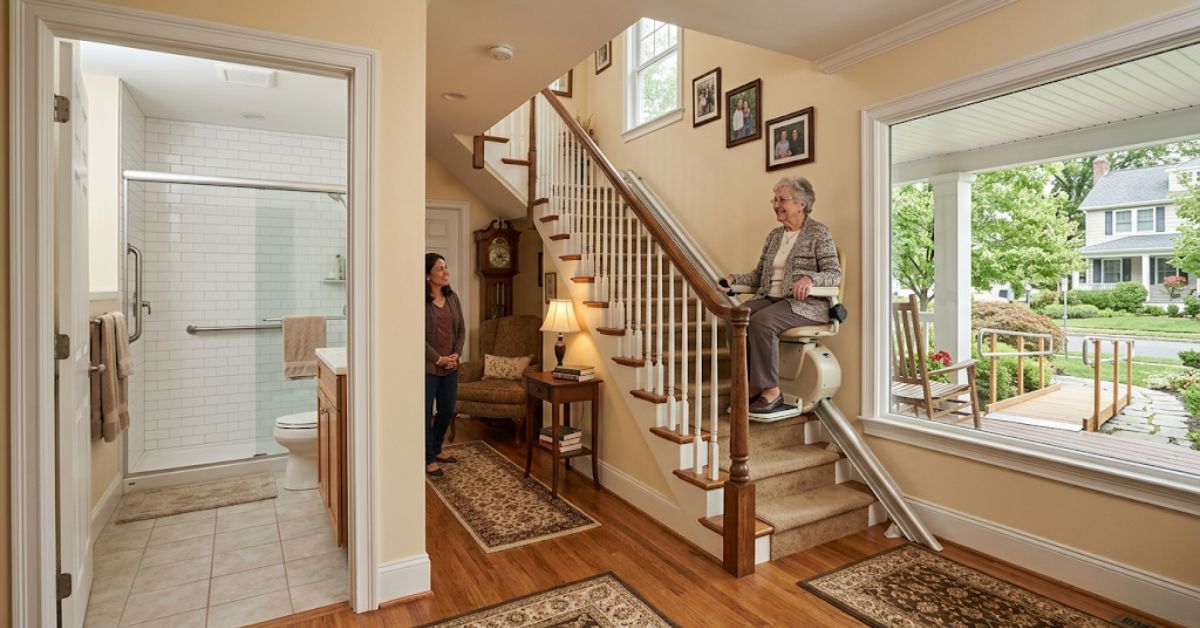
A motorised chair that travels along a rail mounted to the stair treads. The user sits on the chair, rides up or down, and dismounts at the top or bottom. Available in straight, curved, and outdoor configurations.
Best for: Anyone who can safely transfer to a seated position but has difficulty climbing stairs. The most common vertical access solution by far — installed in 24–48 hours for straight staircases.
Vertical Platform Lifts (VPLs)
An open-platform elevator that lifts a wheelchair user (or standing person) 4–14 feet vertically. Common for exterior porch access, garage-to-house transitions, and short interior floor gaps.
Best for: Wheelchair users who need to move between floors but for whom a full home elevator is impractical or excessive. Also serves as an outdoor solution when a wheelchair ramp is not feasible due to space.
Home Elevators
A fully enclosed elevator car installed inside the home that transports the user (and, if needed, a wheelchair) between floors. Requires structural work, permits, and a 2–4 month installation timeline.
Best for: Families with the budget and long-term horizon to justify the investment, particularly when the user cannot safely transfer to a stair lift or when wheelchair transport between floors is essential. Adds home value in most NJ markets.
2. Bathroom Safety Options
Bathrooms are the most frequent site of home falls for older adults — combining wet surfaces, hard fixtures, and challenging transitions. Multiple options address different bathroom safety concerns, and most homes benefit from a combination.
Grab Bars
Fixed metal bars professionally installed at key balance points — near the toilet, in the shower, next to the tub, along walkways. Different from towel bars, which cannot support body weight and should never be used as grab points.
Best for: Almost every senior bathroom. Grab bars are the highest impact, lowest cost bathroom safety modification and are typically covered by Medicare Advantage supplemental benefits and NJ Medicaid MLTSS.
Shower Chairs, Benches, and Transfer Benches
Seating options inside the shower or tub. Standard shower chairs allow seated bathing. Transfer benches extend outside the tub wall, allowing the user to sit on the outside, then slide across without stepping over the tub edge.
Best for: Anyone with balance issues, difficulty standing for long periods, or difficulty stepping over the tub wall. Transfer benches specifically address one of the most dangerous bathroom moves.
Tub Cut-Out Conversions
A section of the existing tub wall is cut out to create a low step-through opening. Preserves the existing tub while dramatically improving access. Typically installed in one day.
Best for: Families who want fast, affordable improvement to tub access without a full bathroom renovation. A middle-ground option between grab bars alone and full walk-in shower conversion.
Walk-In Showers
Full conversion of a tub or step-in shower to a barrier-free walk-in shower with low or no threshold, built-in seating, and grab bars. A more substantial renovation than a tub cut-out but provides the most accessible bathing option.
Best for: Homes where the existing bathroom will be used long-term and the family wants a comprehensive, aesthetically appropriate accessibility solution. Often covered partially by NJ Medicaid MLTSS.
Walk-In Tubs
Bathtubs with a hinged door that swings inward or outward, allowing the user to enter the tub without stepping over a high wall. The user sits inside on a built-in seat and the tub fills around them.
Best for: Seniors who specifically want the therapeutic experience of a full bath (immersion, jets) rather than a shower. Note: the user must remain in the tub while it drains, which is a common drawback that surprises buyers.
Raised Toilet Seats and Comfort-Height Toilets
Raised toilet seats add 2–5 inches of height to a standard toilet. Comfort-height toilets are 17–19 inches tall (vs standard 15 inches), designed to reduce the sit-to-stand strength requirement.
Best for: Anyone with knee, hip, or lower-body strength limitations that make standard toilet use difficult. Often included in comprehensive bathroom safety packages.
3. Entry & Exit Options
Getting into and out of the home is often the most immediately noticeable accessibility challenge — because reduced entry access limits community engagement, medical appointments, and social visits.
Wheelchair Ramps (Modular Aluminum)
Prefabricated aluminum ramp sections assembled to fit the specific home. Typically installed in 1–2 days. Non-permanent — can be removed and reused elsewhere. Cost varies with the vertical rise (steeper front stoops require longer ramps).
Best for: Most senior wheelchair users and anyone with significant mobility limitations at the home entrance. Fast installation makes this the go-to for post-surgical discharge or urgent situations.
Wheelchair Ramps (Permanent Construction)
Custom-built wooden or concrete ramps designed for the specific home and intended for long-term use. Higher cost but often better integrated aesthetically and more durable in NJ weather.
Best for: Homes where the ramp will be a long-term feature, particularly older NJ homes where aesthetic integration matters.
Threshold Ramps
Small ramps that bridge single-step transitions or door thresholds. Often modular aluminum or rubber. Address small step-ups (2–8 inches) that create trip hazards or wheelchair barriers.
Best for: Homes with small front stoops, back door steps, or interior threshold height differences that create small but real hazards.
Outdoor Stair Lifts
Stair lifts designed for exterior installation — weatherproofed for NJ conditions. Common solution for homes with steep front stoops or outdoor steps that would require impractically long ramps.
Best for: Homes where an outdoor stair lift makes more sense than a ramp — typically high stoops (5+ steps) or space-constrained yards where a ramp of adequate length is not feasible.
Outdoor Handrails
Sturdy handrails installed alongside outdoor steps and walkways. Often overlooked but crucial for balance support on front stoops and porch steps.
Best for: Almost every senior home with any outdoor steps. Often a first, immediate improvement before larger modifications are planned.
4. Interior Mobility & Safety
Beyond specific areas of concern, several general home modifications improve safety throughout the interior — often addressing multiple accessibility challenges simultaneously.
Doorway Widening
Existing doorways widened from standard 28–30 inches to 32–36 inches to accommodate wheelchairs or walkers. Involves reframing the doorway and often adjusting adjacent finishes.
Best for: Wheelchair users in homes with narrow interior doorways — common in older NJ housing. Often prioritised for the bathroom and bedroom doors first.
Non-Slip Flooring
Replacing slippery flooring (polished hardwood, glossy tile) with non-slip alternatives (textured vinyl, low-pile carpet, non-slip tile). Particularly important in kitchens and bathrooms.
Best for: Homes where existing flooring creates fall hazards. Can be done room-by-room rather than whole-house.
Improved Lighting
LED fixtures with higher brightness, motion-activated lights in hallways and bathrooms, night lights in stairways, and improved switches (rocker-style rather than toggle). Dramatically reduces fall risk from poor visibility.
Best for: Nearly every senior home benefits from lighting improvements. Motion-activated night lights on stairways specifically prevent overnight bathroom-trip falls.
Handrails on Interior Stairs
Adding a second handrail to interior stairs (most staircases have only one). Substantially improves stair safety when both hands can grip rails, and provides balance support even without a stair lift.
Best for: Any home where the person still uses stairs, particularly before a stair lift is installed or in homes where a stair lift is not chosen.
Assistive Technology & Smart Home Options
Beyond structural modifications, technology increasingly plays a role in home accessibility for seniors. Common categories include:
- Personal emergency response systems (PERS): Wearable devices that call for help with a button press or automatic fall detection. Monthly subscription $25–$60. Substantially reduces "long lie" time after a fall.
- Smart speakers with voice control: Alexa, Google Home — can control lights, temperature, and phone calls hands-free. Particularly useful for people with limited mobility or dexterity.
- Video doorbells: Allow the person to see and speak to visitors without needing to reach the door. Also useful for family remote check-ins.
- Automated pill dispensers: Reduce medication errors — a significant safety issue for seniors managing multiple prescriptions.
- Medical alert refrigerators and stove monitors: Detect if food is left too long, appliances left on, or dangerous conditions.
These technologies complement rather than replace physical modifications — but they add meaningful safety layers, particularly for seniors living alone.
How to Choose the Right Combination
For most families, the right approach is a combination of modifications addressing the highest-risk areas first. Priority typically follows this pattern:
- Bathroom safety first: Grab bars, non-slip flooring, and shower/tub modifications typically address the highest daily fall risk
- Stairs second: If the person is having difficulty on stairs, a stair lift is the highest-impact modification available — restoring full home use immediately
- Entry access third: Wheelchair ramps or outdoor stair lifts if entry has become a barrier to community engagement
- Interior mobility improvements as needed: Threshold ramps, lighting, second handrails
- Kitchen and bedroom modifications: Often addressed as part of a comprehensive package rather than immediately
Consider progression: Modifications should address current needs AND anticipated future needs. A senior currently able to walk with a cane may need wheelchair-appropriate modifications in 2–3 years. Building the ramp wide enough for a future wheelchair, or installing bathroom grab bars in locations that would also work for future transfer needs, prevents having to redo work later.
Typical Cost Ranges Summary
| Modification Category | Typical NJ Cost Range | Installation Time |
|---|---|---|
| Grab bar package (3–5 bars) | $450 – $1,500 | Same day |
| Shower chair or transfer bench | $100 – $400 | Immediate |
| Threshold ramps | $150 – $600 each | Same day |
| Modular wheelchair ramp | $1,500 – $8,000 | 1–2 days |
| Straight stair lift | $2,500 – $5,000 | 1–5 days |
| Tub cut-out conversion | $1,500 – $4,000 | 1 day |
| Walk-in shower conversion | $3,000 – $12,000 | 1–2 weeks |
| Curved stair lift | $8,000 – $16,000 | 2–6 weeks |
| Vertical platform lift | $4,000 – $15,000 | 2–4 weeks |
| Home elevator | $30,000 – $75,000+ | 2–4 months |
Funding Options in New Jersey
Perhaps the most important thing many families do not know: most of these modifications can be funded partially or fully through programs the person may already qualify for. Common funding sources in NJ include:
- VA HISA Grants: Up to $6,800 for eligible veterans. See: VA Grants for Stairlifts & Ramps
- NJ Medicaid MLTSS: Full coverage for eligible enrollees. See: NJ Medicaid Plans That Cover Stairlifts
- Medicare Advantage supplemental benefits: $500–$2,500+ toward modifications. See: Medicare Advantage Home Modification Benefits
- County Area Agency on Aging grants: Income-based grants of $1,000–$5,000
- Federal medical expense tax deduction: Modifications documented as medically necessary
- Financing options: Many providers offer payment plans for uninsured portions
Not sure which combination of modifications fits your family's situation? Everhome Mobility provides free in-home assessments across Northern NJ that identify current and future accessibility needs plus applicable funding sources.
Get a Free Accessibility Assessment →Frequently Asked Questions
What are the most common home accessibility options for seniors?
The most common options include stair lifts (for vertical access), grab bars and walk-in showers (for bathroom safety), wheelchair ramps and outdoor handrails (for entry access), and improved lighting and threshold ramps (for interior mobility). Most senior homes benefit from a combination of two or three of these — rarely does one modification alone address all accessibility needs.
What is the most important accessibility modification to start with?
For most seniors, bathroom safety is the highest priority — bathrooms are the most frequent site of home falls. Grab bars near the toilet, in the shower, and next to the tub are the fastest, lowest-cost improvements with the largest safety impact. If stairs are also a difficulty, a stair lift typically follows as the next priority.
How much do home accessibility modifications cost in total?
Full accessibility packages for NJ seniors typically range from $5,000 to $25,000 depending on the specific modifications needed. Grab bar and threshold ramp packages start under $2,000. Comprehensive packages with a stair lift, bathroom conversion, and entry ramp often fall in the $10,000–$20,000 range. Home elevator installations are substantially more but serve a different level of need.
Do I need to make all modifications at once or can I add them over time?
Modifications can be phased over time — this is common for families managing cash flow or making decisions gradually. The recommended approach is to address the highest-risk area first (typically bathroom or stairs), stabilise, and then add additional modifications as needed. Planning ahead helps — for example, choosing a wheelchair ramp width that anticipates future needs even if current needs are more modest.
Which accessibility options are covered by insurance or grants?
Many modifications are partially or fully covered by VA HISA grants (for veterans), NJ Medicaid MLTSS (for eligible enrollees), Medicare Advantage supplemental benefits, county Area Agency on Aging grants, and federal medical expense tax deductions. Original Medicare (Parts A and B) does not cover home modifications. Checking funding eligibility before deciding what to do often changes the practical cost significantly.
How do I choose between similar options (e.g. stair lift vs home elevator)?
Choice depends on mobility needs, budget, home layout, and long-term horizon. Stair lifts are appropriate for people who can transfer to a seated position and are the fastest and most affordable option. Home elevators serve users who cannot transfer safely or who need wheelchair transport between floors, and add home value but cost 5–10× more. Vertical platform lifts sit between the two options. A professional in-home assessment provides the specific comparison for your situation.