
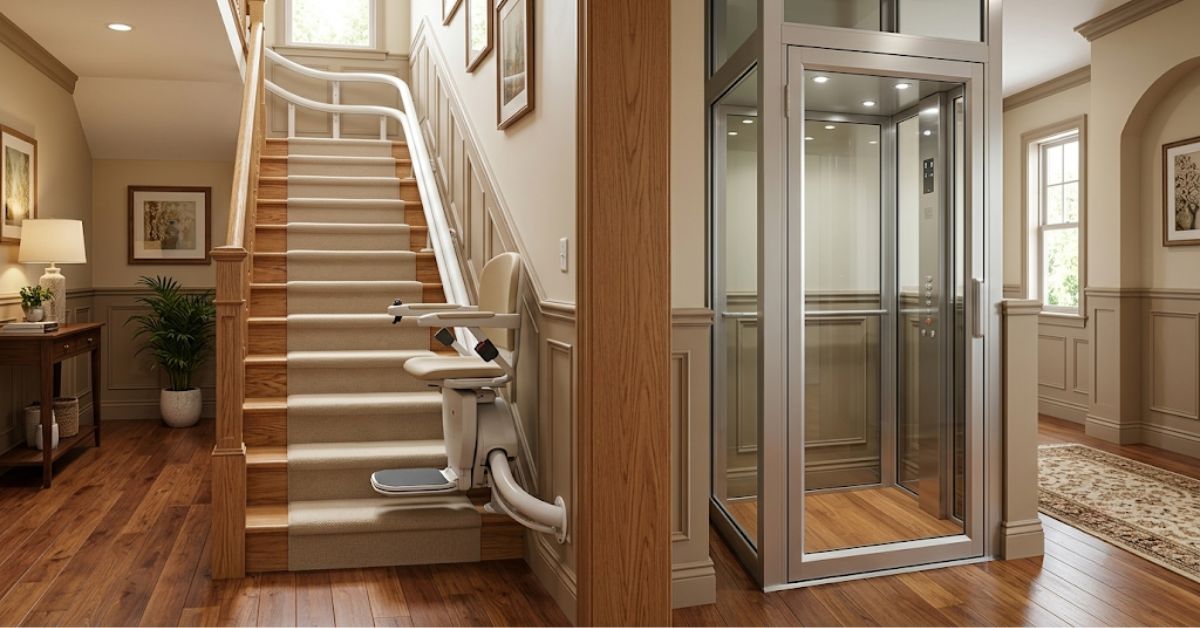
When multi-level access becomes a serious safety concern — whether from a fall, a diagnosis, a surgery, or simply the accumulated effects of aging — most NJ families face the same core question: install a stair lift, or invest in a home elevator? These are the two mainstream solutions for moving between floors of a home, and they differ substantially in cost, footprint, capability, and disruption to install. Choosing between them has less to do with which is "better" in the abstract and more to do with which fits your specific home, your specific needs, and your specific timeline.
This guide compares stair lifts and home elevators fairly across every dimension that matters to a NJ homeowner making this decision. It explains what each solution actually is, what installation involves, what the real costs are, and how to think through which is right for your situation. It also covers a third option — the vertical platform lift — that many families should consider alongside the two headline choices.
Quick Summary
🪜 Stair Lift Is Right When…
- Budget is a meaningful consideration ($2,500–$16,000 range)
- The staircase can accommodate the rail system
- The user can transfer to and from a seated position
- Fast installation is important (1–5 days for straight, 2–6 weeks for curved)
- Minimal structural disruption is required
- The user does not need to transport a wheelchair between floors
🛗 Home Elevator Is Right When…
- Budget allows a larger investment ($30,000–$75,000+)
- The user cannot safely transfer to a seated stair lift
- Wheelchair or mobility scooter must be transported between floors
- The user's mobility is expected to decline significantly
- Home resale value benefit matters (elevators add value; stair lifts generally do not)
- Multiple floors need to be connected (3+ floors)
What Each Solution Actually Is
Stair Lift
A stair lift is a motorised chair that travels along a rail mounted to the stair treads. The user sits on the chair, rides up or down the staircase, and dismounts at the top or bottom. The stair lift occupies one side of the staircase; the remaining width remains usable by other household members. For a complete explanation of how they work, see: How Do Stair Lifts Work? Technology, Safety & Installation.
Stair lifts come in three main configurations: straight (for straight staircases), curved (for staircases with turns or landings), and outdoor-rated (for exterior stairs). They are relatively straightforward to install and can typically be removed later if no longer needed.
Home Elevator
A residential home elevator is a small vertical elevator installed inside the home that transports the user (and, if needed, a wheelchair or scooter) between floors in a fully enclosed car. Unlike stair lifts, home elevators are structural installations — they require a shaft, machine room or motor housing, dedicated electrical circuit, and building permits. Once installed, they add significant home value and can serve residents across their full range of mobility for the life of the home.
Modern residential home elevators come in several types: hydraulic (traditional), traction (cable-driven), shaftless (through-floor "vacuum" or "pneumatic" elevators like Stiltz), and MRL (machine-room-less). Each has different space, structural, and cost implications.
Vertical Platform Lift
A middle-ground option worth understanding: a vertical platform lift (VPL) is essentially a small outdoor or indoor open-platform elevator that lifts a wheelchair or standing user 4–14 feet vertically. It costs less than a full home elevator ($4,000–$15,000 installed) but more than a stair lift, and requires less structural work than a home elevator. VPLs are commonly used for exterior porch access, garage-to-house transitions, and short interior floor gaps.
Side-by-Side Comparison
| Factor | Stair Lift | Home Elevator |
|---|---|---|
| Typical NJ cost (installed) | $2,500 – $16,000 | $30,000 – $75,000+ |
| Installation time | 1–5 days (straight); 2–6 weeks (curved) | 2–4 months (permits + construction) |
| Structural work required | Minimal — mounts to stair treads | Significant — shaft, framing, electrical |
| Permits required | Usually none | Building permit required in all NJ municipalities |
| Wheelchair transport between floors | No — user must transfer to seat | Yes — car accommodates wheelchair or scooter |
| Weight capacity | 250–400 lbs | 500–1,400 lbs |
| Space required | 12–14 inches of staircase width | ~15–25 sq ft floor area per floor |
| Home value impact | Little to none (or slight negative) | Positive — often 5–10% property value increase |
| Removable | Yes — cleanly removable | Structural — removal is major work |
| Reliability lifespan | 10–15 years | 20–30+ years |
| Grant funding eligibility | VA HISA, Medicaid MLTSS, county grants | Very limited — some MLTSS coverage |
| Annual service cost | $150–$300 | $300–$800 |
Real Costs in NJ: What You Actually Pay
Stair Lift Costs
- Straight stair lift: $2,500–$5,000 installed
- Curved stair lift: $8,000–$16,000 installed (custom rail fabrication)
- Outdoor stair lift: $3,500–$7,000 installed
- Annual maintenance: $150–$300
- Total 10-year cost of ownership: $4,000–$19,000 for most residential installations
For full pricing details, see our Stair Lift Cost Guide.
Home Elevator Costs
- Shaftless (through-floor) home elevator: $30,000–$45,000 installed
- Hydraulic home elevator (traditional): $40,000–$60,000 installed
- MRL (machine-room-less) elevator: $50,000–$75,000+ installed
- Annual maintenance: $300–$800
- Total 10-year cost of ownership: $35,000–$85,000
- Home value increase: Often 5–10% of property value — can partially offset the initial investment
Cost comparison in context: A curved stair lift ($8,000–$16,000) may cost 20–40% of a shaftless home elevator ($30,000–$45,000). For families weighing cost, this is often the deciding factor. However, an elevator's contribution to home value at resale — typically 5–10% — can partially close the gap for homes with strong resale prospects.
Which Solution Fits Your Home?
Home Layout and Space
The home itself dictates much of the choice. Most NJ homes — particularly older Bergen, Essex, Hudson, and Passaic County housing — do not have obvious space for a home elevator without significant renovation. Adding an elevator typically requires:
- 15–25 square feet of floor space on each floor served (stacked)
- Structural work to create the shaft or reinforce floor joists
- A dedicated 220V electrical circuit
- Machine room or motor housing (varies by type)
In smaller NJ homes, particularly those with tight floor plans, finding this space means giving up closet space, a corner of a bedroom, or a section of hallway on each floor. A qualified accessibility consultant can identify workable locations, but the process is inherently more disruptive than installing a stair lift.
Stair lifts, by contrast, use existing staircase space — the modification is essentially non-intrusive to the home layout.
Mobility Needs
The other primary factor is the mobility of the person who will use the equipment:
- Can the person safely transfer to a stair lift seat? If yes, a stair lift is a viable option. If no — because balance is significantly impaired, the person cannot safely stand and pivot, or transfers cause pain or risk — a home elevator or vertical platform lift is necessary
- Does the person use a wheelchair or scooter that needs to move between floors? Stair lifts cannot transport wheelchairs (only the person). A home elevator or VPL is required if the wheelchair itself must travel between floors
- Is mobility expected to decline? A person currently able to transfer to a stair lift may not be able to in 3–5 years. Planning for the trajectory of the condition matters — a home elevator provides accessibility across a much wider range of mobility levels than a stair lift
- Are multiple people in the household affected? If two family members both need accessibility, or if the person's needs vary from day to day (arthritis flare-ups, energy fluctuations), an elevator provides more flexibility
Timeline Considerations
Timeline often forces the decision. If someone is being discharged from hospital next week and needs to reach a second-floor bedroom, a stair lift can be installed in 24–48 hours for a straight staircase. A home elevator takes 2–4 months from decision to completion, with permitting, construction, and inspection. Home elevators are planning projects; stair lifts can be emergency solutions.
For post-surgical situations specifically, see our guide: How to Improve Home Mobility After Surgery or Injury.
Grant Funding and Insurance Coverage
This is one area where stair lifts and home elevators differ dramatically — and it often shifts the practical cost calculation significantly for eligible families.
Stair Lifts
Stair lifts have relatively broad funding availability in NJ:
- VA HISA grants — up to $6,800 for eligible veterans
- NJ Medicaid MLTSS — can cover the full cost with pre-authorisation
- Medicare Advantage home modification benefits — $500–$2,500+ depending on plan
- County Area Agency on Aging grants — income-based, $1,000–$5,000
- Non-profit programs (Rebuilding Together, Lions Clubs)
For a full breakdown of stair lift funding, see: Can You Qualify for a Free or Low-Cost Stair Lift?
Home Elevators
Home elevators have much more limited funding availability:
- NJ Medicaid MLTSS — occasionally covers elevator installation with strong clinical justification, but far less common than stair lift coverage
- VA HISA — the $6,800 grant is typically insufficient for elevator installation but can be applied as a partial contribution
- Medicare — does not cover home elevators
- Home elevators may qualify as a deductible medical expense on federal taxes with proper documentation, providing indirect tax benefit
For eligible families, this funding difference can shift the practical cost calculation dramatically. A stair lift that appears to cost $10,000 may cost the family $0–$3,000 after VA or Medicaid coverage. A home elevator that costs $40,000 may cost the family $30,000+ regardless of eligibility. This is often the single largest financial factor in the decision.
Home Value and Resale Impact
For families considering long-term financial impact, the effect on home value differs meaningfully:
Stair Lifts
Stair lifts generally have neutral or slightly negative impact on home value. Some buyers view them as a positive (accessibility-ready), others as a negative (perceived as a "medical" feature or a reminder of mobility issues). Because stair lifts are removable, most homeowners simply uninstall them before listing the property — which restores the staircase to its original condition. The stair lift is a functional tool for a specific time period, not a long-term property asset.
Home Elevators
Home elevators typically add measurable value to a property, particularly in higher-end NJ markets (Bergen County, parts of Essex County) where multi-story homes are common and aging-in-place readiness is a growing buyer priority. Recent industry data suggests home elevators can add 5–10% to property value in appropriate markets. Additionally, elevators appeal to a broader pool of buyers — including families with young children, multi-generational households, and buyers planning for their own aging in place.
For families whose home is a significant financial asset and who may sell in the next 10–20 years, the resale value benefit can meaningfully offset the initial elevator investment.
When a Vertical Platform Lift Might Be the Answer Instead
A vertical platform lift bridges the gap between stair lifts and home elevators. Consider a VPL when:
- The person uses a wheelchair and cannot transfer to a stair lift
- The height to be covered is 4–14 feet (typical range for VPLs)
- A full home elevator is not budgetarily feasible
- The installation location is exterior (porch access, garage-to-house transition) or a partial interior gap
- Installation timeline is important — VPLs take 2–4 weeks vs 2–4 months for a full elevator
Typical NJ VPL costs range from $4,000–$15,000 installed depending on rise height, indoor vs outdoor, and any structural work required. Learn more: Vertical Platform Lift Installation NJ.
The Decision Framework
To make this decision cleanly for your specific situation, work through these questions in order:
- Can the person safely transfer to a seated stair lift? If no, skip to home elevator or VPL — a stair lift is not a safe option regardless of other factors
- Does the wheelchair or scooter need to travel between floors? If yes, an elevator or VPL is required
- What is the timeline? If installation must happen within days or weeks (post-surgery, urgent decline), a stair lift is the only practical option — a home elevator cannot be installed that quickly
- What is the budget? Below $20,000 total budget almost always points to a stair lift. Above $30,000 opens up elevator options
- What grant funding may apply? If VA, Medicaid, or county grants apply, they typically favour stair lifts significantly — potentially making a $10,000 stair lift cost $0, while a $40,000 elevator still costs $30,000+
- How long will the person live in this home? A stair lift's 10–15 year lifespan is often sufficient. A home elevator's 20–30 year lifespan and resale value benefit favour longer-term ownership scenarios
- What are the home's structural characteristics? Some homes simply cannot accommodate an elevator without impractical renovation; the physical constraints eliminate that option regardless of preference
For most NJ families facing this decision, the answer is a stair lift — because it meets the mobility need, fits the budget, installs quickly, and qualifies for funding programs that reduce the practical cost significantly. Home elevators are the right choice for a smaller group of situations: significant mobility loss requiring wheelchair transport, long-term planning horizons, larger budgets, and homes that structurally accommodate the installation. Both are legitimate solutions — the question is which is right for you, not which is objectively better.
Our team helps NJ families make this decision every week. A free in-home assessment evaluates the specific home, the specific mobility needs, and the applicable funding — and provides an honest recommendation for the right solution.
Get an Honest Comparison →Frequently Asked Questions
Is a stair lift or home elevator better for aging in place?
Both support aging in place. A stair lift is more accessible in cost, timeline, and grant funding — making it the practical choice for most NJ families. A home elevator serves a wider range of mobility levels (including full wheelchair use), lasts significantly longer, and adds home value — making it the better long-term investment when budget and space allow. The right choice depends on specific mobility needs, budget, and home layout.
How much does a home elevator cost vs a stair lift?
A residential home elevator typically costs $30,000–$75,000+ installed in NJ. A stair lift costs $2,500–$5,000 for a straight staircase or $8,000–$16,000 for a curved staircase. The elevator's initial cost is 3–10× higher than a comparable stair lift — but includes structural improvements that may add 5–10% to home value at resale.
Can I get a home elevator installed in a small NJ home?
Yes — shaftless (through-floor) home elevators are specifically designed for retrofit installations in existing homes without dedicated elevator shafts. They typically require 15–20 square feet of stacked floor space (small closet-sized footprint) and can be installed in most homes with structural evaluation. Traditional hydraulic elevators require more space and more extensive structural work.
Does Medicare pay for home elevators?
No. Medicare Parts A, B, and most Medicare Advantage plans do not cover home elevator installation. Some Medicare Advantage plans include limited home modification benefits ($500–$2,500) that could contribute partially, but the amount is small relative to elevator costs. NJ Medicaid MLTSS occasionally covers home elevator installation with strong clinical justification, but this is far less common than stair lift coverage under the same program.
How long does home elevator installation take?
Typically 2–4 months from initial decision to completion. This timeline includes design and permitting (2–6 weeks), construction and installation (2–4 weeks), and inspection and certification (1–2 weeks). This makes home elevators impractical for urgent situations (post-surgical discharge, sudden mobility decline) where a stair lift can be installed in days.
Which is safer — a stair lift or a home elevator?
Both are extremely safe when properly installed and maintained. Modern residential stair lifts have obstruction sensors, seat belts, swivel locks, and battery backup. Modern home elevators have door interlocks, overspeed governors, emergency lowering systems, and phone-outs. The safety profile depends more on installation quality, ongoing maintenance, and appropriate matching to the user's abilities than on which technology is chosen.