
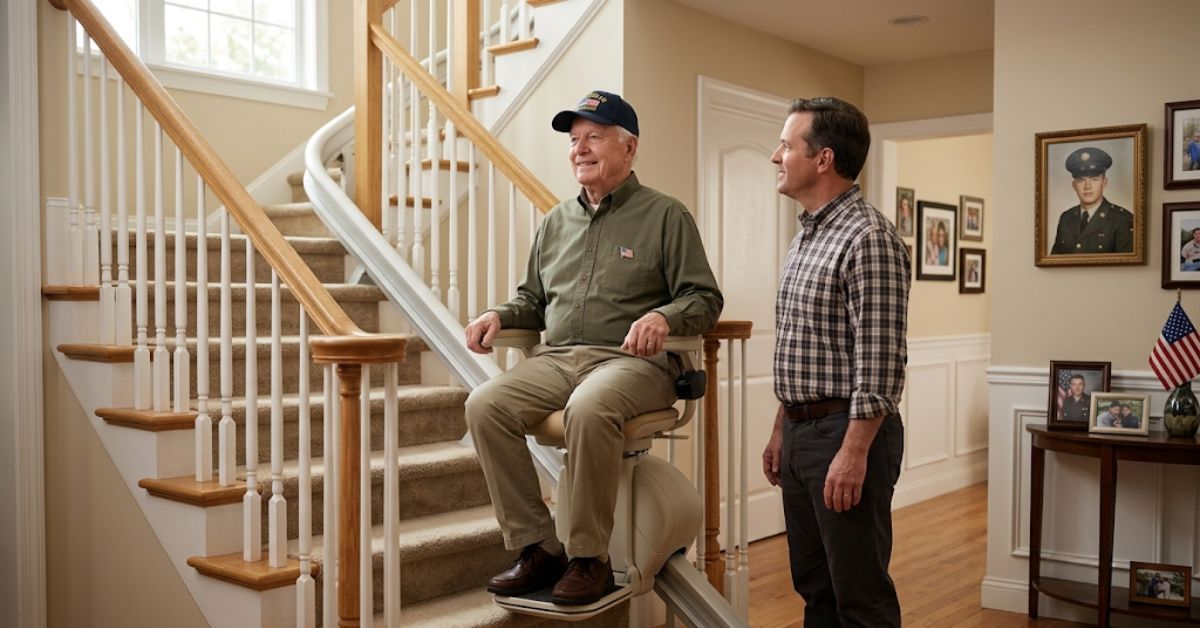
The Department of Veterans Affairs administers three separate grant programs that can pay for stairlifts, wheelchair ramps, bathroom modifications, and other home accessibility improvements for eligible veterans. Between them, these grants can cover anywhere from a few thousand dollars to over $120,000 depending on the veteran's disability status and specific circumstances. For most NJ veterans installing a stair lift or wheelchair ramp, the appropriate grant can cover the full cost of the modification.
This guide explains each of the three VA grant programs — HISA, SAH, and SHA — including who qualifies, how much each grant provides, what documentation is required, and how to apply. It is written for the veteran's family member who is often the one navigating the process, and for veterans who want to understand their options before starting an application. The goal is to help you identify which grant fits your situation and give you a clear path to getting the funding approved.
The Three VA Home Modification Grant Programs
HISA — Home Improvements and Structural Alterations
Covers stairlifts, wheelchair ramps, bathroom modifications, and other structural alterations needed for medical treatment or continued treatment at home. Available to any veteran with a VA-rated disability, regardless of whether the disability is combat-related. The most commonly used VA grant for home accessibility.
SHA — Special Home Adaptation Grant
Provides substantially more funding than HISA for veterans with specific service-connected disabilities that qualify. Can be used for adapting an existing home or purchasing a home already adapted. Qualifying conditions include the loss or loss of use of both hands, certain severe burn injuries, and specific respiratory injuries related to service.
SAH — Specially Adapted Housing Grant
The largest VA home modification grant, providing substantial funding to build, remodel, or purchase an adapted home. For veterans with the most severe service-connected disabilities — including loss or loss of use of both lower extremities, loss of both upper extremities at or above the elbow, or blindness in both eyes combined with loss of use of a lower extremity.
Grant amounts are updated annually by the Department of Veterans Affairs each fiscal year (October 1). The amounts listed above are current as of Fiscal Year 2026. Always confirm current amounts directly with the VA or your accessibility provider before applying — Everhome Mobility monitors these updates and provides current information during every veteran assessment.
HISA Grant: The Most Commonly Used VA Grant for Stairlifts
The HISA grant is the workhorse of VA home modification funding. It has broader eligibility than SAH or SHA, faster processing, and is the grant most NJ veterans use to fund a stair lift or straightforward wheelchair ramp installation. If you are a veteran with any VA-rated disability considering a home accessibility modification, HISA should be your first stop.
Who Qualifies for HISA
- Service-connected disability: Any veteran with a VA rating for a service-connected disability qualifies for up to $6,800
- Non-service-connected disability: Veterans with a VA-rated non-service-connected disability may qualify for up to $2,000
- The modification must be medically necessary and prescribed by a VA physician or treating provider
- The veteran must own the home OR have written permission from the property owner to make the modification
- The modification must be structurally reasonable and related to the veteran's medical condition
What HISA Covers
- Stairlifts (straight and, in some cases, curved)
- Wheelchair ramps (modular aluminum or permanent construction)
- Bathroom modifications — walk-in showers, grab bars, roll-in shower conversions
- Widening doorways for wheelchair access
- Kitchen modifications for accessibility
- Vertical platform lifts in some cases
- Improved plumbing or electrical for medical equipment
What HISA Does NOT Cover
- Purely cosmetic or convenience upgrades not related to disability
- Modifications to properties not owned or occupied by the veteran
- Equipment maintenance or repair — the grant is for installation only
- Modifications that do not have a medical justification
- Retroactive reimbursement — the grant must be approved BEFORE installation begins
The HISA Lifetime Limit
HISA is a lifetime grant — meaning the $6,800 (or $2,000) is a total limit across all uses, not an annual limit. If a veteran uses $3,000 of the grant for a bathroom modification in 2026 and later needs a stair lift, they have the remaining balance available for the stair lift installation. Partial use of the grant does not exhaust future eligibility for the remaining balance.
Strategic tip: If a veteran anticipates future modifications beyond an immediate need, plan HISA usage strategically. Installing a bathroom safety package that costs $3,500 may leave enough remaining grant balance for a future stair lift as mobility declines. A qualified NJ installer helps veterans plan this sequencing during the initial assessment.
How to Apply for the HISA Grant: Step by Step
Confirm the veteran's VA enrollment and disability rating
If the veteran is not currently enrolled in VA healthcare, enrollment must be completed first. Call 1-877-222-8387 or visit VA.gov to begin enrollment. The veteran must have a disability rating (service-connected or non-service-connected) documented in their VA records to qualify for HISA.
Obtain a prescription from a VA physician
The veteran's VA physician (or approved treating provider) must document the medical necessity of the home modification. This is typically a written prescription or a note in the veteran's medical record specifying which modification is needed and why. The prescription should describe the mobility limitation and how the modification addresses it.
Contact the local VA Medical Center's Prosthetics department
HISA applications are processed through the Prosthetics and Sensory Aids Service at the veteran's local VAMC — not through the general VA Regional Office. For NJ veterans, this typically means the VA New Jersey Health Care System (East Orange or Lyons) or a satellite outpatient clinic. The Prosthetics team confirms eligibility and provides the required application forms.
Get a written quote from a qualified installer
The VA requires a detailed written quote from a qualified installer specifying the modification, materials, labour, warranty, and total cost. Everhome Mobility provides all VA quotes in the exact format the VA Prosthetics team requires — no back-and-forth revisions. The quote must be recent (typically within 60–90 days of application submission).
Submit VA Form 10-0103 (HISA Application)
The completed application is submitted to the VAMC Prosthetics office along with the prescription and installer quote. The Prosthetics team reviews the package and determines eligibility. This step is where most delays occur — missing documentation, unclear prescription language, or improperly formatted quotes can send the application back for correction.
Wait for pre-authorisation (typically 2–8 weeks)
The VA reviews the application and, if approved, issues a pre-authorisation letter specifying the approved amount and any conditions. This letter authorises the installer to proceed. Installation cannot begin before this authorisation — retroactive reimbursement is not available.
Schedule and complete the installation
Once pre-authorised, the installation is scheduled. For a straight stair lift, this typically takes 1–5 days from scheduling. For a curved stair lift or larger modification, the timeline extends. The installer completes the work, obtains the veteran's sign-off, and submits final documentation to the VA.
VA reimburses the installer directly
In most HISA cases, the VA pays the installer directly upon completion — the veteran never has to front the money and wait for reimbursement. This is one of the biggest practical advantages of HISA versus other funding sources.
SAH and SHA Grants: When They Apply
The SAH and SHA grants are much larger than HISA but have significantly narrower eligibility criteria. They are typically used for major structural adaptations (SAH) or purchasing an already-adapted home (both). For a veteran installing a stair lift or standard wheelchair ramp, HISA is almost always the appropriate program. But if the veteran qualifies for SAH or SHA, those programs can fund much more comprehensive modifications.
SAH (Specially Adapted Housing) — Up to $125,563
SAH is for veterans with the most severe service-connected disabilities that permanently affect mobility or vision. Qualifying conditions include:
- Loss or loss of use of both lower extremities requiring braces, crutches, canes, or a wheelchair
- Blindness in both eyes plus loss or loss of use of one lower extremity
- Loss or loss of use of one lower extremity plus organic disease or injury affecting balance
- Loss or loss of use of both upper extremities at or above the elbow
- Certain severe burn injuries
- Loss or loss of use of one lower extremity together with residuals of organic disease or injury
SAH funds are typically used to build a new adapted home, remodel an existing home extensively, or apply toward the purchase of an already-adapted home. The grant is subject to the six-time use limit and lifetime maximum.
SHA (Special Home Adaptation) — Up to $25,162
SHA is for veterans with specific service-connected disabilities that qualify but are less severe than SAH criteria. Qualifying conditions include:
- Blindness in both eyes with 20/200 visual acuity or less
- Loss or loss of use of both hands
- Certain severe burn injuries
- Certain respiratory injuries — including those related to burn pit exposure
SHA funds are used for adapting an existing home or purchasing an already-adapted home. Unlike HISA, SHA can be used across multiple homes over the veteran's lifetime up to the total limit.
How to Apply for SAH or SHA
SAH and SHA applications are processed differently from HISA — through the VA Regional Loan Center rather than the local VAMC. The application process:
- Complete VA Form 26-4555 (Application in Acquiring Specially Adapted Housing or Special Home Adaptation Grant)
- Submit the application through eBenefits, VA.gov, or by mail to the VA Regional Loan Center serving your state
- The VA determines eligibility based on service-connected disability records
- If approved, the veteran works with the VA to develop specifications for the adaptation
- Contractor selection, quotes, and construction proceed with VA oversight
- The VA pays the contractor directly or reimburses the veteran depending on program specifics
SAH and SHA processing timelines are longer than HISA — often 8–16 weeks for approval — because the scope of work is larger and requires more detailed VA review.
Common HISA Application Mistakes That Cause Delays
Most HISA delays trace back to a handful of correctable mistakes. Being aware of these ahead of time can shorten your approval timeline significantly.
- Prescription too vague: The physician's prescription must specifically describe the mobility limitation and the modification needed. "Home modifications for safety" is insufficient. "Patient requires a stair lift on primary staircase due to progressive muscle weakness from ALS limiting stair ambulation" is appropriate.
- Installer quote missing required elements: The quote must include specific product make/model, materials, labour, warranty, and total price. Quotes lacking any of these elements are returned for revision. Everhome Mobility provides quotes in the VA's required format.
- Beginning work before pre-authorisation: The single most costly mistake. Any work started before VA pre-authorisation is issued is generally not eligible for reimbursement. Wait for the authorisation letter before scheduling installation.
- Missing property ownership documentation: If the veteran does not own the home, written consent from the property owner must be included in the application. Missing this documentation delays approval.
- Submitting incomplete Form 10-0103: The application form has several sections that must all be completed. Missing signatures, missing dates, or unfilled fields cause the application to be returned.
Everhome Mobility's VA support: We work with NJ veterans applying for HISA grants regularly. Our team provides all documentation in the exact format the VA requires, coordinates directly with the VAMC Prosthetics office when helpful, and helps veterans avoid the common mistakes that cause delays. This support is included at no additional cost with every veteran assessment.
Combining VA Grants with Other Funding
Veterans often qualify for multiple funding sources at once. Understanding how they can be combined is important because it may substantially reduce out-of-pocket costs on larger modifications.
HISA + Medicare Advantage Home Modification Benefits
Veterans enrolled in a Medicare Advantage plan with home modification benefits can potentially combine HISA with the MA benefit. HISA typically pays first, and any remaining balance may be covered by the MA benefit up to the plan's limit. Call the MA plan's member services and ask specifically about combining benefits with VA funding.
HISA + NJ Medicaid MLTSS
Veterans enrolled in NJ Medicaid MLTSS may combine HISA and Medicaid coverage. HISA typically pays first, with any remaining balance covered by MLTSS with pre-authorisation. This combination can cover the full cost of larger modifications like a curved stair lift or comprehensive bathroom conversion. See our full breakdown: Medicaid & Home Modification Grants for Accessibility in NJ.
HISA + County AAA Grants
Some NJ county Area Agency on Aging programs will fund modifications for veterans and can be combined with HISA when the total scope of work exceeds HISA's $6,800 cap. Contact your county AAA office for specifics.
Federal Tax Deduction
Home modifications documented as medically necessary — including those funded partially by VA grants — may qualify for federal medical expense tax deduction on the portion not covered by the grant. Consult a tax professional for specifics.
NJ-Specific Considerations for Veteran Applicants
Local VA Medical Centers Serving NJ
NJ veterans applying for HISA are typically served by:
- VA New Jersey Health Care System — East Orange campus: Primary facility serving northern NJ including Bergen County, Essex County, and Passaic County
- VA New Jersey Health Care System — Lyons campus: Serves central and southern NJ
- Community-based outpatient clinics: Located in Brick, Elizabeth, Hackensack, Jersey City, Newark, Paterson, and other NJ locations
The Prosthetics and Sensory Aids Service at each VAMC processes HISA applications. Contact the department directly to begin the application process.
NJ Housing Considerations
Older NJ homes — particularly common in Bergen, Essex, and Hudson County — often have narrow staircases, high stoops, and small bathrooms that require experienced installers to handle correctly. When submitting a VA-funded installation quote, working with an installer experienced in NJ housing stock ensures the quote reflects the actual complexity of the installation rather than a generic estimate that may be revised later.
NJ Veterans Service Officers
NJ counties employ Veterans Service Officers (VSOs) who provide free assistance with VA benefit applications including HISA. Contact your county VSO for personal help navigating the application. Contact information is available at the NJ Department of Military and Veterans Affairs website.
NJ veterans: Everhome Mobility helps navigate the entire VA grant process at no additional cost. Free in-home assessment, all VA documentation prepared in the required format, and coordination with your VAMC Prosthetics office.
Get Veteran-Ready Documentation →Frequently Asked Questions
What is the maximum VA grant amount for a stair lift?
Most stair lift installations for NJ veterans are funded through HISA, which provides up to $6,800 for service-connected disabilities or $2,000 for non-service-connected. This amount typically covers the full cost of a straight stair lift installation. For curved stair lifts costing $8,000–$16,000, veterans may combine HISA with other funding sources or use the SAH grant if they qualify.
Can I get a VA grant for a stair lift if I do not have a service-connected disability?
Yes — HISA covers veterans with either service-connected or non-service-connected disabilities. The maximum grant amount is lower for non-service-connected disabilities ($2,000 versus $6,800), but eligibility is broader than SAH or SHA which require service-connected qualifying conditions.
How long does VA grant approval take?
HISA typically takes 2–8 weeks for approval once a complete application is submitted. SAH and SHA can take 8–16 weeks due to the larger scope of work. The primary cause of delays is incomplete documentation — a properly prepared application from an experienced installer significantly reduces approval time.
Can VA grants be used to repair or maintain a stair lift?
HISA is for installation of new modifications, not for repair or maintenance of existing equipment. If an existing stair lift needs repair, other funding sources apply. Some veterans may qualify for VA prosthetics coverage for equipment replacement when needed for medical reasons — discuss specific needs with your VA physician.
Does the VA pay the installer directly or reimburse the veteran?
In most HISA cases, the VA pays the installer directly upon completion of the work. The veteran does not have to front the money and wait for reimbursement. This is one of the most practical advantages of HISA over some other funding sources that require initial out-of-pocket payment.
Can I use a VA grant on a home I rent, not own?
HISA can be used on a rented home if the property owner provides written consent for the modification. The modification typically must be removable (modular ramp, stair lift on tread mounts) rather than permanent structural change. SAH and SHA generally require the veteran to own or have interest in the home. Discuss specific rental situations with your VAMC Prosthetics office before applying.