
The decision to improve home accessibility for a senior parent almost never comes with an obvious moment of clarity. There is rarely a single dramatic event that makes the answer clear — most families reach the decision through a slow accumulation of small observations. A hesitation on the stairs that was not there last year. A bathroom visit that takes longer than it used to. A quiet abandonment of the second floor. By the time these signs are recognised, they have often been present for months.
This guide is for adult children who are beginning to wonder whether their parent's home still fits their needs. It walks through the specific signs that indicate accessibility improvements would meaningfully help — physical signs, behavioural signs, environmental signs, and emotional signs — and explains what each observation typically means. The goal is not to alarm, but to give you a clearer framework for what you are seeing.
Physical Signs of Difficulty
Physical signs are the most obvious category and often the ones adult children notice first. They are also the ones seniors are most likely to minimise or hide when family visits. Watch for these during unhurried observation — not by asking directly, which often prompts the person to "perform" more capably than they actually manage day to day.
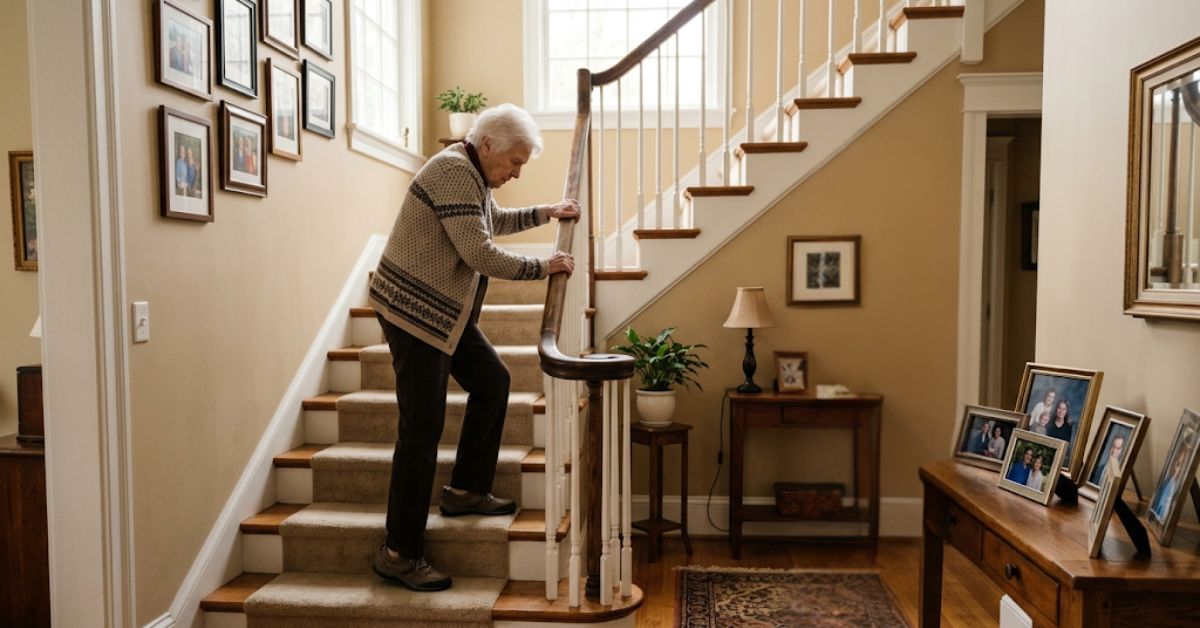
1 Holding the handrail tightly on stairs
Everyone uses the handrail occasionally. But if you notice your parent gripping tightly, pausing halfway up, or leaning heavily on the rail rather than using it as a light guide, the stairs are becoming a real physical challenge. This is one of the earliest and most reliable indicators that a stair lift would meaningfully help.
2 Steadying against walls and furniture while walking
Watch how your parent moves through their own house. If they touch walls, doorframes, counters, or furniture as they move — even briefly — this is called "furniture walking" and is a well-recognised sign of balance decline. It is often unconscious.
3 Difficulty getting up from chairs or the toilet
The strength required to rise from a seated position — particularly a lower seat — declines with age. If your parent uses armrests to push themselves up, needs multiple attempts, or has been buying "higher" chairs, they are managing declining lower-body strength.
4 Reports of near-falls (or actual falls)
A near-fall is a "close call" — a slip or trip where the person caught themselves before hitting the ground. These are often dismissed as unimportant. They should not be. Near-falls are the strongest predictor of an actual fall within the next 6–12 months.
5 Difficulty entering or exiting the shower or tub
Stepping over a tub wall becomes surprisingly difficult with age — the combination of a wet surface, elevated threshold, and shifting balance is challenging. If your parent has switched to sponge baths at the sink, avoids showering when alone, or reports the shower as "getting harder," this is a clear sign.
6 Slower, shuffling gait
Gait changes with age, but sudden or significant slowing — particularly a shuffling pattern where feet stay closer to the ground — indicates increased fall risk. Threshold ramps and non-slip flooring become important because even small floor transitions can catch a shuffling foot.
Behavioural Signs — What Your Parent Has Quietly Stopped Doing
Behavioural signs are subtler than physical ones and often reveal themselves through what your parent no longer does rather than what they visibly struggle with. These signs are worth paying close attention to because they often precede a major fall by months or years.
7 Avoiding the second floor
Has your parent moved their bedroom to the first floor? Are they sleeping in a recliner because getting upstairs is difficult? Is the second-floor bathroom no longer being used? These are strong indicators that stairs have become a real barrier — the house is functionally becoming a single-story home.
8 Reducing trips outside the home
If your parent has stopped going to their regular activities — bridge club, church, gym, garden centre visits — the cause might not be interest. It might be that the stairs to the front door, the walk to the car, or the entrance to the destination has become too much. Physical decline often shows first in reduced social participation.
9 Not inviting people over
If your parent has quietly stopped hosting family gatherings, holiday meals, or friends' visits, embarrassment about home accessibility may be part of the reason. Seniors who cannot comfortably navigate their own home often withdraw socially rather than acknowledge the change.
10 Wearing the same clothes multiple days
Getting dressed requires reaching, bending, and standing on one leg to put on trousers. If your parent is wearing the same outfits day after day, the physical difficulty of dressing may be the underlying reason — not lack of care.
11 Meals becoming simpler or less frequent
Cooking requires reaching high cabinets, bending to low ones, standing at the stove, and carrying pots. If your parent has switched to microwave meals, sandwiches, or is simply eating less, kitchen accessibility may be the barrier — not lack of appetite.
Environmental Signs in the Home Itself
The home itself often tells a story that the person will not. Certain environmental signs — visible during a normal family visit — indicate that the household is already adapting to declining mobility, usually informally and not always safely.
12 Clutter accumulating in walkways
Bags, boxes, mail piles, and small furniture accumulating in hallways and near doorways is a subtle but important sign. It indicates that the person is no longer moving items away consistently — either from fatigue, difficulty carrying items, or reduced awareness. These clutter points are also trip hazards.
13 Loose or fraying area rugs, cords, and floor coverings
The home has hazards that would have been addressed years ago. Area rugs with curled edges. Extension cords running across walkways. Missing floor transition strips. Broken tile edges. These accumulated hazards suggest declining awareness or ability to address them.
14 Improvised handholds and grab points
Look at towel bars in the bathroom (are they pulled loose from the wall?), the tops of banisters (are the finials loose or wobbling?), and radiator covers or windowsills (are they polished from repeated hand contact?). These indicate the person has been using non-safety items as balance supports — dangerous because they are not designed to hold body weight.
15 Poor lighting or burnt-out bulbs left unreplaced
Ceiling light bulbs require standing on a stool or reaching overhead — both difficult and dangerous for older adults. If bulbs are burnt out and unreplaced (particularly in stairwells and hallways), the person cannot safely replace them anymore, and they have accepted living with reduced lighting rather than ask for help.
16 First-floor sleeping arrangement
Has the bedroom moved downstairs, or is a family room set up as a bedroom? Is your parent sleeping in a recliner in the living room? These arrangements are almost always improvised responses to stairs becoming too difficult. They may be working — but they signal that the underlying accessibility issue has not been formally addressed.
Emotional and Social Signs
The emotional dimensions of declining home accessibility are often the most personally painful — both for the senior and for adult children observing. These signs can be missed in short visits but reveal themselves in patterns over time.
17 Frustration or apologies about their own home
Comments like "I don't know how it got so messy" or "I used to keep it better" or "This house is too much for me now" are important. They reflect awareness that the home is no longer serving them well — and often, quiet grief about that fact.
18 Reluctance to acknowledge difficulty
Alternatively, some seniors minimise or deny challenges. "I'm fine on the stairs" from someone visibly struggling on the stairs is common. This response is often driven by fear — of being "put in a home," of losing independence, of becoming a burden.
19 Discussions about moving
If your parent has started mentioning senior living communities, downsizing, or moving in with a family member — even in passing — the current home may already feel unmanageable. Sometimes the best response is not to accept the move but to explore whether accessibility modifications could resolve the underlying concern.
Medical Events That Should Trigger a Home Assessment
Beyond gradual observation, specific medical events should trigger an immediate accessibility review — not "eventually" but within the following few weeks.
- Any fall, even without injury: A fall dramatically increases the probability of another fall. The home environment that led to the first fall is likely to lead to another
- Hospitalisation for any reason: Discharge from hospital is a high-risk period. The person's strength and balance are typically diminished. See: Home Mobility After Surgery
- New diagnosis of a mobility-affecting condition: Parkinson's, MS, stroke, severe arthritis, cardiac limitations. These diagnoses typically warrant proactive modification planning
- Death of a spouse: The surviving partner often loses informal balance support they were unconsciously receiving. Home modifications become more important
- Vision changes: Macular degeneration, cataracts, glaucoma — anything reducing depth perception dramatically increases stair and step hazards
- Recent surgery of any kind: Even non-mobility surgery (cardiac, abdominal) affects balance and strength during recovery
The "one sign is enough" principle: You do not need to see multiple signs from this list to justify a professional accessibility assessment. Any single significant sign — a fall, difficulty on stairs, avoiding a floor of the home, difficulty exiting the tub — warrants an in-home evaluation. Assessments are typically free, non-obligatory, and can identify improvements before a serious event occurs.
What To Do If You See These Signs
Once you have noticed one or more of these signs, the practical question is what to do next. The most helpful approach is usually a sequence of small steps rather than one large decision.
Step 1: Have a Gentle Conversation
Approach the topic without urgency or alarm. Something like: "I noticed the stairs have been a bit harder for you lately. I'd love for us to look at some options that might help." Frame it as adding tools to their independence, not accommodating decline. Many seniors are relieved when the topic is raised — they have often been thinking about it themselves.
Step 2: Schedule a Free In-Home Assessment
A professional accessibility assessment is different from a walkthrough. A qualified assessor evaluates the specific home, the specific person's mobility needs, and identifies both immediate and future modifications. Everhome Mobility provides these assessments free and without obligation across Northern New Jersey.
Step 3: Check Funding Eligibility
Before deciding what to do, check funding options. Many families are surprised to learn that VA HISA grants, NJ Medicaid MLTSS, Medicare Advantage supplemental benefits, and county AAA programs can substantially — sometimes completely — cover accessibility modifications. See our funding guides:
- VA Grants for Stairlifts & Wheelchair Ramps
- NJ Medicaid Plans That Cover Stairlifts
- Medicare Advantage Home Modification Benefits
Step 4: Prioritise the Highest-Impact Modifications
Not every identified issue needs to be addressed immediately. Prioritise modifications with the highest safety impact — typically stairs and bathrooms come first. Other improvements can follow over time.
If you have noticed any of these signs in a parent's home, a free in-home assessment is the right next step. No commitment, no pressure — a straightforward evaluation of what would help most.
Schedule a Free Assessment →Frequently Asked Questions
What are the earliest signs that a senior's home needs accessibility modifications?
The earliest signs are typically subtle: gripping the handrail tightly on stairs, steadying against walls while walking, difficulty rising from chairs, or quietly avoiding certain rooms of the house. These often appear months or years before a fall. Behavioural changes — like reducing social outings or moving the bedroom downstairs — are frequently early indicators as well.
How do I talk to my parent about home accessibility without upsetting them?
Frame accessibility improvements as protecting independence rather than accommodating decline. Something like: "I want to make sure your home continues to work well for you for years to come." Focus on what the modifications enable (staying in their home, keeping their routines) rather than what triggered the discussion. Many seniors are relieved when the topic is raised — they have often been aware of the issue themselves.
Should I wait until my parent has a fall before making modifications?
No. Falls are the strongest predictor of future falls — waiting until a fall occurs means acting after preventable injury has happened. Near-falls, difficulty on stairs, or any of the signs discussed above are sufficient to warrant a professional assessment. Prevention is dramatically less expensive and painful than recovery from a hip fracture or head injury.
Do I need my parent's agreement to schedule an accessibility assessment?
Yes — the assessment is for them and takes place in their home. Adult children can arrange the assessment and be present for it, but the senior's participation and consent are important. Framing the assessment as an "opinion gathering" rather than a decision often eases resistance — no commitment is required after the visit.
What if my parent refuses to acknowledge they need help?
Resistance is common and usually rooted in fear of losing independence or being seen as declining. Sometimes framing the modifications as benefiting future visitors ("your grandchildren will be safer here too") or maintaining home value ("this actually helps resale") reduces resistance. If refusal continues, a physician's recommendation often carries weight — mentioning concerns to the parent's doctor can be effective.
How quickly can accessibility modifications be installed after we decide?
For straight stair lifts, installation is typically 1–5 days from decision. Curved stair lifts take 2–6 weeks due to custom rail fabrication. Wheelchair ramps vary: modular aluminum installations in 1–2 days, permanent construction in 1–3 weeks. Bathroom modifications range from same-day (grab bars) to 1–2 weeks (walk-in shower conversions). If funding programs are involved, add 4–8 weeks for pre-authorisation.