
If you are considering a stair lift for your home or a family member's home, understanding how the technology works makes the decision far less intimidating. A stair lift is not a complex or mysterious piece of equipment — it is a straightforward mechanical system with a small number of well-engineered components that have been refined over decades of residential use.
This guide explains how a stair lift works from the inside out — the drive mechanism, the rail system, the power source, the safety features, and how straight and curved systems differ. By the end, you will understand exactly what you are buying, what makes one model different from another, and what to look for when evaluating options for your NJ home.
The Basic Principle: Simpler Than You Think
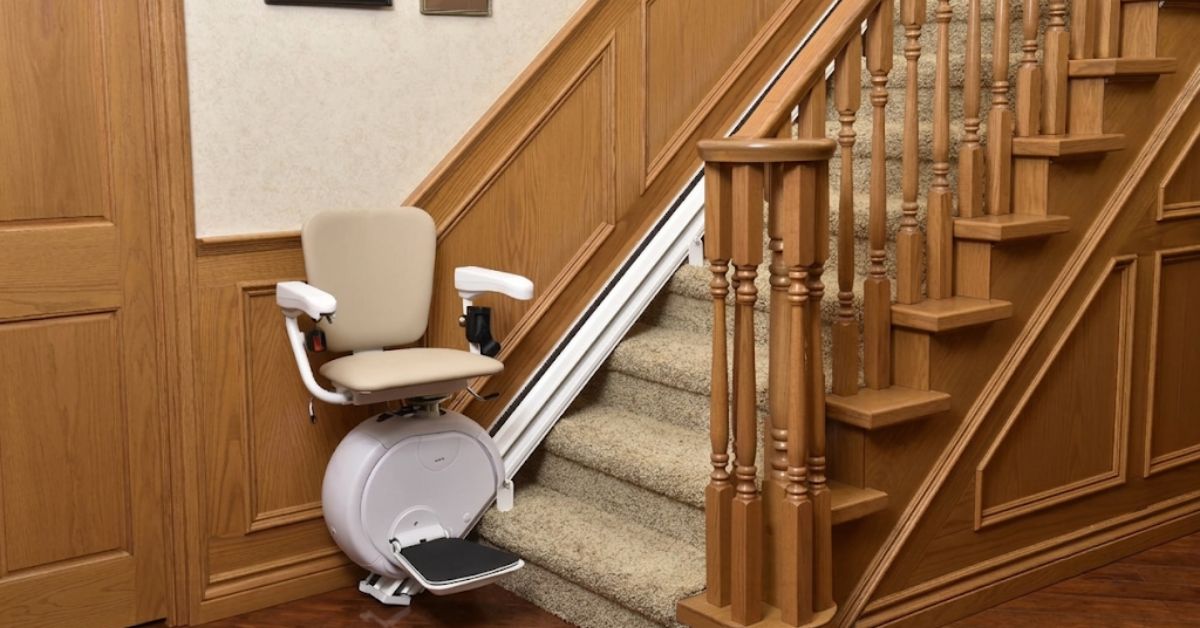
A stair lift is a motorised chair that travels along a rail (track) mounted to the staircase. The user sits on the chair, fastens the seat belt, and operates the lift using a simple joystick or toggle switch on the armrest. The chair moves smoothly up or down the staircase at a controlled, steady speed — typically about 15–20 feet per minute, which is slow enough to feel completely safe and controlled.
That is the entire concept. Everything else — the drive mechanism, the power system, the safety sensors — is engineering that makes this simple idea reliable, safe, and practical for daily residential use.
The Five Core Components
⚙️ 1. The Rail (Track)
The rail is an aluminum or steel track that runs the full length of the staircase, mounted directly to the stair treads — not the wall. For straight staircases, the rail is a standard section cut to length on-site. For curved or L-shaped staircases, the rail is custom-fabricated to follow the exact geometry of the staircase, including any turns, landings, or angle changes. The rail is the foundation of the entire system — its alignment and mounting quality determine how smoothly and quietly the lift operates throughout its lifetime.
⚙️ 2. The Drive Mechanism
The drive mechanism is what moves the chair along the rail. Two main types exist in residential stair lifts: rack-and-pinion and cable-driven. Rack-and-pinion is by far the most common in modern residential lifts — a small motorised gear (pinion) engages with a toothed track (rack) built into the rail, pulling the carriage smoothly along. Cable-driven systems use a steel cable running the length of the rail with a motorised drum — these are less common today but still found in some older and budget models.
⚙️ 3. The Power System
Most modern residential stair lifts run on rechargeable DC batteries — not direct mains power. The batteries charge continuously from a standard household outlet via a charging strip located at the rail's parking position (typically the top or bottom of the staircase). This battery-powered design provides two critical advantages: the lift continues to operate during a power outage (essential for safety), and the DC motor operates more quietly and smoothly than an AC motor would.
⚙️ 4. The Seat Assembly
The seat assembly includes the chair itself, the armrests (which fold up), the footrest (which folds up), the seat belt, and — on most modern models — a swivel mechanism that allows the seat to rotate at the top of the staircase for safe dismounting away from the stair edge. The entire assembly folds flat against the wall when not in use, minimising the width it occupies on the staircase.
⚙️ 5. The Control and Safety System
The user operates the lift with a simple joystick or toggle switch on the armrest — push one direction to go up, the other to go down, release to stop. Remote controls allow the lift to be called or sent to either end of the staircase. Safety sensors, a key switch, seat belt interlock, and obstruction detection work together to prevent unsafe operation. The control system is deliberately simple — even users with limited hand dexterity can operate it comfortably.
Rack-and-Pinion vs Cable Drive: What Is the Difference?
| Feature | Rack-and-Pinion | Cable Drive |
|---|---|---|
| How it works | Motorised gear engages toothed track on rail | Motor winds steel cable along rail |
| Noise level | Very quiet | Slightly louder |
| Smoothness | Very smooth, consistent speed | Smooth but can have slight variation |
| Maintenance | Low — gear inspection at annual service | Moderate — cable tension needs checking |
| Reliability | Excellent — fewer wear points | Good — cable can stretch over time |
| Curved staircase compatibility | Yes — standard for curved systems | No — straight staircases only |
| Used in | Most modern residential lifts (Bruno, Stannah, Handicare) | Some budget and older models |
For most NJ homeowners, a rack-and-pinion system is the better choice — quieter, more reliable, lower maintenance, and compatible with both straight and curved configurations. Cable-driven systems are found mainly in budget models and are perfectly functional for straight staircases, but they require more frequent maintenance over time.
GSC signal answer: "What is the difference between chain-driven and rack-driven stairlifts?" — Chain-driven stair lifts use a chain and sprocket mechanism similar to a bicycle chain, while rack-driven (rack-and-pinion) lifts use a toothed gear engaging a toothed track. Rack-and-pinion is quieter, smoother, and requires less maintenance. Most modern residential models use rack-and-pinion exclusively.
Safety Features: What Protects the User
Modern residential stair lifts are built with multiple redundant safety systems — each one independently capable of stopping the lift if something goes wrong. Understanding these features is important both for confidence in the equipment and for evaluating which models offer genuine safety versus marketing claims.
Obstruction Sensors
Sensors on the footrest and the lower edge of the carriage detect any object in the path of the lift — a shoe on a stair, a pet, a bag. When an obstruction is detected, the lift stops immediately and will not resume until the obstruction is cleared. These sensors are tested as part of every annual service and should be tested monthly by the homeowner by placing a soft object in the path and confirming the lift stops cleanly.
Seat Belt
A retractable seat belt is standard on all residential stair lifts. Many models include a seat belt interlock — the lift will not operate unless the belt is fastened. This prevents the user from riding with the belt unfastened, which could allow them to lean or fall forward during travel.
Swivel Lock at Landing
At the top of the staircase, the seat swivels to face away from the stairs before the user dismounts — so they step off onto the landing, not toward the open staircase. The swivel locks into position before the user can stand, preventing the seat from rotating back while they are dismounting. This is one of the most important safety features on any stair lift and should operate smoothly and lock firmly every time.
Key Switch
A key switch prevents unauthorised operation — particularly important in homes with young children or where cognitive decline means the user should only operate the lift under supervision. Removing the key disables the lift entirely.
Emergency Stop
A manual emergency stop — either a button or the joystick itself — allows the user or a nearby person to halt the lift instantly at any point during travel. Releasing the joystick or toggle on most modern models automatically stops the lift — it only moves while the control is actively held.
Battery Backup
Because residential stair lifts run on rechargeable batteries rather than direct mains power, the lift continues to operate during a power outage. This is not an optional feature — it is inherent to the battery-powered design. A person who is upstairs when the power goes out can still use the stair lift to come down safely. The batteries typically provide 15–20 full trips on a single charge, more than enough for any normal power outage duration.
Overspeed Governor
An internal speed limiter prevents the lift from exceeding its rated travel speed under any circumstances — including downward travel on a steep staircase where gravity would otherwise accelerate the carriage. If overspeed is detected, the lift stops automatically.
Straight vs Curved Stair Lifts: How They Differ
| Feature | Straight Stair Lift | Curved Stair Lift |
|---|---|---|
| Staircase type | Single straight run, no turns or landings | Any configuration with curves, turns, L-shapes, or intermediate landings |
| Rail system | Standard sections cut to length on-site | Custom-fabricated to exact staircase geometry |
| Cost | $2,500 – $5,000 installed | $8,000 – $16,000 installed |
| Installation time | 2–4 hours | 4–6 hours (after 2–6 week fabrication) |
| Lead time | 1–5 days (24–48 hours urgent) | 2–6 weeks (custom fabrication) |
| Transferable to another staircase | Yes — rail can be recut | No — rail is custom to original staircase |
The curved stair lift costs significantly more than a straight model because the rail is a custom-manufactured piece of precision engineering — fabricated to match the exact measurements of your specific staircase down to the millimetre. This is not a standardised product; it is bespoke manufacturing. The higher cost reflects this manufacturing complexity, not a higher profit margin.
For a detailed comparison of brands and features, see our Stair Lift Comparison Guide.
How a Stair Lift Is Installed in Your Home
Understanding how stair lifts work also means understanding how they are installed — because the quality of the installation directly affects how the lift performs over its entire lifetime.
The rail mounts to the stair treads — not the wall. This is a point of confusion for many homeowners who assume the rail is wall-mounted. Tread mounting means no wall damage, no structural work, and no plaster or drywall repair. The rail is secured using brackets bolted into the horizontal surface of each tread at several points along the staircase.
The lift plugs into a standard household outlet — no hardwiring, no electrical panel upgrades, and no dedicated circuit required for the vast majority of residential installations. The charging strip at the parking position connects to the nearest outlet via a standard power cable.
For the complete installation process, see our guide: Stair Lift Installation: What NJ Homeowners Should Know.
Common Concerns: Straight Answers
Will it take up the whole staircase?
No. When folded against the wall (seat up, armrests up, footrest up), a stair lift occupies approximately 12–14 inches of staircase width. On a standard 36-inch staircase, this leaves 22–24 inches of clear walking space — enough for other household members to use the stairs normally when the lift is parked and folded.
Is it loud?
Modern rack-and-pinion stair lifts are remarkably quiet — comparable to a refrigerator hum. The motor runs for 30–90 seconds per trip depending on staircase length. It will not disturb other household members, even at night.
What happens during a power outage?
The lift continues to work normally. Battery-powered operation is standard on all modern residential models — the lift charges continuously when parked but runs entirely on battery power during operation. A full battery charge provides 15–20 trips, more than sufficient for any typical power outage.
Can other people still use the stairs?
Yes. When the lift is parked and folded at the top or bottom, the staircase remains usable for all other household members walking past. The folded unit occupies one side of the staircase; the remaining width is clear for walking.
What is the weight capacity?
Standard residential stair lifts support 250–300 lbs. Heavy-duty models are available with capacity ratings of 350–400 lbs or higher. The weight capacity must be confirmed during the in-home assessment — it affects which models are suitable and which are not. For a comparison of weight capacities across brands, see our Stair Lift Comparison Guide.
How Long Do Stair Lifts Last?
A well-maintained residential stair lift from a quality manufacturer — Bruno, Stannah, Handicare, or similar — typically lasts 10–15 years of reliable daily use. Some units last considerably longer with proper annual servicing. The factors that most affect lifespan are usage frequency, user weight relative to the rated capacity, maintenance regularity, and the quality of the original installation.
For a complete maintenance guide, see: Stair Lift Repair & Maintenance: What Homeowners Should Know.
The technology inside a modern stair lift is mature, proven, and reliable. These are not experimental devices — they are refined systems that have been in residential use for over 40 years. The engineering is straightforward and the failure modes are well-understood and addressed by multiple redundant safety systems. A properly installed, properly maintained stair lift is one of the most reliable pieces of equipment in any home.
Ready to see how a stair lift would work in your specific NJ home? Free in-home assessments across Bergen, Essex, Passaic, and Hudson County — no cost, no obligation.
Learn About Stair Lift Options →Frequently Asked Questions
How does a stair lift get its power?
Most modern residential stair lifts run on rechargeable DC batteries that charge continuously from a standard household outlet. A charging strip at the rail's parking position connects to the nearest outlet. The battery-powered design means the lift works during power outages and operates more quietly than a direct-mains system would.
What is the difference between rack-and-pinion and cable-driven stair lifts?
Rack-and-pinion uses a motorised gear engaging a toothed track on the rail — quieter, smoother, lower maintenance, and compatible with curved staircases. Cable-driven uses a motor winding a steel cable — functional for straight staircases but louder, requires more maintenance, and cannot handle curves. Most modern residential models use rack-and-pinion.
Do stair lifts work during a power outage?
Yes. Battery-powered operation is standard on all modern residential stair lifts. The batteries typically provide 15–20 full trips on a single charge — more than sufficient for any normal power outage. The lift charges automatically when parked at the charging strip during normal operation.
How fast does a stair lift travel?
Residential stair lifts travel at approximately 15–20 feet per minute — slow enough to feel completely safe and controlled, fast enough to complete a typical residential staircase in 30–90 seconds. An overspeed governor prevents the lift from exceeding its rated speed under any circumstances.
Can a stair lift handle a curved or L-shaped staircase?
Yes — curved stair lifts use a custom-fabricated rail manufactured to match the exact geometry of your staircase, including any turns, landings, or angle changes. The custom fabrication takes 2–6 weeks, and these systems cost more than straight models ($8,000–$16,000 vs $2,500–$5,000), but they handle any staircase configuration including tight turns and split-level layouts common in NJ homes.