
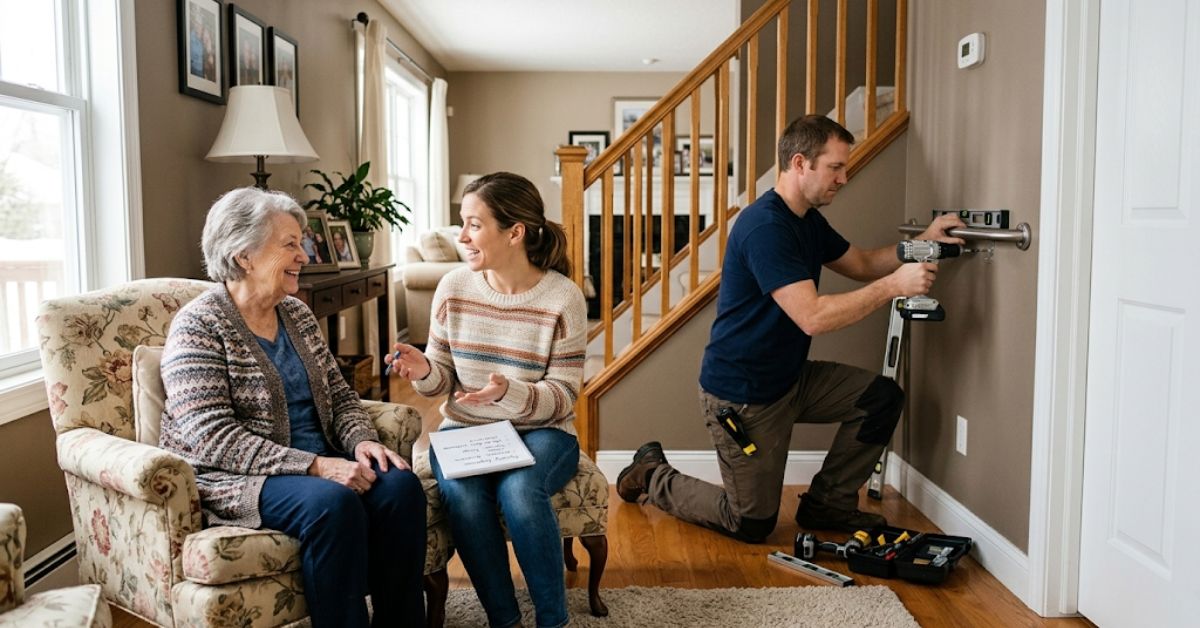
Preparing a parent's home for the changes that come with aging is one of the most meaningful things an adult child can do — and one of the most practically complex. It involves assessing a space you may not live in or visit frequently, navigating conversations that can be emotionally charged, making decisions about modifications that balance cost against urgency, and often doing all of this while managing your own work and family responsibilities.
This guide is written specifically for families in that position — adult children preparing to make a parent's home safer, whether ahead of a planned need or in response to a recent health change. It covers the assessment process, the highest-priority modifications, how to navigate NJ-specific funding programs, and how to manage the family dynamics that this process often surfaces.
Step 1: Assess the Home Before Making Any Decisions
The most common mistake families make is jumping to solutions before understanding the specific risks in the specific home. A stair lift may be the right answer for one household and completely unnecessary for another. Grab bars in the bathroom are almost universally needed, but the right type and placement depends on the bathroom layout and the individual's mobility.
Walk through the home systematically — ideally on a dedicated visit with no other agenda — and assess each area with fresh eyes. Ask yourself: would I feel safe navigating this space if my balance and strength were significantly reduced?
The Five Areas That Matter Most
- Bathroom: Is there a grab bar at the toilet and shower? Is the floor non-slip when wet? Is the tub step-over manageable?
- Staircase: Are there handrails on both sides running the full length? Are the treads non-slip and in good condition? Does your parent use the stairs with any visible difficulty?
- Home entry: Can your parent safely enter and exit without assistance? Are exterior steps in good repair with handrails?
- Bedroom: Is the nighttime path to the bathroom lit and clear? Can your parent rise from bed without difficulty?
- General circulation: Are hallways clear? Are there loose rugs anywhere? Are pathways through the home unobstructed?
For a complete room-by-room framework, use our Home Safety Checklist for Seniors.
If you cannot visit in person: A CAPS-certified professional can conduct the assessment on your behalf and provide a written report with photographs. Many families use this approach when they live at a distance from their parents — it produces a shared, objective assessment that removes the emotional charge from the family conversation.
Step 2: Have the Conversation — Thoughtfully
Many families find the home modification conversation harder than the modifications themselves. A parent who has lived in their home for decades may experience any suggestion of change as a challenge to their independence or a sign that the family has lost confidence in them. This reaction is understandable — and it requires a different approach than a practical problem-solving conversation.
Frame It Around Staying Home
The most effective framing is the true one: these modifications are what make it possible for your parent to continue living in their own home — independently and on their own terms — rather than having to move to a facility. A stair lift is not about giving up on the stairs; it is about keeping access to the whole house. A grab bar is not a sign of weakness; it is what makes the bathroom manageable without relying on another person.
Start with the Smallest Changes
Beginning with the most visible, low-profile changes — nightlights, non-slip mats, removing loose rugs — establishes a pattern without triggering defensiveness. Once small changes are accepted and normalised, larger conversations become easier. A parent who accepted nightlights last month will find it easier to discuss grab bars this month.
Involve Your Parent in the Choices
Give genuine ownership over the aesthetic and practical decisions. Which finish for the grab bar? Which style of stair lift seat? Where exactly should the nightlight go? When a person chooses the specifics, they have investment in the outcome. The goal is a safer home; the path to that goal should respect the person's preferences and dignity throughout.
Use a Third-Party Professional
A recommendation from a CAPS-certified accessibility specialist, GP, or occupational therapist carries different weight than the same recommendation from an adult child. The professional relationship removes the emotional charge — it becomes a clinical recommendation rather than a child telling a parent what to do. Scheduling a free in-home assessment often resolves conversations that have been stalling for months.
Step 3: Prioritise the Modifications
Not everything needs to happen at once — and trying to do everything simultaneously is overwhelming for everyone. Prioritise based on fall risk and the consequences of an incident:
| Priority | Modification | Timeline |
|---|---|---|
| 1 — Immediate | Remove loose rugs, install nightlights, clear pathways | This visit |
| 2 — This week | Non-slip mat in bathroom, secure any loose handrails | Within 7 days |
| 3 — High priority | Grab bars at toilet and shower | Within 2 weeks |
| 4 — High priority | Stair lift if stairs are a concern | Schedule assessment now |
| 5 — Medium priority | Entry ramp or handrail upgrade at front steps | Within 1 month |
| 6 — Medium priority | Tub cut-out or walk-in shower if tub entry is difficult | Within 1–2 months |
| 7 — Plan ahead | Widened doorways, bedroom relocation, kitchen modifications | As needed |
Step 4: Understand NJ-Specific Housing Challenges
New Jersey's older housing stock creates specific preparation challenges that families in newer construction markets rarely face:
Raised Front Stoops
Older NJ homes — particularly in Bergen County, Hudson County, and Essex County — frequently have elevated front entries with 18–36 inches of rise. At a 1:12 ADA slope, a 30-inch stoop requires 30 feet of ramp — which almost never fits as a straight run. Switchback configurations with central landings are the standard solution. See our guide: Wheelchair Ramp Installation in NJ: What Homeowners Need to Know.
Narrow Staircases
Pre-1970 NJ homes often have staircases as narrow as 26–28 inches — particularly in rowhouses and townhomes throughout Hudson and Essex Counties. Standard stair lifts require a minimum of 28 inches of clear width. Slimline rail systems address this, but an in-home assessment is essential before assuming a standard solution will fit.
Split-Level Layouts
Split-level homes are extremely common in Bergen, Morris, and Passaic County — and their multiple short stair runs create unique accessibility challenges. Each section needs to be assessed and addressed individually. A curved or multi-section stair lift may be required; alternatively, relocating the bedroom to the ground level and addressing individual sections with handrail upgrades may be sufficient depending on the person's mobility.
Small Bathrooms
Many older NJ bathrooms are too small to meet ADA turning requirements for wheelchair users. Even for ambulatory seniors, small bathrooms may require furniture repositioning or fixture replacement to create adequate space for safe grab bar use and comfortable daily movement.
Step 5: Identify Funding Before Starting Work
The cost of home modifications is a significant concern for most families — and NJ has more resources than most families realise. Apply to all relevant programs simultaneously rather than sequentially:
VA HISA Grant
If your parent is a veteran, this is the first call to make. Up to $6,800 for service-connected disabilities, up to $2,000 for non-service-connected conditions. Apply through the VA medical center's prosthetics or rehabilitation department before any work begins.
Medicare Advantage
If your parent has a Medicare Advantage plan, call member services and ask specifically about home modification benefits. Some plans cover $500–$2,000 or more toward accessibility modifications.
NJ Medicaid MLTSS
For Medicaid-eligible parents, the MLTSS program may fund stair lifts, ramps, bathroom modifications, and grab bars. Pre-authorization before installation is required. Call NJ FamilyCare at 1-800-701-0710.
County Area Agency on Aging
Bergen (201-336-7459), Essex (973-395-8375), Passaic (973-569-4060), and Hudson (201-369-4313) County all administer home modification grants for income-qualified seniors.
Long-Term Care Insurance
If your parent has an LTC policy, check for a home modification benefit — many policies include allowances for exactly this type of work. Call the insurer's claims department before installation.
For a comprehensive funding guide, see: Medicaid & Home Modification Grants for Accessibility in NJ.
Step 6: Choose the Right Provider
Not all home accessibility providers in NJ are equal. When preparing your parent's home, the provider you choose matters as much as the modifications themselves. Key things to look for:
- CAPS certification: Ensures the assessor evaluates the whole person and their home holistically — not just sells the most expensive solution
- Local NJ installation team: Own employees, not subcontractors — critical for accountability and post-installation service
- All-inclusive written quotes: Unit, rail, hardware, and installation in one price — no surprises
- Labor warranty: Backs the installation work, not just the manufacturer's product warranty
- Knowledge of NJ funding programs: A provider experienced in NJ should help you navigate VA, Medicaid, and county programs
See our full provider evaluation guide: How to Choose a Home Accessibility Company in NJ.
Step 7: Plan for the Future, Not Just Today
When making modification decisions, think about where your parent's needs are likely to be in two to three years — not just where they are today. A stair lift that is not urgently needed this month may become essential after the next health event. Installing it now — when there is time to research, fund, and make a calm decision — is significantly better than installing it under pressure after a fall or hospitalisation.
The families who navigate aging-in-place preparation most successfully are almost always those who started before they felt they had to. The conversation is easier, the options are broader, the funding timeline is manageable, and the outcome is a home that supports rather than challenges the person living in it.
Our CAPS-certified team provides free in-home assessments specifically for families preparing a parent's home — across Bergen, Essex, Passaic, and Hudson County NJ.
Schedule a Home Safety Consultation →Frequently Asked Questions
When should families start preparing a parent's home for aging?
Ideally, before any specific incident makes it urgent. The best time is when the first physical signals appear — difficulty on stairs, increased caution in the bathroom, reduced confidence when moving through the home. Planning ahead gives families time to research, apply for funding, and make decisions without pressure. See our guide: How to Know When Your Home Needs Accessibility Upgrades.
What if siblings disagree about what modifications to make?
A professional CAPS assessment provides an objective third-party recommendation based on observed risk — not on any family member's opinion. Involving all relevant family members in the assessment discussion, even by phone or video, typically produces alignment faster than presenting a decision already made. The assessor's recommendation is based on what the person and home actually need — not family dynamics.
How do we handle a parent who refuses modifications?
Frame modifications as enabling independence, not admitting limitation. Start with the smallest, least intrusive changes. Use a CAPS professional whose recommendation carries clinical weight. Give the parent genuine ownership over aesthetic decisions. For a full approach, see: Caregiver's Guide to Home Accessibility.
Can we prepare a parent's home remotely if we do not live nearby?
Yes. A CAPS-certified professional can conduct a full in-home assessment on your behalf and provide a written report with photographs and a prioritised modification plan. You can review the findings together with your parent by phone or video, and authorise work to proceed without needing to be physically present. Everhome Mobility regularly works with families in this situation across North NJ.
How long does it take to make a home fully accessible for an aging parent?
The immediate, free changes — removing rugs, installing nightlights, clearing pathways — can be done in a single visit. Grab bar installation typically takes under a week to schedule. Stair lifts are usually 1–5 days for straight configurations; curved lifts require 2–6 weeks for custom fabrication. Bathroom conversions take 1–5 days. A comprehensive plan can often be fully implemented within 4–8 weeks of the initial assessment.