
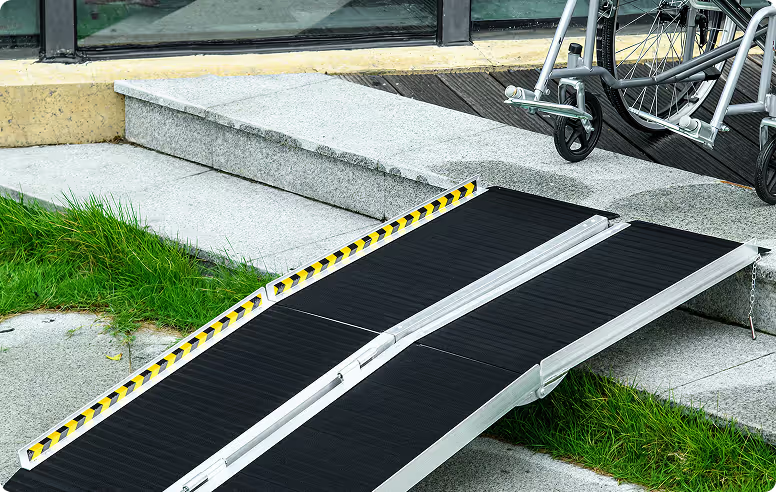
A wheelchair ramp is one of the most impactful home accessibility modifications available — restoring full access to the home for wheelchair users, walker users, and anyone whose mobility makes steps a genuine barrier. Yet choosing and installing the right ramp involves more decisions than most families expect.
This complete guide covers everything you need to know about residential wheelchair ramps — from ADA slope requirements and material comparisons to indoor applications, outdoor configurations, and what professional installation actually involves. Whether you are planning ahead or responding to an immediate need, this is the reference you need.
Wheelchair Ramp Basics: What You Need to Know First
The Slope Calculation
The most fundamental fact about any wheelchair ramp is the slope — the angle at which it rises. The ADA recommends a maximum slope of 1:12 for ramps used by individuals propelling their own wheelchair. This means for every 1 inch of vertical rise, you need 12 inches (1 foot) of horizontal ramp run.
For users who are pushed by caregivers or who use power wheelchairs, a gentler slope — 1:16 or even 1:20 — is easier to navigate and reduces physical strain. If space allows, always build gentler than the minimum requirement.
| Slope Ratio | Rise per Foot of Run | Best For |
|---|---|---|
| 1:12 (maximum ADA) | 1 inch per foot | Manual wheelchair users, minimum compliance |
| 1:16 | 0.75 inches per foot | Easier self-propulsion, elderly users |
| 1:20 | 0.6 inches per foot | Power wheelchairs, scooters, maximum comfort |
Calculating Your Ramp Length
Measure the vertical rise — the height from the ground to the top of the door threshold. Multiply by 12 (for a 1:12 slope) to get the minimum ramp length in inches, then divide by 12 to convert to feet.
Example: A 24-inch rise × 12 = 288 inches ÷ 12 = 24 feet minimum ramp length at 1:12 slope.
Measure before you plan: Stand at your front door and measure from the ground to the top of the threshold sill with a tape measure. This single number determines everything else about your ramp project.
Width Requirements
ADA guidelines specify a minimum clear width of 36 inches between handrails for wheelchair ramps. For power wheelchair users or bariatric wheelchairs, 48 inches of clear width is strongly recommended. Most modular aluminum ramp systems are available in both 36-inch and 48-inch deck widths.
Landing Requirements
ADA guidelines require a level landing at the top and bottom of every ramp run, and at any point where the ramp changes direction. Landings must be at least 60 × 60 inches — large enough for a wheelchair to turn around. For switchback ramps, the central landing is typically 5 × 5 feet.
Types of Wheelchair Ramps for Homes
Modular Aluminum Ramps
The most popular choice for residential applications. Modular aluminum ramps are assembled from pre-fabricated sections that connect together on-site. They are:
- Weatherproof: Aluminum alloy does not rust, rot, warp, or corrode
- Non-slip: Open-grate aluminum decking provides traction even when wet or icy
- Removable: Can be disassembled and relocated or returned for refund when no longer needed
- Permit-free: Classified as temporary structures in most NJ municipalities — no building permit required
- Fast installation: Most residential ramps installed in a single day
- Long-lasting: 20+ year lifespan with minimal maintenance
For the vast majority of NJ homeowners, modular aluminum is the right choice. The flexibility, durability, and permit-free status make it the practical solution for almost every residential application.
Portable Folding Ramps
Suitable for low thresholds (under 6–8 inches) and temporary or travel needs. Single-fold and multi-fold designs are available. They require no installation and cost $150–$600. Not appropriate for primary residential access or high thresholds.
Threshold Ramps
Small wedge-shaped ramps designed to bridge a single door threshold — typically 1–4 inches high. Made from rubber, aluminum, or modular materials. Cost $30–$200. Useful for small interior transitions but not for exterior stairs.
Wood Ramps
Custom-built wood ramps offer design flexibility and can be aesthetically integrated into a home's exterior. Cost $2,000–$7,000 depending on size and complexity. Drawbacks include regular maintenance requirements (annual sealing and painting), vulnerability to rot in wet climates, and slippery surface when wet unless treated or covered.
Concrete Ramps
Permanent, maintenance-free, and durable. Cost $4,000–$12,000+. Require a building permit, significant installation time, and cannot be removed or modified easily once poured. Appropriate for properties where a permanent ramp is the long-term plan and aesthetics are a priority.
| Type | Cost Range | Lifespan | Maintenance | Removable | Permit NJ |
|---|---|---|---|---|---|
| Modular aluminum | $1,500–$8,500 | 20+ years | Minimal | Yes | Usually no |
| Portable folding | $150–$600 | 5–10 years | None | Yes | No |
| Wood | $2,000–$7,000 | 5–10 years | Annual | No | Usually yes |
| Concrete | $4,000–$12,000+ | Permanent | None | No | Always yes |
| Threshold ramp | $30–$200 | 3–10 years | None | Yes | No |
Ramp Configurations: Straight, L-Shape, and Switchback
Straight Run
The simplest and least expensive configuration. A single continuous ramp from ground level to the door threshold. Requires sufficient linear space in front of or beside the entrance. Always the first choice if space allows — easiest to navigate and least expensive to build.
L-Shaped Ramp
When a straight run is too long for the available space, an L-shaped ramp turns 90 degrees at a landing platform and continues in a new direction. Allows a longer total ramp length to fit within a more compact footprint. The 90-degree turn requires good wheelchair maneuverability — generally easier for power wheelchair users than manual users.
Switchback Ramp
The switchback runs up to a landing, turns 180 degrees, and runs back in the opposite direction. This is the most space-efficient configuration for high-rise entrances and is the standard solution for high-stoop NJ homes where a straight run would extend far into the yard or sidewalk. The 5 × 5 foot central landing provides ample turning space.
Wraparound Ramp
Wraps around the side or corner of a porch or deck, following the building's perimeter. Ideal for homes with wide porches where the ramp can run along the side of the structure rather than projecting straight out from the front. Often the most aesthetically integrated option.
Indoor Wheelchair Ramps
Not all ramp applications are exterior. Indoor ramps address level changes inside the home — sunken living rooms, garage steps, split-level transitions, and doorway thresholds. Key considerations for indoor applications:
- Headroom: Ceiling height must be sufficient at the highest point of the ramp travel
- Floor surface: The ramp deck should match or complement the existing flooring — some modular systems offer solid aluminum decking for interior use
- Handrails: Required on both sides for runs over 6 feet — consider wall-mounted rails to minimize footprint in tight indoor spaces
- Threshold transitions: Beveled edge transitions at the top and bottom of the ramp prevent trip hazards for other household members
Indoor ramps are typically shorter and less complex than exterior ramps — many interior level changes are 4–8 inches, requiring just 4–8 feet of ramp at a 1:12 slope.
Handrail Requirements and Options
ADA guidelines require handrails on both sides of any ramp run longer than 6 feet. Key requirements:
- Rail height: 34–38 inches above the ramp surface
- Rail diameter: 1.25–2 inches for graspability
- Rails must extend 12 inches horizontally beyond the top and bottom of the ramp run
- Top and bottom rail ends must return to the post or wall to prevent snagging
Most modular aluminum ramp systems include pre-engineered handrail sections that meet ADA requirements. For permanent wood or concrete ramps, rails are typically custom-built on-site.
Outdoor Ramps: Weather and Safety Considerations
Outdoor ramps must handle rain, ice, snow, and temperature extremes. Key features to look for in an outdoor ramp:
Surface Traction
Open-grate aluminum decking allows water and small debris to fall through, maintaining traction even in rain. Solid decking retains water and requires anti-slip coating or tape to remain safe when wet. For NJ's wet winters, open-grate decking is the superior choice.
Ice and Snow Management
Open-grate aluminum ramps are more manageable in snow — snow falls through the grating, leaving less accumulation. However, ice can still form on the surface and handrails. Use pet-safe ice melt rather than rock salt (which can corrode aluminum finishes). Anti-slip nosing strips on the edges of ramp sections add traction in icy conditions.
Anchoring
Outdoor ramps must be securely anchored to prevent movement under load and from wind. Frost heave — the movement of ground from winter freeze-thaw cycles — can shift anchor points over time. Check anchoring connections each spring and address any looseness immediately.
Accessibility for Different Mobility Equipment
Not all ramps are suitable for all mobility equipment. Here is what to know for different use cases:
| Equipment | Min. Width | Recommended Slope | Surface |
|---|---|---|---|
| Manual wheelchair (self-propelled) | 36 inches | 1:12 maximum | Open-grate or non-slip solid |
| Manual wheelchair (caregiver-pushed) | 36 inches | 1:16 preferred | Open-grate or non-slip solid |
| Power wheelchair | 48 inches preferred | 1:16 to 1:20 | Solid deck or open-grate |
| Mobility scooter | 48 inches | 1:16 to 1:20 | Solid deck preferred |
| Walker | 36 inches | 1:12 maximum | Any non-slip surface |
| Crutches | 36 inches | 1:12 maximum | Any non-slip surface |
What Professional Ramp Installation Includes
A professional wheelchair ramp installation from Everhome Mobility covers everything from initial assessment to final handover:
- Free in-home assessment — measurement of rise, available space, surface conditions, and any constraints
- Configuration recommendation — straight, L-shape, switchback, or alternative based on your specific entrance
- Written all-inclusive quote — covering all materials, hardware, and labor
- Permit research — we confirm local requirements for your municipality
- Full installation — assembly, anchoring, and handrail installation
- Load testing — testing under load before handover
- User walkthrough — demonstrating safe use and any maintenance requirements
Most standard residential ramp installations in Bergen County, Essex County, Passaic County, and Hudson County are completed within 24–48 hours of the free assessment.
Free same-day in-home ramp assessments across North New Jersey — no pressure, no obligation.
Request Your Free Ramp Assessment →Frequently Asked Questions
How steep can a wheelchair ramp be?
The ADA maximum for wheelchair ramps is a 1:12 slope — 1 inch of rise for every 12 inches of run. Steeper slopes are not ADA-compliant and are difficult or dangerous for manual wheelchair users. For comfort and safety, a gentler 1:16 or 1:20 slope is preferred when space allows.
Does a wheelchair ramp need handrails?
ADA guidelines require handrails on both sides of any ramp run over 6 feet long. For shorter ramps, handrails are strongly recommended even if not technically required — they provide critical support for anyone using the ramp, not just wheelchair users.
Can a wheelchair ramp be used indoors?
Yes. Indoor ramps address level changes inside the home such as sunken living rooms, garage steps, and doorway thresholds. Solid aluminum decking is available for indoor applications where open grating would be inappropriate. Most indoor ramps are shorter and simpler than exterior installations.
How wide should a wheelchair ramp be?
The ADA minimum clear width between handrails is 36 inches. For power wheelchairs and scooters, 48 inches of clear width is strongly recommended. Most modular aluminum systems are available in both 36-inch and 48-inch deck widths.
How long does a wheelchair ramp last?
Quality modular aluminum ramps last 20+ years with minimal maintenance. They do not rot, rust, warp, or corrode in New Jersey's climate. Wood ramps require regular maintenance and typically need replacement every 5–10 years.
Can a wheelchair ramp be removed if no longer needed?
Modular aluminum ramps can be fully disassembled and removed in a few hours. Some manufacturers offer buyback or trade-in programs. This makes modular aluminum far more flexible than permanent wood or concrete ramps for situations where the need may be temporary or may change over time.