
Coming home after surgery or a significant injury is a milestone — but for many patients and their families, it quickly becomes clear that the home they left is not yet ready for the person returning to it. Stairs that were manageable before the operation become impassable with a walker. A bathroom that felt fine last week is now a serious fall risk. A front step that was never given a second thought now stands between the patient and getting inside safely.
This guide is for families in exactly that position — whether a discharge date is approaching, has just passed, or a loved one returned home and the home environment is proving more difficult than expected. It covers the modifications that make the most immediate difference, the timeline for acting, and the NJ-specific resources that can help manage the cost.
Why the First Weeks at Home Are the Highest-Risk Period
The period immediately following hospital or rehabilitation discharge is statistically one of the highest fall-risk periods in any older adult's life. Several factors combine to create elevated risk:
- Reduced strength: Surgery, hospitalisation, and bed rest cause rapid muscle deconditioning — sometimes as much as 1–3% muscle mass loss per day during inactivity
- Medication effects: Post-surgical pain medications, anaesthesia residues, and new prescriptions can all affect balance, reaction time, and alertness
- Unfamiliar movement patterns: Using a walker or crutches changes gait in ways that take time to become natural — the transition period is when errors are most likely
- Overconfidence: Patients discharged from rehabilitation often feel better than they functionally are — the controlled, assisted environment of rehab does not prepare them for the unpredictability of home
- Unprepared home environment: Most homes are discharged to without prior modification — the patient returns to a space with all its original hazards, now navigating it with significantly reduced capacity
⚡ Acting Before Discharge Is Always Better Than Acting After
If you know a discharge date is coming — from a hip replacement, knee surgery, stroke rehabilitation, or any significant surgical procedure — contact Everhome Mobility immediately. Straight stair lifts can be assessed and installed within 24 hours. Wheelchair ramps within 1–3 days. Grab bars in 1–5 days. Having modifications in place on day one of homecoming is dramatically safer than scrambling after an incident.
The Most Common Post-Surgery Home Challenges
Hip Replacement Recovery
Hip replacement patients face specific mobility restrictions during recovery — typically no bending the hip past 90 degrees, no crossing the legs, and limited weight bearing in the early weeks. This makes standard toilet height (15 inches) extremely difficult — rising requires the hip to flex beyond the safe range. Standard bathtubs become essentially inaccessible. Stairs are manageable with proper technique and handrails, but significantly more effortful and risky than before surgery.
Priority modifications for hip replacement recovery:
- Raised toilet seat (3–6 inches) to reduce hip flexion during toilet use
- Grab bars at toilet and shower — essential for safe lowering and rising
- Shower chair or fold-down shower seat — standing showers are not safe during early hip recovery
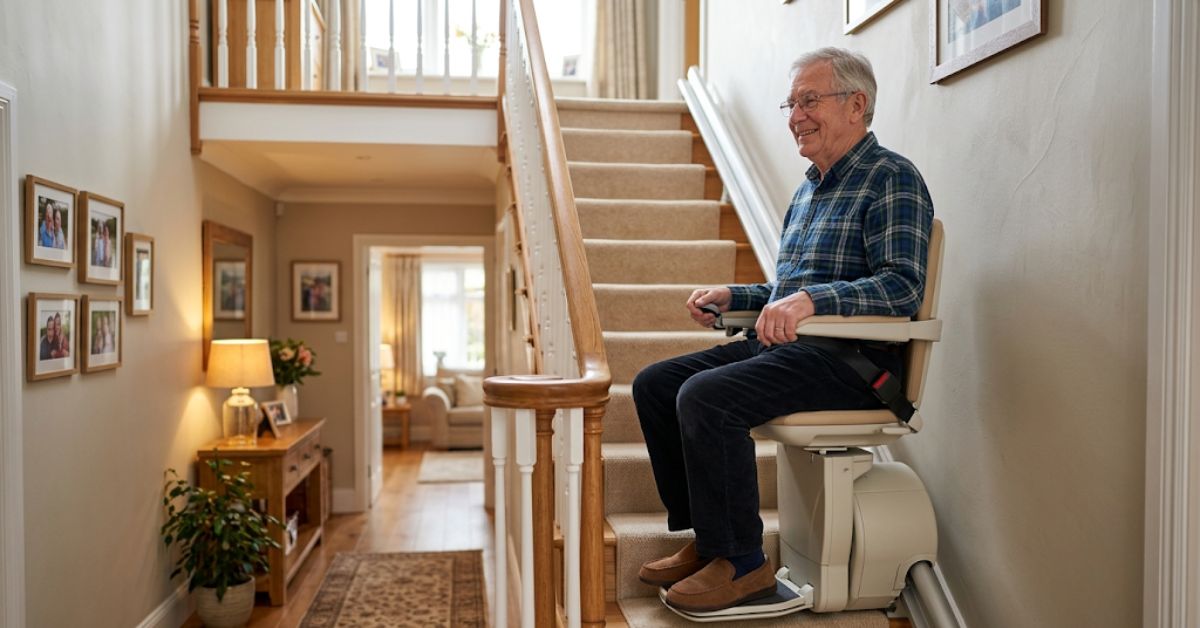
- Stair lift if the bedroom is on an upper floor and the patient must use stairs daily
- Removal of all loose rugs and low furniture that requires bending to navigate around
Knee Replacement Recovery
Knee replacement recovery involves significant swelling and reduced knee flexion for weeks after surgery. Rising from low chairs and toilets is painful and difficult. Stairs require careful technique — leading with the stronger leg going up, the surgical leg going down — and become exhausting when used multiple times daily.
Priority modifications for knee replacement recovery:
- Raised toilet seat and grab bars at toilet
- Grab bars in shower — shower chair strongly recommended
- Firm chair with armrests at the correct height for easy rising
- Stair lift if stairs are used daily — reduces the physical demand and fall risk significantly during recovery
- Ice pack accessibility at primary seating and bed locations
Stroke Recovery
Stroke recovery presents highly variable mobility challenges depending on the location and severity of the stroke. One-sided weakness (hemiplegia or hemiparesis), balance deficits, and cognitive changes all affect home mobility in different ways. Modifications must be tailored specifically to the individual's specific deficits — a one-size approach is not appropriate.
Common modifications for stroke recovery:
- Grab bars on the stronger side throughout the home
- Stair lift — particularly important if one-sided weakness makes stair use unsafe
- Wheelchair ramp if a wheelchair or rollator is in use
- Walk-in shower conversion — step-over tubs are not manageable with significant hemiparesis
- Lever-style door handles and faucets — round knobs require bilateral hand function that may be impaired
- Removal of all trip hazards — reduced foot clearance and balance make any obstacle a serious risk
Spinal Surgery Recovery
Spinal surgery — particularly lumbar fusion or cervical procedures — restricts bending, twisting, and lifting for weeks or months. Activities that involve forward trunk flexion (getting in and out of a low car, rising from a deep sofa, bending to put on shoes) become impossible or dangerous during recovery.
Priority modifications for spinal surgery recovery:
- Raised toilet seat — bending forward to rise from a standard toilet is contraindicated
- Grab bars at toilet and shower
- Shower chair — reduces the need to manage balance while following spinal precautions
- Firm, raised seating throughout the home — deep sofas and low chairs require trunk flexion to rise from
- Handrail upgrades on any staircase
The Fastest Modifications to Have in Place for Discharge
| Modification | Installation Timeline | Cost Range | Who Needs It |
|---|---|---|---|
| Grab bars at toilet and shower | 1–3 days | $300–$800 | Almost all post-surgical patients |
| Raised toilet seat | Same day (tool-free) | $30–$200 | Hip, knee, spinal surgery patients |
| Shower chair | Same day | $30–$150 | All patients with balance or weight-bearing restrictions |
| Straight stair lift | 24–48 hours | $2,500–$5,000 | Multi-story homes where bedroom is upstairs |
| Wheelchair ramp | 1–3 days | $1,500–$8,500 | Patients discharged with wheelchair or walker on uneven entry |
| Loose rug removal | Immediate — free | $0 | All patients |
| Handrail upgrade | 1–3 days | $200–$800 | All multi-level homes |
| Nightlights (bedroom to bathroom) | Same day | $10–$40 | All patients taking post-surgical medication |
Temporary vs Permanent Modifications: How to Think About It
One of the most common family conversations during post-surgical discharge planning is whether modifications should be temporary — installed for the recovery period and then removed — or permanent. The answer is almost always more nuanced than the question implies.
Modifications That Are Almost Always Worth Making Permanent
- Grab bars: The conditions that made them necessary during recovery do not fully reverse with age. A grab bar installed for a hip replacement at 72 is almost certainly still needed at 76, 80, and beyond.
- Handrail upgrades: Better handrails benefit everyone in the home permanently and address ongoing fall risk well beyond the recovery period.
- Nightlights: Cost essentially nothing and provide permanent benefit.
- Non-slip bathroom treatments: Permanent and maintenance-free.
Modifications That May Start Temporary and Become Permanent
- Stair lifts: Installed for recovery may reveal that the stairs were already more difficult than acknowledged. Many families who install a stair lift for recovery find it remains in regular use long after recovery is complete.
- Wheelchair ramps: Modular aluminum ramps can be removed if no longer needed — but many families find the ramp continues to serve as a safer entry than steps even after recovery from the immediate event.
Genuinely Temporary Modifications
- Raised toilet seats — can be removed once strength and range of motion are restored
- Shower chairs — can be removed as balance and strength improve
- Hospital bed rentals — used during early recovery, returned when no longer needed
The framing of "temporary vs permanent" often prevents families from making modifications that are genuinely needed during recovery — out of reluctance to commit to a "permanent" change. Modular stair lifts and ramps can be removed. The risk of not having them during a high-risk recovery period is real and immediate.
NJ-Specific Considerations for Post-Surgical Modifications
Discharge Timeline Pressure
Hospital and rehabilitation discharge timelines in NJ are often shorter than families expect — and discharge planners must confirm that the home environment is safe before the patient can return home. Having modifications in place before the discharge assessment occurs not only protects the patient but can also prevent unnecessary delays in the discharge itself.
NJ Medicaid MLTSS
For Medicaid-eligible patients, NJ Medicaid MLTSS may fund post-surgical home modifications. Pre-authorization is required before installation — contact NJ FamilyCare at 1-800-701-0710 as soon as the surgery date is known, not after discharge.
VA HISA Grant for Veterans
Veterans undergoing surgery may qualify for up to $6,800 through the VA HISA grant for home modifications. Applications take 2–8 weeks — begin the process before the surgery date if possible. Everhome Mobility provides all required documentation and quotes in the format required by the VA. See our full guide: Does Medicare Cover Stair Lifts?
Urgent Installation Across North NJ
Everhome Mobility provides same-day assessment and expedited installation for post-surgical discharge situations across Bergen County, Essex County, Passaic County, and Hudson County NJ. Contact us as soon as a surgery or discharge date is known — do not wait until the day before.
Surgery or discharge coming up? Same-day assessments and expedited installation available across North NJ — straight stair lifts installed in 24–48 hours, ramps in 1–3 days.
Request a Mobility Consultation →Frequently Asked Questions
How quickly can a stair lift be installed for a hospital discharge?
For a straight staircase, Everhome Mobility can typically complete an assessment and installation within 24–48 hours of contact. Curved stair lifts require custom rail fabrication — 2–6 weeks — which is why contacting us before surgery or as early as possible in the rehabilitation stay is strongly recommended. Do not wait until the day before discharge for a curved stair lift.
Does Medicare cover home modifications after surgery?
Standard Medicare Parts A and B do not cover stair lifts, ramps, or grab bars — even when medically necessary following surgery. Some Medicare Advantage plans have home modification benefits — call the plan's member services line and ask specifically. For veterans, the VA HISA grant is the primary funding source. For Medicaid recipients, NJ MLTSS may cover modifications with pre-authorization. See: Medicaid & Home Modification Grants for Accessibility in NJ.
My parent is being discharged to our home, not their own — can modifications be installed in our house?
Yes — modifications can be installed in any residential home where the patient will be living during recovery, regardless of ownership. Modular aluminum ramps are particularly practical for this situation because they can be fully removed when the patient returns to their own home. Grab bars and stair lifts installed in your home also remain a permanent benefit for your own household after the recovery period.
What is the most important modification for someone recovering from a hip replacement?
A raised toilet seat combined with a grab bar at the toilet is the most critical combination for hip replacement recovery. Rising from a standard 15-inch toilet requires hip flexion that exceeds safe limits during the early recovery period. A raised seat and a secure grab bar make this movement safe and independent. Grab bar installation should always be done professionally — anchored properly and load-tested after installation.
How long will my parent need the home modifications after surgery?
Recovery timelines vary significantly by procedure and individual. Hip and knee replacement patients typically reach functional independence within 6–12 weeks, though full recovery takes 3–6 months. Stroke recovery varies enormously. Spinal surgery recovery depends on the procedure and extent. More importantly, many modifications installed for recovery reveal pre-existing needs that persist well beyond the recovery period — particularly grab bars, handrails, and stair lifts.