
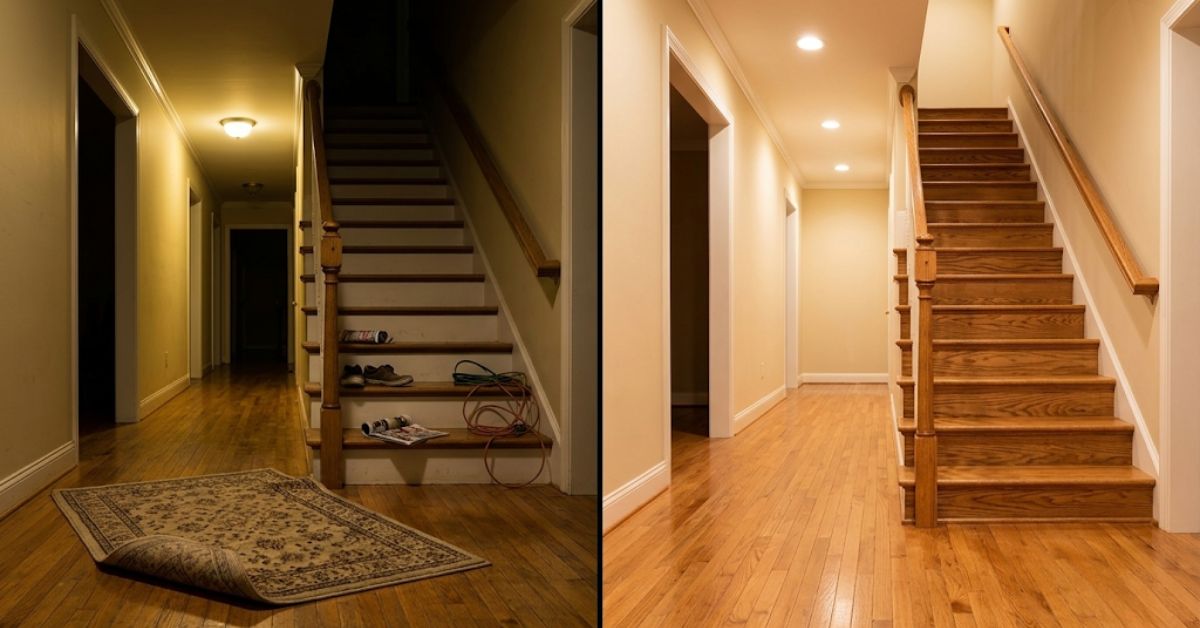
The majority of falls among older adults happen at home — and the majority of those falls involve a hazard that was hiding in plain sight. A rug. A dark hallway. A tub with no grab bar. A staircase used without holding the rail. These are not freak accidents or bad luck — they are predictable outcomes of predictable hazards that most homes contain and most families never address until a fall forces the conversation.
This guide identifies the most common home fall hazards room by room, explains exactly why each one causes falls, and gives you a clear, specific prevention action for each. Many of these fixes cost nothing or next to nothing. All of them can be implemented quickly. And all of them are worth doing before a fall makes them feel urgent.
The Scale of the Problem
Falls are the leading cause of injury-related death among adults over 65 in the United States. More than 36 million falls occur each year among older Americans — roughly one in four adults over 65 falls annually. The medical cost exceeds $50 billion annually. Behind those numbers are individual families — and the vast majority of those falls happened in a home with identifiable, preventable hazards.
Falls are not random events that happen to unlucky people. They are predictable outcomes of specific hazards interacting with specific vulnerabilities. Identify and remove the hazards, and you dramatically reduce the outcomes.
Hazard 1: Loose and Unsecured Area Rugs
Why it causes falls
Loose rugs slide on hard floors when stepped on, and curled or uneven rug edges catch feet during normal walking — particularly the toe-clearance shuffle that becomes more common as balance and gait change with age. A rug edge that catches mid-stride causes an immediate forward fall with no time to recover.
Prevention actions:
- Remove all loose rugs from high-traffic areas — hallways, bedroom-to-bathroom pathways, kitchen, and bathroom
- If rugs are retained for aesthetic reasons, secure all four edges with double-sided non-slip backing tape — not just a non-slip pad underneath, which allows the edges to still curl
- Replace loose rugs with wall-to-wall carpet or area rugs that are large enough to be held flat by furniture on all sides
- Never use a bath mat outside the tub that is not secured — use a heavy rubber-backed bath mat that does not shift
Hazard 2: Poor Lighting and Dark Pathways
Why it causes falls
Depth perception and contrast sensitivity decline with age. In low light, step edges are not clearly visible, obstacles are not detected in time, and the visual information needed to place feet accurately is simply not available. Nighttime trips from bedroom to bathroom — often taken while still partially asleep — account for a disproportionately large share of serious home falls.
Prevention actions:
- Install motion-activated nightlights on the full pathway from bedroom to bathroom — not just in one location
- Ensure light switches are accessible at both ends of every hallway and staircase — never navigate a dark area to reach the light switch
- Add step-level lighting to staircases — small LED lights at the base of each riser dramatically improve step edge visibility
- Increase overall lighting wattage in primary living areas — what seemed adequate at 50 may be genuinely insufficient at 75
- Consider contrasting colour on stair nosings — a visually distinct step edge significantly improves depth perception on staircases
Hazard 3: Bathroom Wet Surfaces Without Grab Bars
Why it causes falls
The bathroom is the most dangerous room in any home. Wet tile and wet tub surfaces are extremely slippery — comparable to icy pavement — while the physical movements required (stepping over a tub edge, rising from the toilet, reaching to turn the shower) demand strength and balance at precisely the moments those abilities are most tested. Without a secure handhold, any slip during these movements becomes an uncontrolled fall onto hard surfaces.
Prevention actions:
- Install grab bars at the toilet — on the dominant hand side at minimum, both sides preferred — at 33–36 inches from the floor
- Install grab bars inside the shower — horizontal bar on the back wall, vertical bar at the shower entry
- Apply non-slip strips or adhesive mat inside the tub or shower
- Place a heavy rubber-backed non-slip bath mat outside the tub or shower
- Apply anti-slip coating to tile bathroom floors — wet tile without treatment is genuinely dangerous
- Consider a tub cut-out or walk-in shower conversion if the tub step-over has become difficult
Hazard 4: Staircases Without Proper Handrails
Why it causes falls
A handrail provides the only reliable recovery mechanism if a foot slips or catches on a stair. A single-sided rail forces the person to reach across the staircase or operate without support on the non-rail side. A rail that does not run the full length of the staircase leaves sections without support. A rail that wobbles under load provides false security — it will not hold if gripped during a slip.
Prevention actions:
- Install handrails on both sides of every staircase, running the full length from bottom tread to top landing
- Test existing rails for security — apply firm sideways pressure; any movement means the anchoring is insufficient
- Ensure rail height is 34–38 inches above the stair nosing — too low or too high reduces effective leverage
- Ensure rail diameter allows a full grip — 1.25–2 inches is the correct range
- Add non-slip strips or tread covers to worn stair edges
- Keep staircases completely clear of stored items at all times
For stairs that have become genuinely difficult to use safely, see our guide to stair safety for seniors and our stairlift options.
Hazard 5: Electrical Cords Across Pathways
Why it causes falls
Cords crossing floors — lamp cords, phone charger cables, extension cords — create trip hazards that are easy to miss in low light or during distracted walking. Unlike a rug edge that requires stepping on it, a cord across a pathway can catch a foot at ankle height, causing a sudden forward stumble with almost no recovery time.
Prevention actions:
- Reroute all electrical cords to run along walls and under furniture — never across open floor areas
- Use cord management channels or clips to secure cords along skirting boards
- Never run extension cords under rugs — this is both a trip hazard and a fire risk
- Eliminate the need for extension cords where possible by using wireless or battery-powered alternatives
Hazard 6: Clutter and Obstacles in Pathways
Why it causes falls
Items left in circulation paths — shoes by the door, bags in the hallway, items waiting on stair treads to be carried up — require a deliberate step around or over them. For a person whose gait and balance are already compromised, an unexpected obstacle requires the kind of quick lateral adjustment that is no longer reliably available. The object does not need to be large to cause a fall.
Prevention actions:
- Establish a household rule: all primary pathways — hallways, bedroom-to-bathroom route, kitchen work area — are kept completely clear at all times
- Designate specific storage locations for frequently used items — shoes go in a rack, bags on a hook, coats on a stand
- Nothing is ever placed on stair treads — use a basket at the base of the stairs for items to be carried up, never place items on the steps themselves
- Review the home monthly and clear any pathway creep — clutter accumulates gradually and is easy to stop noticing
Hazard 7: Inappropriate Footwear
Why it causes falls
Socks on hardwood or tile are among the slipperiest surfaces a person can walk on — the friction coefficient approaches that of wet ice. Loose slippers that do not fasten securely around the heel can fold under the foot mid-stride. High-heeled footwear shifts the centre of gravity forward. Worn-out shoe soles that have lost their tread provide no grip on smooth surfaces.
Prevention actions:
- Wear shoes or slippers with rubber non-slip soles at all times when moving around the home
- Choose slippers that fasten securely around the heel — backless slippers are a fall risk regardless of sole type
- Avoid walking in socks alone on any hard floor surface
- Replace footwear with worn or smooth soles — grip degradation is gradual and easy to miss
- Keep a pair of shoes near the bed specifically for nighttime bathroom trips
Hazard 8: Furniture That Is Too Low or Unstable
Why it causes falls
Rising from a chair or sofa that is too low requires significantly more leg strength and forward momentum than rising from a chair at the correct height. An unstable chair or table used for support will shift under load, providing no support at the moment it is needed most. A bed that is too low makes transfer extremely difficult and risky.
Prevention actions:
- Primary seating chairs should allow the user to sit with feet flat on the floor and knees at 90 degrees — adjust with firm seat cushions or furniture risers if needed
- Chairs used for rising must have firm, load-bearing armrests — soft or absent armrests remove the primary rising support
- Bed height should allow feet to be flat on the floor when sitting on the edge — adjust with bed risers or a different mattress profile
- Never use unstable furniture — wobbly chairs, tables on castors — as a support point for rising or balance
Hazard 9: Raised Door Thresholds and Floor Transitions
Why it causes falls
A raised threshold strip between rooms — even one that is just half an inch high — can catch a foot during normal walking, particularly for anyone with reduced foot clearance due to a shuffling gait. Floor transitions between different materials (carpet to tile, wood to vinyl) with any lip or ridge create similar risks.
Prevention actions:
- Replace raised metal threshold strips with flush transition strips — these are inexpensive and widely available
- Where flush transitions are not possible, apply bevelled threshold ramps that reduce the effective step height to a smooth angle
- Ensure all door thresholds throughout the home have been assessed — these hazards are easy to overlook precisely because they are small
Hazard 10: Outdoor Steps Without Handrails or Non-Slip Surfaces
Why it causes falls
In New Jersey, many older homes have exterior front steps with no handrail, or a handrail on only one side that does not run the full length of the steps. Exterior concrete steps become extremely slippery when wet, and during winter, ice formation on untreated steps creates one of the highest fall-risk surfaces in any home environment.
Prevention actions:
- Install or upgrade handrails on exterior steps — both sides if space permits, running the full length
- Apply non-slip strips to concrete or stone step surfaces
- Clear snow and ice from exterior steps promptly — do not allow accumulation
- Use pet-safe ice melt on steps during winter — not rock salt, which degrades concrete over time
- Install motion-activated lighting at the entry so steps are always lit at night
- If steps have become genuinely difficult, assess a wheelchair ramp or platform lift as a long-term solution
Quick Prevention Summary
| Hazard | Cost to Fix | Time Required |
|---|---|---|
| Loose rugs | Free (remove) or $10–$30 (non-slip backing) | Same day |
| Poor lighting | $10–$40 per nightlight | Same day |
| No bathroom grab bars | $150–$400 per bar installed | Within 1 week |
| Inadequate handrails | $200–$800 installed | Within 2 weeks |
| Electrical cords | Free to $20 (cord clips) | Same day |
| Pathway clutter | Free | Same day |
| Inappropriate footwear | $20–$80 (non-slip slippers) | Same day |
| Low or unstable furniture | $20–$100 (risers, cushions) | Within 1 week |
| Raised thresholds | $10–$50 per transition | Within 1 week |
| Exterior steps | $200–$800 (handrails) / $20–$50 (non-slip strips) | Within 2 weeks |
Want a professional to walk through your home and identify every fall hazard? Our CAPS-certified team provides free in-home safety assessments across North NJ — no cost, no obligation.
Book Your Free Home Safety Assessment →Frequently Asked Questions
What is the number one fall hazard in the home for seniors?
Loose area rugs are consistently identified as the most common environmental fall hazard. They are present in nearly every home, are easy to overlook because they have been there for years, and cause falls in a sudden and unpredictable way. Removing loose rugs is the single most impactful free action any family can take immediately.
What time of day do most home falls happen?
Nighttime falls — particularly those occurring during trips from the bedroom to the bathroom — account for a disproportionately large share of serious falls. The combination of disorientation, low lighting, medication effects at night, and the physical demands of the bathroom make this the highest-risk period. Motion-activated nightlights on the full bedroom-to-bathroom pathway are the primary prevention for this.
Are most home falls preventable?
Yes — research consistently shows that the majority of home falls involve identifiable environmental hazards that could have been addressed. Falls are not random events. They are predictable outcomes of specific hazards interacting with specific vulnerabilities. The environmental hazards — rugs, lighting, wet bathroom surfaces, inadequate handrails — are almost always preventable with relatively low-cost modifications.
How do I know which fall hazards in my home are most urgent?
Prioritise by frequency of use and consequence of a fall. The bathroom and staircase account for the majority of serious falls and should be addressed first. A professional CAPS assessment provides a prioritised hazard list specific to your home and the individual's specific mobility — which is more useful than a general checklist because it accounts for the particular risk factors in that specific situation.