
"Will installing a stair lift damage my stairs?" is one of the most common concerns NJ homeowners raise during their first accessibility consultation — and it is a legitimate concern to raise. A staircase is a structural feature of the home, often a decorative one, and homeowners are understandably reluctant to modify something they have lived with for decades. Some worry that a stair lift will splinter the wood, crack the treads, damage the finish, or leave permanent scarring that affects the home's resale value.
The short answer is reassuring: a properly installed residential stair lift causes minimal to no lasting damage to your staircase, and any marks that remain after removal are typically easy to repair. But that answer comes with important qualifications about installation quality, staircase type, and what "properly installed" actually means. This guide walks through exactly what happens to your stairs during installation, what marks remain after removal, and how to protect your staircase throughout the entire process.
Where Does a Stair Lift Actually Attach?
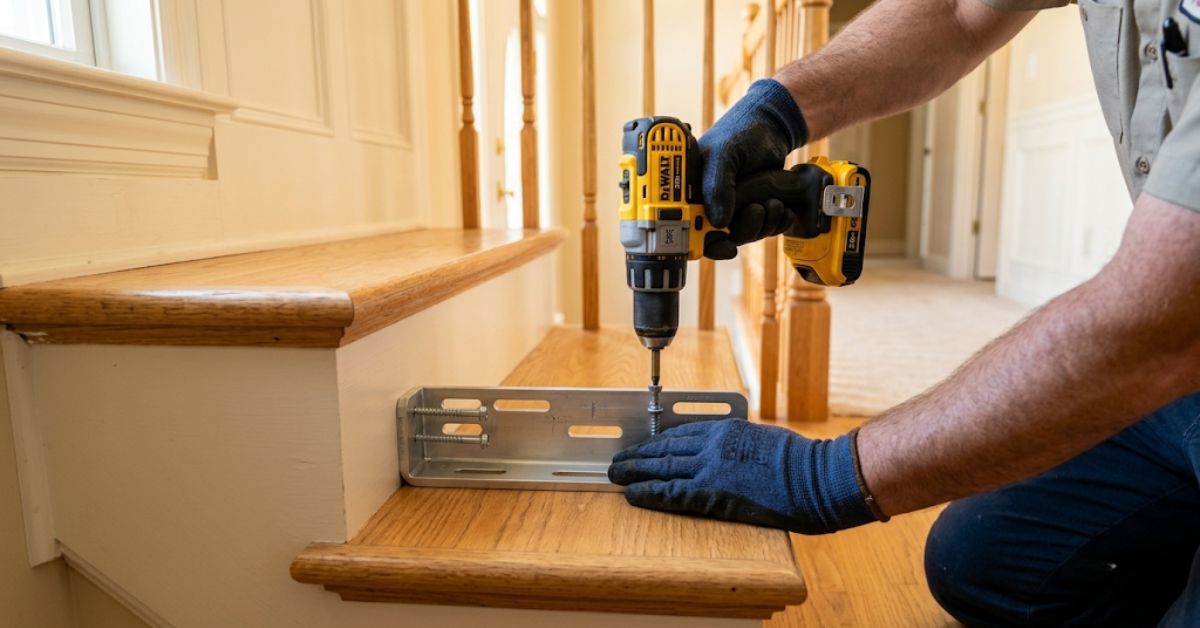
The most common misconception about stair lift installation is that the rail mounts to the wall. It does not. In every modern residential stair lift, the rail mounts to the stair treads — the horizontal surface you step on — using small brackets bolted through the tread. The wall next to the staircase is not touched at all. There is no drilling into plaster, no anchoring into studs, no wall repair required if the lift is later removed.
Key fact: Stair lift rails mount to the stair treads, not the walls. This means no wall damage, no plaster repair, and no visible marks on adjacent walls when the unit is eventually removed.
The brackets are typically placed every 3–5 treads along the length of the staircase. Each bracket uses 2–4 small bolts anchored into the tread. On a standard 14-tread NJ staircase, this typically means 4–5 brackets total and roughly 10–20 small anchor holes distributed along the tread edges.
What the Brackets Look Like on the Tread
The bracket that connects the rail to the tread is small — typically 3–5 inches wide, 2–3 inches deep, and made of powder-coated aluminum or steel. It sits on the outer edge of the tread (the side opposite the handrail), where the stair lift rail runs. When the stair lift is installed, the bracket is largely hidden by the rail itself. When the stair lift is removed, the small anchor holes in the tread remain — typically 6 to 10 holes in total across the entire staircase, each roughly the size of a screw hole.
These holes are the extent of the lasting mark. They are the same size and appearance as a hole left by any wall-mounted fixture — easily filled with wood filler, sanded flush, and touched up with matching stain or paint if desired.
Will the Wood Splinter, Crack, or Warp?
Properly installed stair lifts do not splinter, crack, or warp staircase wood. There are several reasons for this:
- Pilot holes are pre-drilled before any anchor is inserted, preventing splitting
- Anchors are appropriately sized for residential lumber and load requirements — not oversized
- Load is distributed across multiple brackets — no single point bears more weight than the tread can handle
- Modern stair lifts are lightweight — the combined weight of the rail, carriage, and user rarely exceeds what the staircase already supports during normal use by two adults walking together
- No structural modification to the tread itself — the anchor holes are surface-level, not deep enough to affect structural integrity
A residential staircase is engineered to support significant dynamic loads — people walking, jumping, and carrying furniture. The static loads placed on the treads by a stair lift bracket are far below these design tolerances. This is why the same tread can bear a stair lift bracket for 10–15 years without any visible or structural change.
What About the Staircase Finish, Carpet, or Runner?
Different staircase finishes require slightly different considerations:
| Staircase Type | Impact of Installation | Impact of Removal |
|---|---|---|
| Bare hardwood | Small anchor holes on outer tread edge | Holes remain; easily filled and stained |
| Painted wood | Small anchor holes on outer tread edge | Holes remain; easily filled and repainted |
| Fully carpeted stairs | Brackets typically installed through the carpet | Small holes in carpet; usually barely visible after removal |
| Stair runner (carpet down middle) | Brackets install on the exposed wood outside the runner | Runner is untouched; only outer wood shows marks |
| Tile or stone treads | Requires specialised anchors; installer assesses | Fills may be visible; discuss with installer during assessment |
| Metal or spiral staircase | Rare; specialised installation required if feasible | Case by case |
Carpet consideration: If your staircase is fully carpeted, brackets can be installed through the carpet with minimal visible impact. If the staircase has a runner, brackets are placed on the exposed wood outside the runner — meaning the runner itself is untouched. If you plan to replace the carpet or runner in the near future, mention this during your accessibility assessment — the installer can time bracket placement to align with the new floor covering.
What About Vintage or Antique Staircases?
Older NJ homes — particularly those built before 1940 in Bergen County, Essex County, and Hudson County — often have staircases with original wood, decorative moldings, or antique finishes that the homeowner wants to preserve. In these cases, professional assessment is even more important than for standard staircases.
Experienced installers can typically work with antique staircases by:
- Selecting bracket placements that avoid decorative elements
- Using specialised anchors that require smaller pilot holes
- Placing brackets along tread edges rather than in visible face areas
- Documenting the pre-installation staircase condition for future reference
- Recommending finish-matching wood fillers for eventual removal
If the staircase is a significant historical or aesthetic feature of the home, discuss this with the accessibility provider during the assessment. A CAPS-certified installer can typically accommodate preservation concerns without compromising the safety or function of the installation.
What Happens When the Stair Lift Is Removed?
When the stair lift is eventually removed — because the person no longer needs it, they have moved to a different living arrangement, or the home is being sold — the removal process is straightforward:
- Installer disconnects the electrical connection at the charging strip
- The seat, footrest, and carriage are removed from the rail
- The rail is unbolted from the brackets and removed in sections
- Each bracket is unbolted from the tread and removed
- Small anchor holes remain in the treads — typically 6 to 10 holes total
- The installer usually fills these holes with matching wood filler as part of the removal service
- If touch-up finish is needed, the installer can either apply it or provide instructions for the homeowner
Total removal time is typically 1–2 hours for a straight stair lift. The staircase is fully usable immediately afterward. From a distance, the treads look essentially unchanged. Up close, careful inspection may reveal the filled anchor points — but these are cosmetically minor and do not affect structural integrity or resale value.
Does Stair Lift Installation Void Warranties or Affect Insurance?
Two related concerns that come up frequently:
Home Warranty
Home warranty coverage on the staircase itself is generally not affected by professional stair lift installation. Because the installation does not modify the structural components of the staircase (only surface mounting brackets to the treads), home warranty providers typically do not consider this a covered modification issue. Verify with your specific home warranty provider if concerned.
Homeowner's Insurance
Standard homeowner's insurance is not affected by stair lift installation. Some insurers actually offer premium discounts for accessibility modifications that reduce fall risk. However, most residential stair lifts run on standard 120V household outlets — the same electrical load as a lamp or small appliance — and do not require electrical panel upgrades or dedicated circuits that might trigger insurance review.
For a complete look at the insurance side, see: Does Insurance Cover Stair Lifts?
What Damage CAN Happen — And How to Avoid It
While properly installed stair lifts cause minimal damage, poor installations can cause real problems. The damage risks that are worth knowing about:
- Splitting from oversized anchors: Using anchors sized for larger loads than necessary can split the tread. Prevented by pilot-drilling and correct anchor sizing
- Cracking from over-torqued bolts: Over-tightening the bracket bolts can crack the wood around the anchor point. Prevented by using torque-controlled tools
- Finish damage during installation: Poor protection of the surrounding staircase during installation can leave scratches or marks. Prevented by installers using protective coverings during the work
- Wall damage from misaligned rail attempts: Extremely rare with tread-mounted systems, but a poorly installed rail that shifts under load can occasionally rub against the wall. Prevented by proper rail alignment and secure bracket installation
- Rail marking on tread finish: Over years of use, the rail contact points can develop faint marks on the tread finish. Usually invisible to casual inspection; addressable with light refinishing if desired
Every one of these potential damage scenarios is prevented by professional installation using appropriate tools, correct anchor sizing, and proper alignment. This is why professional installation matters — not because installation is complicated, but because the small details that prevent damage require training, experience, and the right equipment. DIY stair lift installation or installation by a general handyman without stair lift-specific training is where damage most often occurs.
What to Ask During Your Accessibility Assessment
To ensure your staircase is protected throughout the installation, ask these questions during your in-home assessment:
- Where exactly on the treads will the brackets be placed?
- How many brackets will my specific staircase require?
- What size are the anchor holes, and how many total?
- How is the staircase protected during the installation itself?
- What is the removal process, and are anchor holes filled as part of removal?
- Do you provide a written pre-installation condition report?
- What is your labour warranty on the installation work?
An experienced accessibility installer will answer these questions confidently and specifically. Vague answers or reluctance to discuss protection details are warning signs to look for a different provider.
Concerned about your staircase? Everhome Mobility provides free in-home assessments across NJ that include a detailed walkthrough of exactly how the installation will affect your specific staircase. No commitment, no obligation.
Book Your Free Assessment →Frequently Asked Questions
Does a stair lift damage your stairs?
A properly installed residential stair lift causes minimal to no lasting damage. The rail mounts to the stair treads (not the wall) using small brackets, leaving only 6–10 small anchor holes total across the staircase after eventual removal. These holes are easily filled with wood filler and touched up. Splitting, cracking, or warping only occurs with improper installation — not with professional installation using correct tools and anchors.
Where does the stair lift rail attach — the wall or the stairs?
The rail attaches to the stair treads (the horizontal surface you step on), not the wall. This is standard for all modern residential stair lifts. The wall is not touched, drilled, or modified in any way. This design means no plaster repair, no wall damage, and no visible marks on the wall when the unit is eventually removed.
Can the anchor holes be repaired when the stair lift is removed?
Yes — easily. The anchor holes are small (screw-hole size) and can be filled with wood filler, sanded flush, and touched up with matching stain or paint. Many installers include hole filling as part of the removal service. After repair, the treads look essentially unchanged from a normal viewing distance.
Does stair lift installation work on carpeted stairs?
Yes. For fully carpeted staircases, brackets are typically installed through the carpet with minimal visible impact. For staircases with a runner, brackets are placed on the exposed wood outside the runner — leaving the runner completely untouched. If you plan to replace carpet or runner soon, mention this during your assessment so the installer can time bracket placement appropriately.
Will installing a stair lift affect my home's resale value?
A properly installed and later removed stair lift has essentially no impact on resale value. The small anchor holes, once filled, are cosmetically minor. Some homes retain the stair lift and market to accessibility-focused buyers. Others remove the unit before listing. Neither approach meaningfully changes the property's marketability. Home elevators, by contrast, can add value — see our guide: Stair Lifts vs Home Elevators.
Does a stair lift damage antique or vintage staircases?
Not when properly installed by an experienced provider. Antique and vintage staircases require careful bracket placement to avoid decorative elements, specialised anchors sized for the specific wood, and preservation-focused installation approach. A CAPS-certified installer with experience in older NJ homes can accommodate preservation concerns without compromising the installation. Discuss preservation priorities during the initial assessment.