
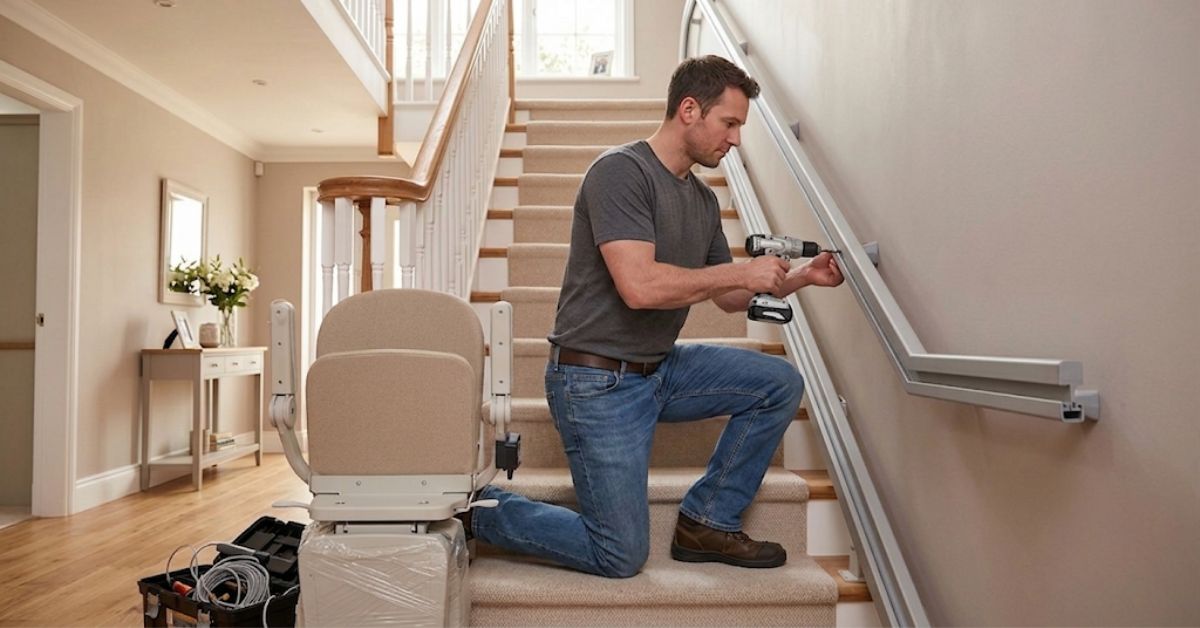
If you are considering a stair lift for your NJ home, one of the biggest questions is not which model to buy — it is what the installation actually involves. How long does it take? Will it damage your staircase? Does it need electrical work? Can it handle your specific staircase layout? And how do you tell a qualified installer from one who will leave you with problems?
This guide walks you through the entire stair lift installation process — from the initial assessment to the final walkthrough — so you know exactly what to expect, what questions to ask, and what to watch out for. It is written specifically for NJ homeowners, because the housing stock in Bergen, Essex, Passaic, and Hudson County presents specific installation challenges that matter.
Step-by-Step: How Stair Lift Installation Works
In-Home Assessment
A qualified installer visits your home to measure the staircase, assess the person's mobility needs, and recommend the right stair lift configuration. This includes staircase width, length, angle, any curves or landings, wall condition, power outlet location, and the user's weight and seat preference. This assessment should always be free and conducted by the company that will perform the installation — never by a separate salesperson.
Quote and Specification
You receive a written, all-inclusive quote covering the stair lift unit, the rail system, all mounting hardware, installation labour, electrical connection, safety testing, user training, and warranty terms. A reputable installer quotes a single total price — not a base price with add-ons revealed later. The quote should specify the exact brand and model being installed.
Rail Installation
The rail (track) is the foundation of the stair lift system. For straight staircases, standard rail sections are cut to length on-site and mounted directly to the stair treads — not the wall. For curved or L-shaped staircases, a custom rail is fabricated off-site based on the measurements taken during the assessment, then installed as a single precision-fitted piece.
Carriage and Seat Installation
The motorised carriage unit is mounted onto the rail and connected to the drive mechanism. The seat assembly — including the swivel mechanism, armrests, footrest, and seat belt — is attached to the carriage. All folding mechanisms are tested for smooth operation.
Electrical Connection
Most residential stair lifts run on rechargeable batteries that charge from a standard household outlet. The charging strip is installed at the top or bottom of the rail (depending on the parking position), and a power cable is run to the nearest outlet. No hardwiring or electrical panel work is required for the vast majority of residential installations.
Safety Testing
Every installed stair lift is tested under load — ridden from top to bottom and back multiple times, at various speeds, with all safety sensors verified. Obstruction sensors are tested by placing objects in the path. The emergency stop is tested. The key switch is tested. The remote controls and call/send stations are confirmed working. Battery charge is verified.
User Training and Walkthrough
The installer walks the person who will use the lift through every aspect of operation — how to sit, how to fasten the belt, how to operate the controls, how to swivel at the top, how to fold the unit when not in use, and what to do if the lift stops mid-run. This training is essential and should never be rushed. A second family member or caregiver should be present whenever possible.
How Long Does Installation Take?
| Stair Lift Type | Assessment to Install | Installation Day Duration |
|---|---|---|
| Straight stair lift | 1–5 days | 2–4 hours |
| Straight — urgent (post-discharge) | 24–48 hours | 2–4 hours |
| Curved stair lift | 2–6 weeks (custom rail fabrication) | 4–6 hours |
| Outdoor stair lift | 1–2 weeks | 3–5 hours |
The installation day itself is remarkably quick for straight staircases — typically 2–4 hours from arrival to walkthrough. The person does not need to vacate the home during installation. The staircase can be used immediately after the installer completes safety testing.
Curved stair lifts take longer because of custom fabrication. If you know your staircase is curved, L-shaped, or has an intermediate landing, start the process as early as possible. The 2–6 week fabrication period cannot be compressed — the rail must be manufactured to the exact geometry of your staircase. Do not wait until a surgery or health event makes the need urgent.
Where Does the Rail Mount? Does It Damage the Staircase?
This is one of the most common concerns — and the answer is reassuring. The stair lift rail mounts to the stair treads (the horizontal surface you walk on), not to the wall. The rail is secured using brackets that bolt into the treads at several points along the staircase. This means no wall damage, no structural modification, and no plaster or drywall work.
If the stair lift is eventually removed, the bracket holes in the treads can be filled and covered — the staircase itself remains structurally sound throughout and after the installation.
The rail is positioned along one side of the staircase — usually the side opposite the handrail, though this depends on the staircase layout and the user's preferred dismount direction. The remaining staircase width is reduced by approximately 12–14 inches — enough to allow other household members to walk past the folded lift when it is not in use.
NJ-Specific Installation Considerations
Narrow Staircases
Many NJ homes built before 1970 — particularly in Hudson County and Essex County — have staircases as narrow as 26–28 inches. Standard stair lift rails require approximately 12–14 inches of width. On a 28-inch staircase, this leaves 14–16 inches of clear walking space beside the folded lift — tight but usable for most adults walking single file.
Slimline rail systems are available that reduce the width footprint by 2–3 inches — important on staircases where every inch matters. A proper in-home assessment determines whether a standard or slimline system is needed for your specific staircase.
Split-Level Homes
Split-level homes — extremely common in Bergen County and Passaic County — present multiple short stair runs with intermediate landings. Depending on the layout, this may require a single curved rail system that navigates multiple sections, or a straight lift on the longest run with handrail upgrades on the shorter sections. An experienced NJ installer assesses which approach delivers the best balance of cost, function, and daily usability.
Outdoor Installations
For NJ homes with exterior entry stairs, outdoor-rated stair lifts are available with weatherproofing for the drive mechanism, seat, and controls. NJ's freeze-thaw cycle requires specific attention during installation — the rail must be mounted with hardware that accounts for thermal expansion, and the charging contacts must be protected from ice and moisture. A weatherproof cover should be included with every outdoor installation.
Permits
Stair lift installations in NJ do not typically require a building permit — they are classified as removable equipment rather than structural modifications in most municipalities. However, if any electrical work beyond plugging into an existing outlet is required, a separate electrical permit may be needed. A qualified NJ installer knows the requirements for your specific municipality and handles any permitting as part of the project.
What Should Be Included in the Installation Price
A reputable stair lift installer provides an all-inclusive quote. Here is what should be included — and what to watch out for if it is not:
| Should Be Included | Watch Out For |
|---|---|
| Stair lift unit (specified brand and model) | Generic "unit" without brand/model specified |
| Rail system cut and fitted to your staircase | Rail listed as a separate add-on charge |
| All mounting hardware and brackets | "Hardware kit" charged separately |
| Installation labour by trained technicians | Installation by subcontractors or general handymen |
| Electrical connection to nearest outlet | Electrical listed as "additional if needed" |
| Safety testing under load | No mention of safety testing in the quote |
| User training and demonstration | Training listed as optional or chargeable |
| Remote controls and call/send stations | Remotes charged as add-ons |
| Manufacturer warranty terms specified | Vague warranty language — "warranty available" |
| Labour warranty specified (e.g., 5 years) | No labour warranty — only manufacturer warranty |
If a quote does not specify the brand and model of the stair lift being installed, does not include a labour warranty, or lists installation components as add-ons rather than included items — that is not a transparent quote. A reputable NJ installer provides a single all-inclusive number that covers everything from assessment to walkthrough.
How to Choose a Stair Lift Installer in NJ
The quality of the installation matters as much as the quality of the equipment. The same stair lift installed by a qualified team and by an unqualified one will perform very differently over its lifetime. Key things to evaluate:
- CAPS certification: A Certified Aging-in-Place Specialist has training specifically in home accessibility assessment — not just equipment sales
- Own installation team: The company should use its own trained employees for installation — not subcontractors. This ensures accountability and consistent quality
- NJ housing stock experience: Ask specifically whether they have installed in narrow NJ staircases, split-level homes, and older properties. A company experienced with NJ homes will have solved your specific challenge before
- All-inclusive written quotes: As described above — everything in one price, no surprises
- Labour warranty: The manufacturer warrants the product; the installer should warrant the installation work. A 5-year labour warranty is a strong signal of confidence
- Post-installation service: The same team that installs should be the team that services. Ask about annual maintenance, response time for service calls, and parts availability
For a comprehensive provider evaluation framework, see our guide: How to Choose a Home Accessibility Company in NJ.
Stair Lift Installation Costs in NJ
| Type | Typical NJ Cost (Installed) | What Affects Price |
|---|---|---|
| Straight stair lift | $2,500 – $5,000 | Staircase length, brand, seat features |
| Curved stair lift | $8,000 – $16,000 | Number of curves, staircase complexity, custom rail fabrication |
| Outdoor stair lift | $3,500 – $7,000 | Weather exposure, staircase length, material upgrades |
| Multi-section (split-level) | $6,000 – $14,000 | Number of sections, landing transitions |
For a full pricing breakdown, see our Stair Lift Cost Guide for 2026. For funding options that can reduce or eliminate the cost, see: Can You Qualify for a Free or Low-Cost Stair Lift?
After Installation: What Maintenance Is Needed
A properly installed stair lift requires minimal maintenance — but it does require some. The key ongoing needs are:
- Annual professional service: A comprehensive checkup covering the rail, drive mechanism, battery, sensors, and all moving parts. Typically $150–$300 per visit. This is the single most important factor in stair lift longevity
- Battery replacement: Every 3–5 years for the rechargeable batteries. Cost: $100–$250 per pair
- Weekly user maintenance: Wipe the rail with a dry cloth, check charging contacts, confirm remote batteries are fresh
For a complete maintenance guide, see: Stair Lift Repair & Maintenance: What Homeowners Should Know.
Free in-home stair lift assessment across Bergen, Essex, Passaic, and Hudson County NJ. Same-week appointments. All-inclusive written quotes. 5-year labour warranty on every installation.
Book Your Free Installation Assessment →Frequently Asked Questions
How long does stair lift installation take?
For a straight staircase, the installation itself takes 2–4 hours. From assessment to installation can be as quick as 24–48 hours for urgent situations, or 1–5 days for planned installations. Curved stair lifts require 2–6 weeks for custom rail fabrication before the installation day, which takes 4–6 hours.
Does the stair lift rail mount to the wall?
No — the rail mounts to the stair treads using brackets that bolt into the horizontal surface. No wall damage, no structural modification, and no plaster or drywall work. If the lift is eventually removed, the bracket holes can be filled and the staircase remains structurally sound.
Will a stair lift fit on a narrow NJ staircase?
Most NJ staircases — even those as narrow as 26–28 inches — can accommodate a stair lift using slimline rail systems. The rail and folded seat occupy approximately 12–14 inches of width (less with slimline models), leaving the remaining width for other household members to pass. An in-home assessment confirms the exact clearances for your specific staircase.
Do I need a permit for a stair lift in NJ?
Stair lift installations in NJ do not typically require a building permit — they are classified as removable equipment rather than structural modifications. If electrical work beyond connecting to an existing outlet is needed, a separate electrical permit may apply. A qualified NJ installer handles any permitting requirements.
What should an installation quote include?
A complete all-inclusive quote should cover: the specified stair lift unit (brand and model), rail system, all mounting hardware, installation labour by trained technicians, electrical connection, safety testing, user training, remote controls, manufacturer warranty terms, and a labour warranty on the installation work. Anything listed as a separate add-on should be questioned.
Can a stair lift be installed in a split-level NJ home?
Yes — split-level homes common in Bergen, Morris, and Passaic County can be equipped with either a single curved rail system that navigates multiple sections, or a straight lift on the primary run with handrail upgrades on shorter sections. The right approach depends on the specific layout. An experienced NJ installer recommends the most practical and cost-effective configuration.