
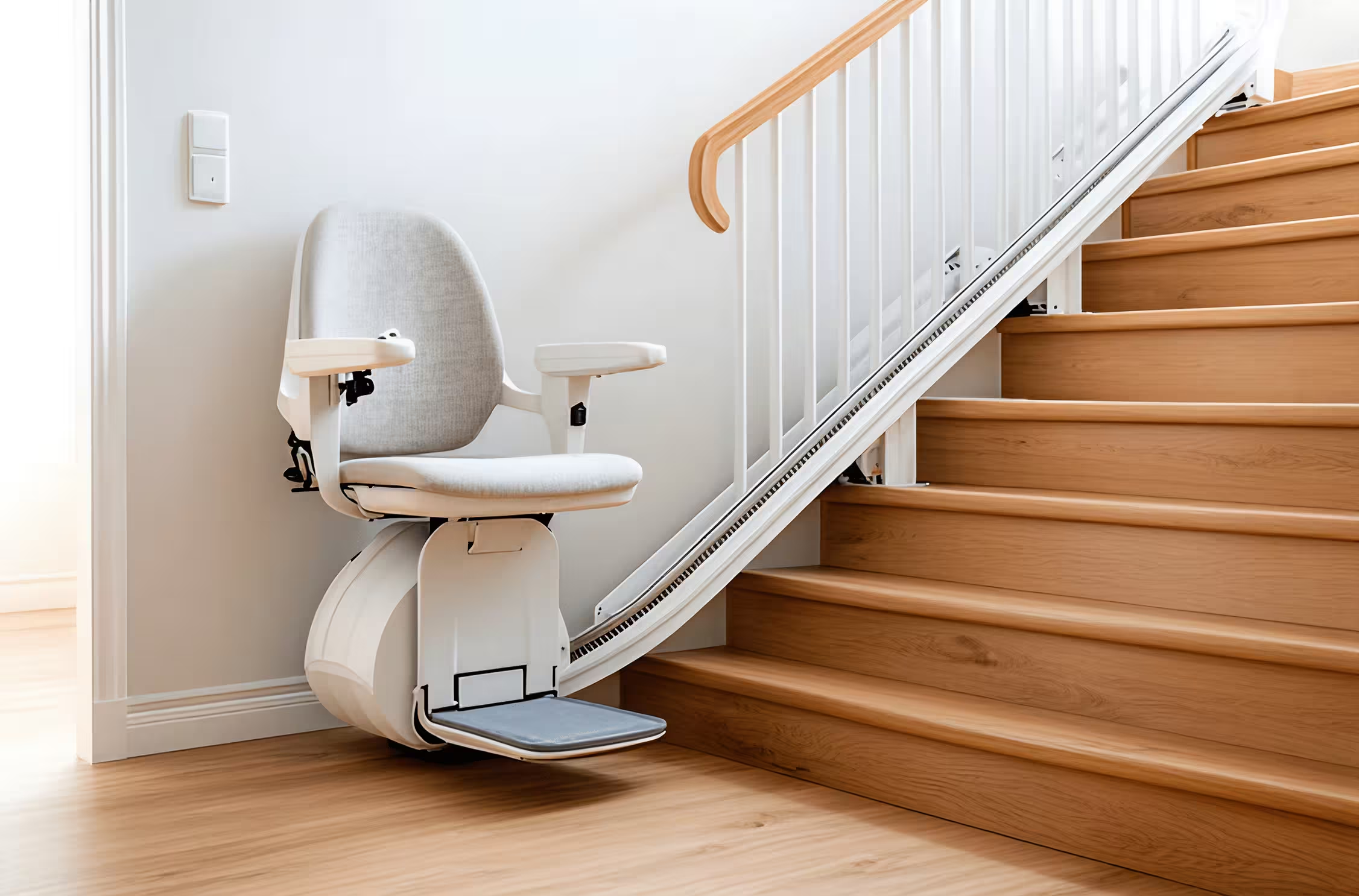
One of the first questions most families ask when considering a stair lift is whether insurance will help cover the cost. It is a reasonable question — stair lifts can cost $2,500 to $16,000 or more, and if insurance could offset even part of that expense, it would make a meaningful difference.
The answer depends entirely on which type of insurance you are asking about. Some insurance types offer real coverage opportunities — others offer none at all. This guide breaks down every major insurance category clearly, so you know exactly where to focus your time and what documentation you need to maximize your chances of coverage.
Quick Reference: Insurance Coverage Summary
| Insurance Type | Covers Stair Lifts? | Notes |
|---|---|---|
| Medicare Parts A & B | ❌ No | Home modifications excluded from DME benefit |
| Medicare Advantage (Part C) | ⚠️ Sometimes | Some plans offer home modification benefits |
| Medicaid (NJ MLTSS) | ⚠️ Sometimes | Eligible participants with medical necessity |
| Private health insurance | ❌ Usually no | Rare exceptions with strong documentation |
| Long-term care insurance | ✅ Often yes | Most policies cover home modification benefits |
| Homeowner's insurance | ❌ No | Covers damage, not accessibility modifications |
| VA benefits (HISA grant) | ✅ Yes | Up to $6,800 for eligible veterans |
| Workers' compensation | ⚠️ Sometimes | If disability resulted from workplace injury |
Medicare Parts A and B: Why They Don't Cover Stair Lifts
Standard Medicare — both Part A (hospital) and Part B (medical) — does not cover stair lifts. The reason comes down to how Medicare classifies equipment. Part B covers Durable Medical Equipment (DME): items that are medically necessary, prescribed by a doctor, and used for a medical purpose in the home — things like wheelchairs, hospital beds, and oxygen equipment.
Stair lifts are classified as home modifications — structural changes to the home — rather than DME. This classification does not change based on how medically necessary the lift is for a specific individual, or whether a physician has prescribed it. The category is fixed.
For a complete breakdown of Medicare's position and all available alternatives, see our dedicated guide: Does Medicare Cover Stair Lifts? Coverage & Alternatives.
Medicare Advantage (Part C): The Opportunity
Medicare Advantage plans are sold by private insurers and can include benefits beyond standard Medicare. Since 2019, the Centers for Medicare & Medicaid Services has permitted Advantage plans to offer Special Supplemental Benefits for the Chronically Ill (SSBCI) — which can include home modification benefits covering stair lifts.
How to Find Out If Your Plan Covers Stair Lifts
- Call the member services number on the back of your Medicare Advantage card
- Ask specifically: "Does my plan include a home modification benefit or Special Supplemental Benefits for the Chronically Ill?"
- If yes, ask: "Does this benefit cover stair lifts, and what is the maximum covered amount?"
- Ask about the pre-authorization process and whether you must use a plan-approved vendor
- Get all coverage details in writing before making any purchase
Important: Medicare Advantage plans change their benefits annually. Even if your plan did not cover home modifications last year, it may this year — and vice versa. Check at the start of each plan year, especially during open enrollment (October 15 – December 7).
Long-Term Care Insurance: The Most Likely Private Coverage
If you or a family member has a long-term care (LTC) insurance policy, this is the most likely source of private insurance coverage for a stair lift. Many LTC policies include a home modification benefit — a lump-sum or annual allowance specifically for modifications that allow the policyholder to remain at home rather than entering a care facility.
What LTC Policies Typically Cover
LTC home modification benefits vary significantly by policy, but commonly include:
- Stair lifts and vertical platform lifts
- Wheelchair ramps and entry modifications
- Grab bars and bathroom safety modifications
- Widened doorways for wheelchair access
- Walk-in shower conversions
How to Make a Claim
- Review your policy documents for the home modification or home care benefit section
- Call your LTC insurer's claims department and ask specifically about home modification coverage
- Obtain a letter of medical necessity from your physician documenting why the stair lift is needed
- Get a written quote from a licensed installer — Everhome Mobility can provide all required documentation
- Submit the claim with supporting documentation per your insurer's process
- Keep copies of all documentation in case of follow-up or appeal
Check your elimination period: Most LTC policies have an elimination period — a waiting period before benefits begin. This is typically 30, 60, or 90 days. Factor this into your planning timeline — you may need to pay out of pocket initially and seek reimbursement.
Private Health Insurance: Rarely, But Possible
Standard private health insurance policies — employer-sponsored plans, ACA marketplace plans, and most individual policies — generally do not cover stair lifts. Like Medicare, most private health insurers classify stair lifts as home modifications rather than covered medical equipment.
However, exceptions do exist in limited circumstances:
- Some plans with robust home health benefits may include home modification coverage as part of a broader care package
- Policies that explicitly cover durable medical equipment with a broad definition may sometimes include stair lifts with strong physician documentation
- Managed care plans that emphasize keeping members out of higher-cost institutional settings occasionally cover home modifications as a cost-avoidance strategy
How to Check Your Private Health Insurance
Call your insurer's member services line and ask:
- "Does my plan cover home modifications or accessibility equipment?"
- "If I have a letter of medical necessity from my physician, could a stair lift be covered as DME?"
- "Does my plan have a home health or home care benefit that might apply?"
Even a low-probability inquiry costs nothing and occasionally produces a positive result. Always ask before assuming the answer is no.
VA Benefits: The Most Comprehensive Coverage for Veterans
For veterans, the VA provides the most generous coverage available for stair lifts and other home accessibility modifications. The primary program is the Home Improvement and Structural Alterations (HISA) grant:
| VA Program | Maximum Benefit | Eligibility |
|---|---|---|
| HISA Grant (service-connected) | $6,800 lifetime | Veterans with service-connected disability |
| HISA Grant (non-service-connected) | $2,000 lifetime | Veterans receiving VA care for any condition |
| Specially Adapted Housing (SAH) | Up to $109,986 | Veterans with severe service-connected mobility impairment |
| Special Housing Adaptation (SHA) | Up to $22,036 | Veterans with specific service-connected conditions |
The HISA grant can cover a straight stair lift partially or entirely depending on the model and installation cost. Everhome Mobility has experience working with veterans through the HISA process and can provide all required quotes and documentation in the format your VA facility requires.
NJ Medicaid: Coverage for Eligible Participants
New Jersey's Medicaid Managed Long Term Services and Supports (MLTSS) program can fund stair lifts for eligible participants who need them to remain safely at home. Coverage requires:
- Enrollment in NJ Medicaid and the MLTSS program
- A determination of medical necessity from a healthcare provider
- Pre-approval from your MLTSS managed care organization before purchase
Contact your MLTSS managed care organization or call NJ FamilyCare at 1-800-701-0710 to initiate a home modification request.
Workers' Compensation: If Disability Resulted from a Workplace Injury
If a worker's disability or mobility impairment resulted directly from a workplace injury, workers' compensation may cover home modifications — including stair lifts — as part of the rehabilitation and accommodation process. The logic is that the employer's liability for the injury extends to the costs of making the worker's home accessible during recovery or permanently.
Coverage depends on the specific workers' compensation policy, the nature of the injury, and the insurer's position on home modifications. Consult a workers' compensation attorney if you believe this avenue may apply to your situation — this is specialized territory that benefits from professional guidance.
Homeowner's Insurance: Generally No
Homeowner's insurance covers damage to the home — fire, flood, theft, and similar events. It does not cover elective home modifications or accessibility equipment. There is no standard homeowner's policy that covers stair lift installation.
The one exception worth knowing: if a stair lift was installed and then damaged by a covered event (fire, flood, vandalism), the cost to repair or replace the unit may be covered under the dwelling or personal property portion of your homeowner's policy. Review your policy for specifics.
How to Appeal an Insurance Denial
If your insurer denies a stair lift claim, you have the right to appeal. Here is a practical framework for a successful appeal:
- Get the denial in writing — ask for the specific reason for denial and the policy provision cited
- Obtain a strong letter of medical necessity — from your physician, documenting the specific medical condition, how it affects mobility, why the stair lift is medically necessary, and what the consequence of not having it would be (falls, institutionalization, etc.)
- Gather supporting documentation — therapy notes, hospital records, or any documentation showing the medical need
- Request a peer-to-peer review — your physician can request a direct conversation with the insurer's medical reviewer, which often results in overturned denials
- File a formal appeal — follow the insurer's appeal process exactly, meeting all deadlines
- Escalate to external review — if the internal appeal fails, most states including New Jersey allow you to request an independent external review of coverage denials
Insurance denials for stair lifts are common — but so are successful appeals. Strong physician documentation that specifically addresses fall risk, functional limitation, and the alternative cost of institutional care gives the best chance of reversal.
When Insurance Doesn't Cover It: Practical Alternatives
If insurance coverage is not available or insufficient, several practical alternatives can make a stair lift financially accessible:
Hearth Financing
Everhome Mobility offers monthly payment plans through Hearth — 12 to 60 months at competitive rates. A $4,000 straight stair lift over 24 months is approximately $167/month. Apply takes minutes and approval is typically immediate.
County and State Grants
Each NJ county administers home modification grants through the Area Agency on Aging for income-qualified seniors. Bergen County (201-336-7459), Essex County (973-395-8375), Passaic County (973-569-4060), and Hudson County (201-369-4313) all have programs worth contacting.
Tax Deductions
Stair lift installations may qualify as a deductible medical expense on your federal tax return if total qualifying medical expenses exceed 7.5% of your adjusted gross income. Consult a tax professional before claiming.
Not sure what funding options apply to your situation? Our team can help you identify programs and prepare documentation during your free in-home assessment.
Book Your Free Assessment →Frequently Asked Questions
Does private health insurance cover stair lifts?
Usually not. Most private health insurers classify stair lifts as home modifications rather than covered medical equipment. However, some long-term care insurance policies include home modification benefits that cover stair lifts. Always ask your insurer directly — exceptions exist.
What documentation do I need to submit a stair lift insurance claim?
At minimum: a letter of medical necessity from your physician documenting the specific condition, functional limitations, and why the stair lift is medically required; a written installation quote from a licensed contractor; and your policy number and claims contact information. Stronger claims also include therapy assessments and records showing fall history or hospitalization risk.
Can I get reimbursed after purchasing a stair lift?
Some policies reimburse after purchase rather than paying the provider directly. Check your policy's claims process before installation — some require pre-authorization before purchase, and failing to obtain pre-authorization can result in a denied claim even when coverage would otherwise apply.
Does long-term care insurance always cover stair lifts?
Not always — it depends on the specific policy. Many LTC policies include a home modification benefit, but the benefit amount, covered items, and claim process vary. Review your policy documents carefully and call your insurer's claims department to confirm coverage before assuming it applies.
What is a letter of medical necessity and how do I get one?
A letter of medical necessity is a document from your physician stating that a specific item — in this case, a stair lift — is medically required for your health and safety. To get one, ask your primary care physician or a specialist treating your condition. The letter should specifically describe your diagnosis, how it affects your ability to navigate stairs safely, the fall risk involved, and why a stair lift is the appropriate solution. The more specific and clinical the language, the more useful it is for insurance and grant applications.