
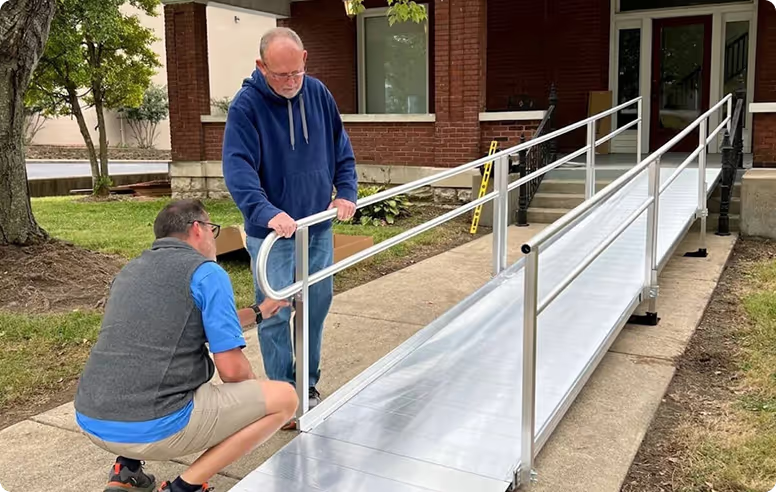
Home accessibility modifications — stair lifts, wheelchair ramps, bathroom safety upgrades, grab bars, widened doorways — can cost anywhere from a few hundred to tens of thousands of dollars. For many New Jersey families, that price tag is a real barrier. But a network of Medicaid programs, federal grants, state initiatives, and county-level resources exists specifically to close that gap.
The challenge is that these programs are fragmented — administered by different agencies, with different eligibility criteria, application processes, and funding limits. Most families do not know all of their options until they are already in crisis, which is exactly when there is least time to research and apply.
This guide consolidates every major Medicaid and grant program available to NJ homeowners seeking funding for accessibility modifications — so you can identify what applies to your situation before you need it.
Program Overview: NJ Accessibility Funding Landscape
| Program | Who It's For | Max Benefit | Type |
|---|---|---|---|
| NJ Medicaid MLTSS | NJ Medicaid enrollees | Varies by need | Medicaid entitlement |
| VA HISA Grant | Veterans (service/non-service connected) | Up to $6,800 | Federal grant |
| USDA Section 504 | Rural NJ, low-income, 62+ | Up to $10,000 | Federal grant |
| County AAA Grants | Low-income NJ seniors | Varies by county | State/federal funded |
| NJ Division of Disability Services | NJ residents with disabilities | Varies | State program |
| Medicare Advantage SSBCI | MA plan members | Varies by plan | Private insurance benefit |
| Rebuilding Together NJ | Low-income homeowners | Full cost (volunteer) | Non-profit |
| CDBG (municipal) | Low-income homeowners | Varies by municipality | Federal block grant |
| Long-term care insurance | LTC policyholders | Varies by policy | Private insurance |
| Hearth financing | Any homeowner | Full cost financed | Private financing |
NJ Medicaid MLTSS: The Primary Medicaid Route
New Jersey's Medicaid Managed Long Term Services and Supports (MLTSS) program is the primary Medicaid pathway for home modification funding in NJ. Designed to support individuals who need long-term services to remain at home rather than entering a nursing facility, MLTSS can fund a broad range of accessibility modifications for eligible participants.
What MLTSS Can Fund
- Stair lifts and vertical platform lifts
- Wheelchair ramps and entry modifications
- Grab bars and bathroom safety modifications
- Walk-in shower conversions and tub cut-outs
- Widened doorways for wheelchair access
- Non-slip flooring treatments
- Handrails and stair safety modifications
MLTSS Eligibility
To qualify for MLTSS home modification funding, you must:
- Be enrolled in NJ Medicaid (NJ FamilyCare)
- Be enrolled in the MLTSS program specifically — not all Medicaid enrollees are automatically in MLTSS
- Have a documented functional need for the modification — typically assessed by a healthcare provider or care manager
- Have the modification approved by your MLTSS managed care organization (MCO) before purchase
NJ FamilyCare / MLTSS Enrollment
To apply for NJ Medicaid or inquire about MLTSS eligibility and home modification coverage
📞 1-800-701-0710
njfamilycare.orgHow to Request a Home Modification Through MLTSS
- Contact your MLTSS managed care organization — your MCO coordinates all MLTSS services
- Request a home modification assessment — a care manager or occupational therapist will evaluate your needs
- Obtain medical necessity documentation from your treating physician or therapist
- Get a written quote from a licensed contractor — Everhome Mobility provides MLTSS-formatted quotes
- Submit the pre-authorization request through your MCO before any work begins
- Schedule installation after written approval is received
Critical: Never purchase or install a modification before receiving written pre-authorization from your MCO. Work completed without pre-authorization will not be reimbursed, even if you would otherwise qualify for coverage.
VA HISA Grant: Essential for NJ Veterans
The VA Home Improvement and Structural Alterations grant is the most generous single-source funding available for eligible veterans. New Jersey has one of the largest veteran populations in the country, yet many NJ veterans are not aware this grant exists or how to access it.
| Grant Type | Maximum Benefit | Who Qualifies |
|---|---|---|
| Service-connected HISA | $6,800 lifetime | Veterans with a service-connected disability affecting mobility or requiring home modification |
| Non-service-connected HISA | $2,000 lifetime | Veterans receiving VA care for any condition |
| Specially Adapted Housing (SAH) | Up to $109,986 | Veterans with severe service-connected mobility impairment |
| Special Housing Adaptation (SHA) | Up to $22,036 | Veterans with specific service-connected conditions |
What HISA Covers
The HISA grant can be applied to any modification that improves accessibility in the home — stair lifts, wheelchair ramps, grab bars, bathroom modifications, widened doorways, roll-in shower conversions, and more. There is no restriction to a single modification type.
How to Apply
- Obtain a prescription or letter of medical necessity from your VA physician
- Get a written quote from a licensed contractor (Everhome Mobility provides these in VA-required format)
- Submit VA Form 10-0103 to the prosthetics or rehabilitation department at your local VA medical center
- Await approval — typically 2–8 weeks
- Install after written approval and submit receipts for reimbursement or direct payment
East Orange VA Medical Center (North NJ)
Prosthetics & Sensory Aids Service — handles HISA grant applications
📞 973-676-1000
Lyons VA Medical Center (Central NJ)
Prosthetics & Rehabilitation Department — handles HISA grant applications
📞 908-647-0180
USDA Section 504: For Rural NJ Homeowners
The USDA Section 504 Home Repair Program provides grants of up to $10,000 for elderly, low-income homeowners in rural areas to remove health and safety hazards — which explicitly includes accessibility modifications. For qualifying rural NJ homeowners, this can cover the full cost of a modular wheelchair ramp, a grab bar installation package, or a bathroom safety modification.
Eligibility Requirements
- Age 62 or older
- Own and occupy the home as primary residence
- Located in an eligible rural area (check USDA eligibility map)
- Income at or below 50% of area median income
- Unable to obtain affordable credit elsewhere
NJ USDA Rural Development Office
Section 504 grant applications and eligibility determination
📞 856-787-7700
rd.usda.gov/njCounty Area Agency on Aging Grants
Each NJ county administers home modification grants and programs for eligible seniors through the local Area Agency on Aging (AAA). These programs are funded through a combination of federal Older Americans Act funds and state allocations. Eligibility is typically income-based, and priority is given to homeowners at greatest risk of institutionalization without the modification.
What AAA Grants Typically Cover
Coverage varies by county and current funding levels, but commonly includes grab bars, ramps, bathroom safety modifications, handrails, and minor structural modifications. Larger modifications like stair lifts may be covered in some counties depending on available funding and individual need.
Bergen County Division of Senior Services
Home modification assistance, caregiver support, senior programs
📞 201-336-7459
Essex County Department of Citizen Services
Home modification grants, senior transportation, Meals on Wheels
📞 973-395-8375
Passaic County Division of Senior Services
Home modification assistance, senior nutrition, caregiver respite
📞 973-569-4060
Hudson County Division of Senior Services
Home modification grants, senior centers, transportation assistance
📞 201-369-4313
Community Development Block Grants (CDBG)
The federal Community Development Block Grant program provides funding to municipalities that can be used — at the municipality's discretion — for home modification assistance for low-income homeowners. Many NJ towns and cities operate CDBG-funded home repair and accessibility programs, though the specific offerings vary significantly.
To find out if your municipality has a CDBG home modification program, contact your town or city's Community Development office or Housing Department directly. Alternatively, call NJ 211 (dial 2-1-1) and ask specifically about CDBG-funded home modification programs in your area.
NJ Division of Disability Services
The NJ Division of Disability Services administers several programs that may include home modification funding for eligible individuals with disabilities — including the Community Care Program and Personal Assistance Services Program. Program availability and eligibility criteria are subject to change based on state budget allocations.
NJ Division of Disability Services
Community Care Program, Personal Assistance Services, disability resources
📞 888-285-3036
nj.gov/humanservices/ddsNon-Profit Programs
Rebuilding Together
Rebuilding Together is a national non-profit with NJ affiliate chapters that provides free home repair and accessibility modifications for low-income homeowners. Work is performed by volunteers and is subject to availability and current program capacity. Modifications completed through Rebuilding Together have included ramp installations, grab bar installations, and bathroom safety upgrades.
Catholic Charities of NJ
Catholic Charities operates aging-in-place support programs across several NJ counties, including case management and connections to home modification resources. Services are available regardless of religious affiliation.
Habitat for Humanity NJ
Some NJ Habitat for Humanity affiliates operate home repair programs for low-income homeowners that may include accessibility modifications. Contact your local affiliate to inquire about current programs.
How to Stack Multiple Programs
One of the most effective strategies for funding a comprehensive home modification plan is combining multiple programs — using each to cover different modifications or to offset different portions of the total cost.
A veteran enrolled in NJ Medicaid MLTSS, for example, could potentially use the VA HISA grant to cover a stair lift, MLTSS to cover bathroom modifications, and a county AAA grant to cover grab bar installation — funding three separate modifications through three separate programs simultaneously.
Key rules for stacking programs:
- Programs generally cannot pay more than the actual cost of the modification — stacking cannot result in a profit
- Each program has its own application process and timeline — apply to all simultaneously rather than sequentially
- Inform each program of other funding sources being applied for — most programs require disclosure of other funding
- A CAPS professional or social worker can help coordinate multiple applications and ensure the right documentation goes to each program
Step-by-Step: How to Apply for Home Modification Funding
- Get a CAPS assessment — identify all needed modifications and get prioritized recommendations with cost estimates
- Obtain a letter of medical necessity — from your physician, covering all recommended modifications
- Call NJ 211 — identify all programs available in your county and situation
- Apply to all relevant programs simultaneously — VA HISA, county AAA, MLTSS, USDA — do not wait for one before applying to others
- Get written quotes — all-inclusive quotes in the format required by each program
- Follow up on applications actively — programs are often understaffed; proactive follow-up speeds processing
- Use financing for the gap — Hearth payment plans can bridge the period between application and approval, or cover any portion not funded by grants
Everhome Mobility helps NJ families navigate the funding process — from CAPS assessment to MLTSS quotes to VA documentation. Free in-home assessment, no obligation.
Book Your Free Assessment →Frequently Asked Questions
Does Medicaid pay for home modifications in New Jersey?
Yes — NJ Medicaid MLTSS can fund home modifications including stair lifts, wheelchair ramps, grab bars, and bathroom safety modifications for eligible participants. You must be enrolled in MLTSS and obtain pre-authorization from your managed care organization before any work begins. Call NJ FamilyCare at 1-800-701-0710 to inquire about eligibility.
What is the maximum amount the VA HISA grant covers for home modifications?
The VA HISA grant covers up to $6,800 lifetime for veterans with service-connected disabilities, and up to $2,000 for non-service-connected conditions. The Specially Adapted Housing grant covers up to $109,986 for veterans with severe service-connected mobility impairment.
Can I apply for multiple home modification grants at the same time?
Yes — you can and should apply to multiple programs simultaneously. Programs generally cannot pay more than the actual modification cost, but different programs can cover different modifications or different portions of the total cost. Apply to all relevant programs at the same time rather than sequentially.
How long does it take to get approved for home modification funding?
Timelines vary significantly by program. VA HISA typically takes 2–8 weeks. MLTSS pre-authorization timelines vary by managed care organization — typically 2–4 weeks. County AAA grants depend on current program capacity and waitlists. Apply early and follow up proactively.
Do I need a letter of medical necessity for all these programs?
Yes — almost all home modification grant and Medicaid programs require a letter of medical necessity from a physician or licensed healthcare provider documenting why the modification is medically required. Getting a comprehensive letter that covers all recommended modifications at once — rather than separate letters for each program — streamlines the process significantly.
What if I do not qualify for any grant programs?
Hearth financing through Everhome Mobility offers monthly payment plans from 12 to 60 months at competitive rates — making it possible to get critical modifications done immediately and pay over time. A tax deduction for medical expenses may also apply if modifications are made for medical reasons and total qualifying medical expenses exceed 7.5% of your adjusted gross income.