
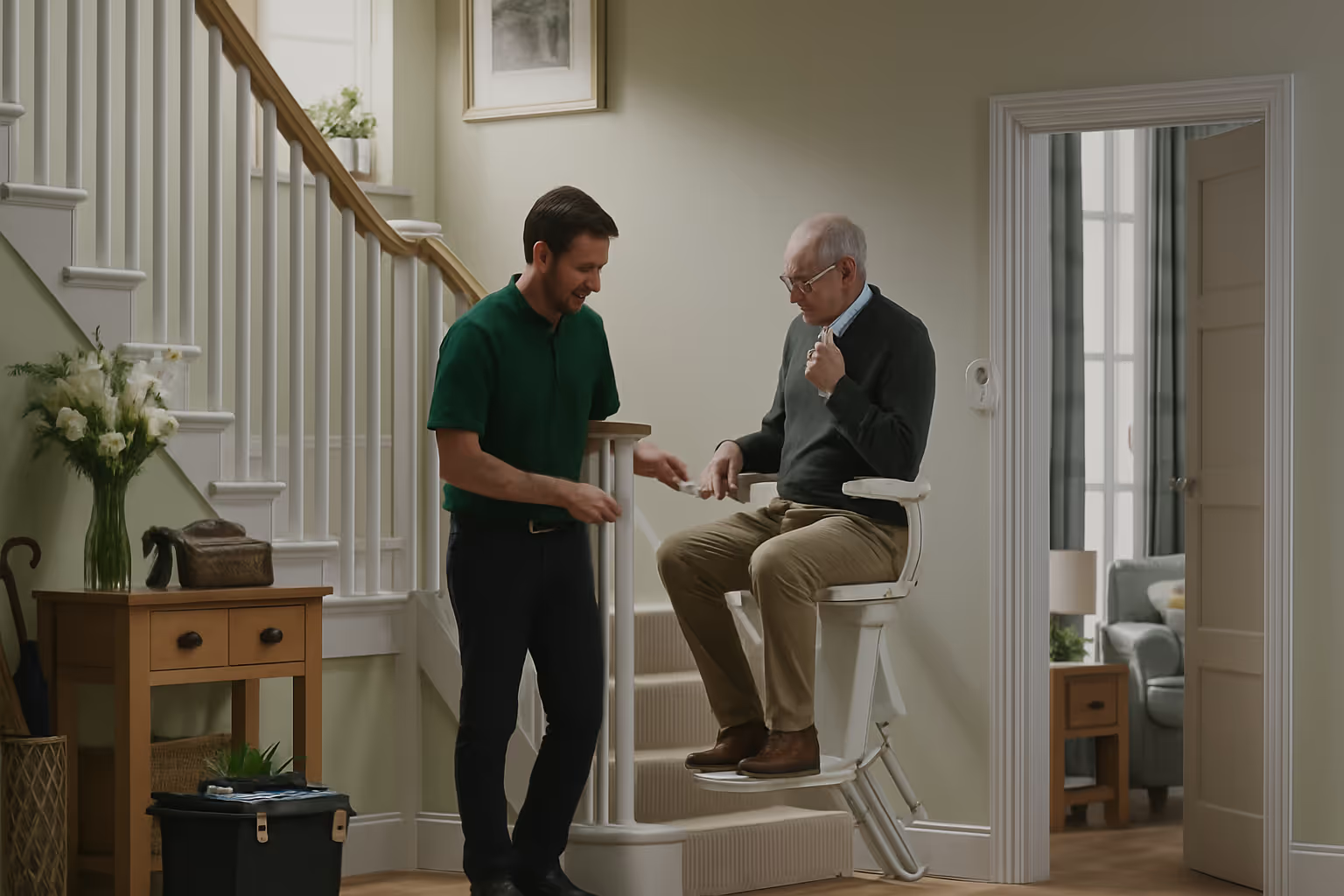
If you or a family member needs a stair lift, one of the first questions you are likely to ask is: does Medicare cover stair lifts? It is a completely reasonable question — Medicare covers a wide range of medical equipment and home health services, so it seems logical that it would also cover a device designed to help someone safely navigate their own home.
The short answer is no — standard Medicare does not cover stair lifts. But that is not the end of the story. There are several other programs, benefits, and funding options available to New Jersey residents that can significantly offset the cost of a stair lift — and in some cases cover it entirely.
This guide explains exactly why Medicare does not cover stair lifts, what programs do offer coverage or assistance, and how to find out what you specifically qualify for.
Why Medicare Does Not Cover Stair Lifts
To understand why Medicare excludes stair lifts, you need to understand how Medicare classifies medical equipment. Medicare Part B covers what it calls Durable Medical Equipment (DME) — items that are medically necessary, prescribed by a doctor, used in the home, and expected to last at least three years. Examples of covered DME include wheelchairs, walkers, hospital beds, and oxygen equipment.
Stair lifts do not meet Medicare's DME criteria because they are classified as home modifications rather than medical devices. In Medicare's framework, a stair lift is a structural improvement to the home — similar to a ramp or a wider doorway — rather than a piece of medical equipment that is used directly for treatment or therapy.
This classification applies regardless of whether a physician has recommended the stair lift, and regardless of how medically necessary the lift may be for the individual's safety. The classification is based on the category of the item, not the clinical context of its use.
A stair lift can be the difference between someone living safely at home and being admitted to a facility — yet Medicare's outdated classification system treats it as a home improvement rather than a medical necessity.
Does Medicare Part A Cover Stair Lifts?
Medicare Part A covers hospital care, skilled nursing facility care, hospice, and some home health services. It does not cover stair lifts under any circumstance. There is no clinical scenario in which Part A would pay for a stair lift purchase or installation.
Does Medicare Part B Cover Stair Lifts?
Medicare Part B covers outpatient medical services and durable medical equipment. As explained above, stair lifts are not classified as DME, so Part B does not cover them — even with a physician's prescription or letter of medical necessity.
Common misconception: Many people believe that if their doctor writes a prescription or letter of medical necessity for a stair lift, Medicare will cover it. This is not correct. The DME classification is what determines coverage — not the physician's recommendation. A letter of medical necessity is valuable for other funding programs but does not change Medicare's position.
What About Medicare Advantage (Part C)?
Medicare Advantage plans are offered by private insurance companies approved by Medicare. Unlike standard Medicare, Advantage plans can include benefits beyond Parts A and B — and this is where stair lift coverage becomes possible.
Since 2019, Medicare Advantage plans have been permitted to offer Special Supplemental Benefits for the Chronically Ill (SSBCI), which can include home modification benefits. Some plans use this provision to cover grab bars, ramps, stair lifts, and other accessibility modifications for eligible members.
However, coverage is not guaranteed and varies significantly between plans. Key things to know:
- Not all Medicare Advantage plans offer home modification benefits — you must check your specific plan
- Plans that do offer this benefit typically require the member to have a qualifying chronic condition
- Coverage amounts vary — some plans offer $500, others $2,000 or more toward home modifications
- Pre-authorization is almost always required before purchasing or installing a stair lift
- You may need to use a plan-approved vendor rather than choosing your own provider
How to check your Medicare Advantage plan: Call the member services number on the back of your Medicare Advantage card. Ask specifically: "Does my plan include a home modification benefit or supplemental benefit for home accessibility equipment?" Get the answer in writing before making any purchase.
Does Medicaid Cover Stair Lifts in New Jersey?
New Jersey's Medicaid program offers more flexibility than standard Medicare when it comes to home modifications. The key program to know about is Medicaid Managed Long Term Services and Supports (MLTSS).
NJ Medicaid MLTSS
The MLTSS program is designed to help individuals who need long-term services and supports remain safely in their homes rather than entering nursing facilities. Home modifications — including stair lifts — can be covered when they are deemed necessary to support the person's ability to remain at home safely.
To qualify for stair lift coverage through MLTSS:
- You must be enrolled in NJ Medicaid and the MLTSS program
- A healthcare provider must document that the stair lift is medically necessary for you to remain safely at home
- The modification must be approved by your MLTSS managed care organization before purchase
- You must use a Medicaid-approved vendor in most cases
Contact your MLTSS managed care organization directly, or call NJ FamilyCare at 1-800-701-0710 to find out if you qualify and how to initiate a home modification request.
VA Benefits: The Most Comprehensive Coverage Available
For veterans, the VA offers the most generous stair lift funding available — in some cases covering the full cost of installation. There are three primary VA programs to be aware of:
| VA Program | Maximum Benefit | Who Qualifies |
|---|---|---|
| HISA Grant (service-connected) | $6,800 lifetime | Veterans with service-connected disability |
| HISA Grant (non-service-connected) | $2,000 lifetime | Veterans receiving VA care for any condition |
| Specially Adapted Housing (SAH) | Up to $109,986 | Veterans with severe service-connected disability affecting mobility |
| Special Housing Adaptation (SHA) | Up to $22,036 | Veterans with specific service-connected conditions |
How to Apply for the HISA Grant
The Home Improvement and Structural Alterations (HISA) grant is the most commonly used VA benefit for stair lift installation. Here is the application process:
- Obtain a prescription or letter of medical necessity from your VA physician or treating provider
- Get a written quote from a licensed contractor or stair lift provider (Everhome Mobility can provide this)
- Submit VA Form 10-0103 to your local VA medical center's prosthetics or rehabilitation department
- Await approval — processing typically takes 2–8 weeks
- Once approved, schedule installation and submit receipts for reimbursement or direct payment depending on your VA facility's process
Everhome Mobility has experience working with veterans through the HISA process and can provide all required documentation, quotes, and invoices in the format your VA facility requires.
NJ State and Local Programs
NJ Division of Disability Services
The New Jersey Division of Disability Services administers several programs that can fund home modifications for eligible individuals with disabilities. The Community Care Program and Personal Assistance Services Program (PASP) may include home modification funding depending on current budget allocations and individual eligibility.
Area Agency on Aging Grants
Each New Jersey county has an Area Agency on Aging (AAA) that administers federal and state funds for senior services — including home modification grants. These programs are typically income-based and prioritize seniors at risk of institutionalization. Contact your county's AAA directly to find out what is currently available:
- Bergen County: our team
- Essex County: our team
- Passaic County: our team
- Hudson County: our team
- Morris County: our team
USDA Rural Development Grants
For homeowners in rural areas of New Jersey, the USDA Section 504 Home Repair Program offers grants of up to $10,000 for elderly, low-income homeowners to remove health and safety hazards — which can include stair lift installation. Contact the USDA Rural Development office in New Jersey at our team to inquire about eligibility.
Financing: Making a Stair Lift Affordable Without Grants
If you do not qualify for grant programs or are waiting for approval, financing is a practical way to get a stair lift installed now and pay over time. Everhome Mobility works with Hearth financing, which offers:
- Monthly payment plans from 12 to 60 months
- Rates starting as low as 0% for qualifying applicants
- Fast approval — typically within minutes
- No prepayment penalty
- Loan amounts covering the full cost of installation
A $4,000 straight stair lift financed over 24 months, for example, works out to approximately $167/month — a manageable amount for most households when weighed against the alternative of assisted living costs.
Tax Deductions for Stair Lifts
Even without insurance coverage, a stair lift installation may qualify as a deductible medical expense on your federal tax return. The IRS allows deductions for medical expenses that exceed 7.5% of your adjusted gross income — and home modifications made for medical reasons can qualify.
To claim a stair lift as a medical expense deduction:
- The modification must be made primarily for medical reasons, not to increase home value
- A physician's letter of medical necessity strengthens the deduction
- The deductible amount may be reduced by any increase in home value the modification adds
- Consult a qualified tax professional before claiming — rules can be complex
Complete Funding Summary for NJ Residents
| Program | Who It's For | Max Benefit | How to Apply |
|---|---|---|---|
| Medicare Parts A & B | Medicare enrollees | $0 — not covered | N/A |
| Medicare Advantage (Part C) | MA plan members with home mod benefit | Varies by plan | Call your plan's member services |
| NJ Medicaid MLTSS | NJ Medicaid enrollees | Varies | Contact your MCO or call 1-800-701-0710 |
| VA HISA Grant | Veterans (service or non-service connected) | Up to $6,800 | VA Form 10-0103 via your VA medical center |
| County AAA Grants | Low-income NJ seniors | Varies by county | Contact your county's Area Agency on Aging |
| USDA Rural Grant | Rural, low-income NJ homeowners 62+ | Up to $10,000 | NJ USDA Rural Development office |
| Hearth Financing | Any homeowner | Full cost financed | Apply through Everhome Mobility |
| Tax deduction (IRS) | Any taxpayer with qualifying medical expenses | Varies | Consult a tax professional |
Not sure which programs you qualify for? Our team can help you identify the right funding options during your free in-home assessment — no charge, no obligation.
Talk to Our Team Today →Frequently Asked Questions
Will a doctor's prescription make Medicare cover a stair lift?
No. A physician's prescription or letter of medical necessity does not change Medicare's coverage decision for stair lifts. The classification of stair lifts as home modifications — rather than durable medical equipment — is what determines Medicare's position, and that classification does not change based on clinical documentation. However, a letter of medical necessity is valuable for Medicaid, VA, and tax deduction purposes.
Does Medicare cover grab bars or wheelchair ramps?
Standard Medicare Parts A and B do not cover grab bars, wheelchair ramps, or other home modifications for the same reason they do not cover stair lifts — these are classified as home modifications rather than durable medical equipment. Some Medicare Advantage plans may cover these items through supplemental home modification benefits.
How do I find out if my Medicare Advantage plan covers stair lifts?
Call the member services number on the back of your Medicare Advantage card. Ask specifically about home modification benefits or Special Supplemental Benefits for the Chronically Ill. Request a written confirmation of any coverage details before making a purchase or scheduling installation.
Can I apply for the VA HISA grant and Medicaid at the same time?
Yes — these are separate programs and you can apply for both simultaneously if you qualify for each. However, the total funding received typically cannot exceed the actual cost of the modification. If both programs approve coverage, they will coordinate benefits so that the combined payment does not result in overpayment.
How long does the VA HISA grant approval take?
Processing time varies by VA facility and current application volume. Most applicants receive a decision within 2–8 weeks of submitting a complete application with all required documentation. If the situation is urgent, you can request expedited review through your VA social worker or case manager.
Is a stair lift tax deductible?
Potentially yes — if the installation qualifies as a medical expense under IRS rules and your total qualifying medical expenses exceed 7.5% of your adjusted gross income. The rules are complex and depend on your specific financial situation. Consult a qualified tax professional before claiming this deduction.