
Home accessibility modifications are a significant investment — in money, in time, and in the trust that the changes made will actually make things safer. When they go wrong, the consequences can range from wasted money to — in the worst cases — a modification that creates a false sense of security while the underlying risk remains.
Having assessed and modified hundreds of NJ homes across Bergen, Essex, Passaic, and Hudson County, our team has seen the same mistakes made repeatedly — by well-meaning families, by unqualified installers, and sometimes by homeowners who meant to do the job properly but made assumptions that turned out to be wrong.
This guide covers the most common and most consequential home accessibility planning mistakes — what they are, why they happen, and specifically how to avoid them.
Mistake 1: Using Suction Cup or Non-Anchored Grab Bars
❌ The Mistake
Purchasing and installing suction cup grab bars, tension-mounted bars, or bars anchored only into drywall rather than into wall studs or with proper toggle anchors. These look identical to properly installed grab bars but will fail under load — often catastrophically and without warning.
✅ The Fix
All grab bars must be anchored into wall studs or using specialist toggle anchors rated for the load. After installation, every bar should be load-tested — gripped firmly and force applied in all directions. A properly installed bar feels completely solid. Any movement means the installation is unsafe. Always use a qualified installer for grab bar installation; this is not a DIY job where the consequences of error are trivial.
Mistake 2: Skipping the Professional Assessment and Going Straight to Products
❌ The Mistake
Ordering a stair lift, wheelchair ramp, or grab bar package online based on general research without having the specific home assessed by a qualified professional. The result is frequently the wrong product, installed in the wrong location, or a solution that does not actually fit the staircase, entrance, or bathroom it was purchased for.
✅ The Fix
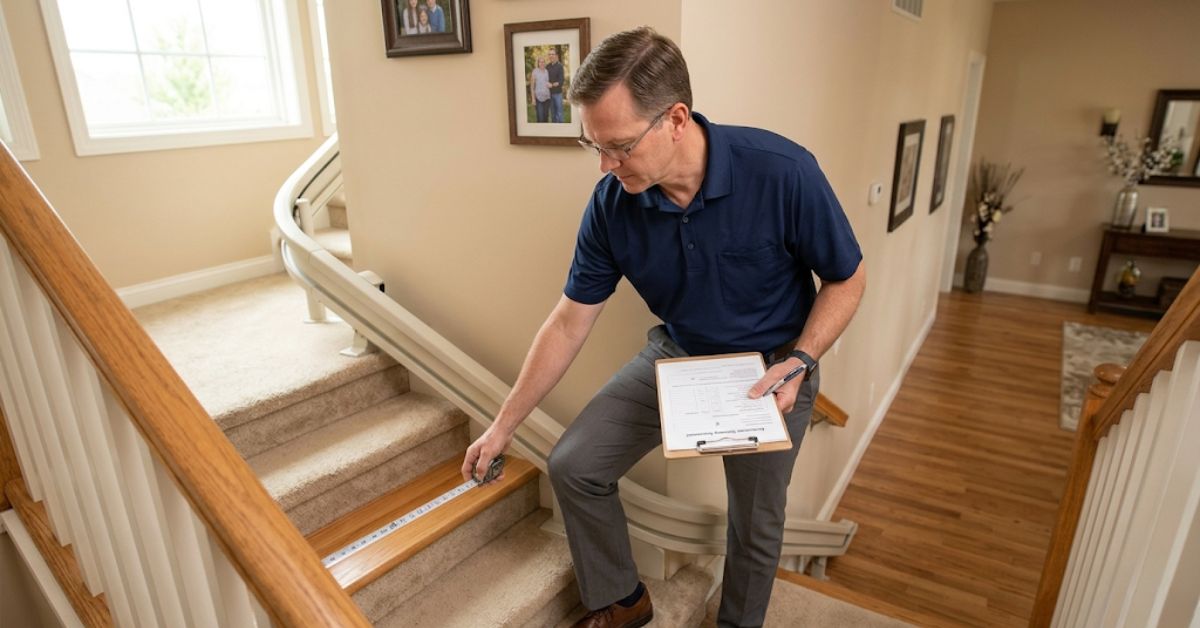
Always start with a free in-home assessment from a CAPS-certified (Certified Aging-in-Place Specialist) provider before purchasing any major modification. The assessment identifies the right solutions for the specific person, in the specific home, based on actual measurements and observed mobility needs — not assumptions. Reputable providers offer this assessment at no charge and with no obligation.
A stair lift purchased online based on standard measurements is almost guaranteed to require costly adjustments or returns. NJ homes — particularly older properties in Bergen, Essex, and Passaic County — have enough variation in staircase width, angle, and configuration that every installation needs to be assessed individually.
Mistake 3: Prioritising Aesthetics Over Function
❌ The Mistake
Choosing a grab bar finish, ramp material, or stair lift model primarily based on appearance rather than functional suitability for the person using it. A decorative grab bar that is the wrong diameter for easy gripping, or a ramp material chosen for visual appeal but inadequate for wet-weather traction, fails the fundamental purpose of the modification.
✅ The Fix
Function first, aesthetics second. The good news is that modern accessibility products are available in a range of finishes and styles that are both functional and attractive. A CAPS assessor can recommend products that meet functional requirements while accommodating aesthetic preferences — but the functional requirements set the floor that aesthetic choices must meet, not the other way around.
Mistake 4: Treating Modifications as a One-Time Event
❌ The Mistake
Making a set of modifications based on current needs and then considering the job done — without planning for how needs will change over the next 5–10 years. A stair lift installed for someone with mild difficulty on stairs today may need to accommodate a walker or wheelchair in a few years. A bathroom modified for ambulatory use may need to be reconfigured for wheelchair transfers later.
✅ The Fix
Plan modifications with the next 5–10 years in mind, not just current needs. Ask your CAPS assessor specifically about future-proofing — which modifications can be made now that will also serve anticipated future needs, and which current modifications might need to be changed later. This forward planning often changes which solutions are the right investment today.
Mistake 5: DIY Installation of Safety-Critical Equipment
❌ The Mistake
Attempting to install a stair lift rail, wheelchair ramp structure, or bathroom grab bars without professional installation. This is one of the most dangerous accessibility mistakes — not because the equipment itself is complicated, but because the consequences of an installation error are a person falling from height, a grab bar failing during a transfer, or a ramp collapsing under load.
✅ The Fix
Safety-critical accessibility equipment must be professionally installed by a qualified team — not a general handyman, not a family member with DIY skills, and not following a YouTube tutorial. This applies specifically to stair lifts (rail alignment and electrical connections), wheelchair ramps (structural load capacity and slope), and grab bars (anchoring and load testing). The cost of professional installation is a small fraction of the liability of an installation failure.
Mistake 6: Choosing the Cheapest Option Without Considering Total Cost
❌ The Mistake
Selecting the lowest-priced stair lift, ramp, or bathroom modification without considering the total cost over time — including maintenance, repair, and earlier-than-expected replacement. A budget stair lift that requires servicing every year and fails after 5 years costs significantly more over a decade than a quality unit that runs reliably for 15 years with minimal maintenance.
✅ The Fix
Evaluate total cost of ownership, not just purchase price. For stair lifts, ask about the manufacturer's warranty, parts availability, expected service interval, and the installer's labor warranty. For ramps, compare the 10-year cost of a wood ramp (with annual maintenance and likely replacement at 8–10 years) against a modular aluminum system (minimal maintenance, 20+ year lifespan). See our comparison: Aluminum vs Wood Wheelchair Ramps.
Mistake 7: Ignoring NJ Permit Requirements for Permanent Structures
❌ The Mistake
Installing a permanent wood ramp or other structural modification without obtaining the required building permit from the local NJ municipality. Unpermitted structural work can create complications when selling the home, may not be covered by homeowner's insurance in case of an incident, and may have to be removed or modified at the homeowner's expense if discovered.
✅ The Fix
Understand the permit requirements before any structural work begins. In most NJ municipalities, modular aluminum ramps are classified as temporary structures and do not require a permit. Wood ramps and permanent structural modifications typically do require a permit. A qualified local installer knows the requirements for your specific municipality and handles the permit process as part of the installation. See our guide: Wheelchair Ramp Installation in NJ.
Mistake 8: Not Applying for Available Funding Before Installation
❌ The Mistake
Paying out of pocket for modifications before checking eligibility for VA HISA grants, NJ Medicaid MLTSS, Medicare Advantage home modification benefits, or county Area Agency on Aging grants. Most of these programs require pre-authorization before work begins — retroactive reimbursement is typically not available.
✅ The Fix
Check all funding options before scheduling any work. For veterans, contact the VA medical center's prosthetics or rehabilitation department first. For Medicaid recipients, contact NJ FamilyCare before installation. For Medicare Advantage, call the plan's member services line and ask about home modification benefits. For income-qualified seniors, contact the county Area Agency on Aging. A CAPS-certified provider can help navigate all available options. See: Medicaid & Home Modification Grants for Accessibility in NJ.
Mistake 9: Installing Modifications in the Wrong Location
❌ The Mistake
Installing grab bars, handrails, or other modifications in positions that seem logical but do not match the person's actual movement patterns, dominant hand, or specific mobility limitations. A grab bar installed on the wrong side of the toilet, or at the wrong height for the person's reach, provides little useful support and may even interfere with safe movement.
✅ The Fix
Grab bar placement must be assessed based on the specific person's mobility, reach, and dominant hand — not based on a diagram in a brochure or a standard template. Have a qualified assessor observe the person performing the movements in the actual bathroom, identify exactly where they need support and at what height, and specify placement accordingly. See: Grab Bars for Bathroom Safety: Placement, Types & Benefits.
Mistake 10: Waiting for a Crisis to Force the Decision
❌ The Mistake
Delaying modifications until a fall, hospitalisation, or other crisis forces the decision. Reactive modifications made under time pressure — during a hospital discharge, immediately after a fall — are more expensive, more stressful, and more likely to result in a poor choice. Funding applications cannot be completed in time, comparisons cannot be made properly, and the person returning home may be waiting in a modified-but-not-yet-safe environment.
✅ The Fix
Plan proactively. The right time to begin assessing and modifying a home is when the first signals of changing mobility appear — not when a crisis removes the options. A free CAPS assessment can be scheduled within a week, and for most modifications, planned installation takes far less time than emergency installation under discharge pressure. See: How to Know When Your Home Needs Accessibility Upgrades.
The single most effective way to avoid all of these mistakes is to start with a free CAPS in-home assessment from a qualified NJ provider before making any purchasing or installation decisions. A CAPS assessment identifies the right solutions, in the right locations, for the specific person and home — and a reputable provider will help you navigate funding and avoid every pitfall on this list.
Avoid costly mistakes with a free CAPS-certified in-home assessment — we identify the right modifications for your specific home, in the right locations, at the right time. No cost, no obligation, same-week availability.
Talk to a Local Accessibility Expert →Frequently Asked Questions
What is the most dangerous home accessibility mistake?
Installing non-anchored or suction cup grab bars is the most immediately dangerous mistake — because the bar appears to provide support right up until the moment it fails under load. A person gripping a suction cup bar during a bathroom transfer may fall harder than if no bar were there at all, because they were relying on support that was not there. All grab bars must be professionally anchored and load-tested after installation.
Can I install grab bars myself?
Not recommended for safety-critical locations. Proper grab bar installation requires locating wall studs or using specialist anchors rated for human body weight loads, installing at the correct height and angle for the specific user, and load-testing after installation. A professional installation typically costs $150–$400 per bar — a small cost relative to the consequences of an installation failure.
What happens if I install a ramp without a permit in NJ?
For modular aluminum ramps — classified as temporary structures in most NJ municipalities — no permit is typically required. For permanent wood ramps, installing without a permit can create complications when selling the home, may affect insurance coverage in case of an incident, and the structure may have to be modified or removed at the homeowner's expense. Always check with your specific municipality before installing any permanent structure.
How do I know if a home accessibility provider is qualified?
Look for CAPS (Certified Aging-in-Place Specialist) certification, which confirms specific training in home modification assessment. Check that the provider uses their own trained installation team — not subcontractors. Ask for a written all-inclusive quote before any work begins. Verify that a labor warranty backs the installation work. Ask about their experience with NJ homes specifically — older NJ housing stock presents specific challenges that inexperienced providers may not be equipped to address.