
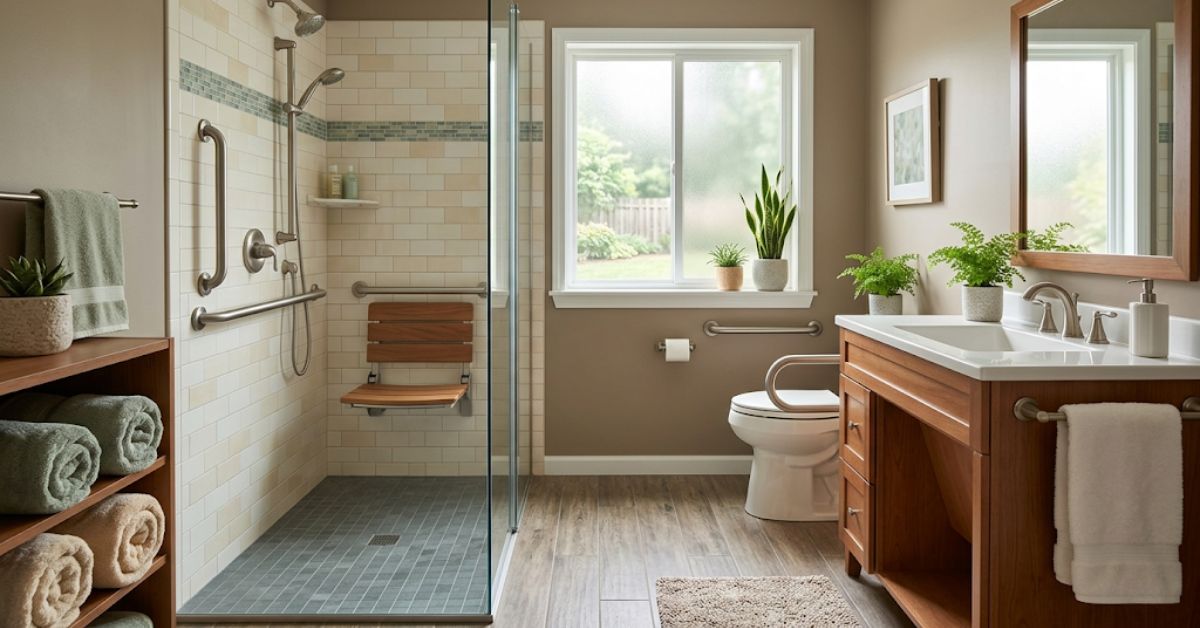
Bathrooms are the highest-risk area in almost any senior's home — the combination of wet surfaces, hard fixtures, height transitions, and required balance transfers makes bathrooms the site of more home falls than any other room. So when a family looks at installing grab bars, a walk-in shower, a tub cut-out, or a comfort-height toilet for a senior or disabled family member, the natural question is whether Medicaid will help pay for it. The answer for NJ Medicaid enrollees is often yes — with some important qualifications about which program covers what.
This guide explains exactly what bathroom modifications NJ Medicaid covers, which program provides the coverage, how to apply, and how much documentation is needed. It also covers what Medicaid will not cover — the aesthetic upgrades and luxury fixtures that families often assume will be included but rarely are.
The Direct Answer
Yes — NJ Medicaid can cover bathroom modifications for eligible enrollees, but only through the MLTSS (Managed Long-Term Services and Supports) program, not through standard NJ FamilyCare. Coverage includes grab bar installation, walk-in shower conversions, tub cut-outs, comfort-height toilets, non-slip flooring, and other safety-focused modifications. Pre-authorisation is required before installation.
The distinction matters. Standard NJ Medicaid (NJ FamilyCare) does not include home modification benefits at all — a common source of confusion when families call and hear "no." MLTSS is a specific HCBS waiver program within NJ Medicaid that provides long-term services and supports including bathroom modifications. If you are new to how MLTSS works, our companion posts cover the details: Which NJ Medicaid Plans Cover Stairlifts and How to Apply for a NJ Medicaid HCBS Waiver for Home Modifications.
What Bathroom Modifications NJ Medicaid Covers
Under the MLTSS program, NJ Medicaid covers a wide range of bathroom safety modifications when they are medically necessary and included in the enrollee's approved care plan. Coverage typically includes:
Grab Bar Installation
Professional installation of stainless steel or coated grab bars in the shower, next to the tub, near the toilet, and along walkways. Installation includes proper anchoring to wall studs — not simply screwing into drywall, which can fail dangerously under load.
Walk-In Shower Conversions
Full conversion of an existing tub or step-in shower into a barrier-free walk-in shower with low or no threshold, built-in seating, and integrated grab bars. This is one of the most transformative bathroom safety modifications and typically the largest single covered project.
Tub Cut-Out Conversions
Cutting a low step-through opening in an existing tub wall to eliminate the tub-wall step-over. A middle-ground option between grab bars and full walk-in shower conversion — faster and less expensive to install.
Comfort-Height Toilets & Raised Toilet Seats
Comfort-height toilets (17–19 inches tall vs standard 15) or raised toilet seat attachments added to existing standard toilets. Both reduce the strength required to sit and stand.
Non-Slip Flooring
Replacing slippery bathroom flooring with non-slip alternatives — textured vinyl, non-slip tile, or specialised bathroom-safe surfaces. Reduces the highest-risk fall factor in the bathroom.
Shower Chairs, Transfer Benches, & Fold-Down Seats
Portable shower chairs, transfer benches that extend outside the tub, and wall-mounted fold-down seats. Some are classified as durable medical equipment (DME) rather than home modifications — potentially covered under a different benefit.
Handheld Shower Wands & Adjustable Shower Fixtures
Handheld shower wands mounted at appropriate heights, adjustable shower arms, and thermostatic mixing valves (that prevent scalding). Often included as part of a walk-in shower conversion but sometimes require separate justification.
Doorway Widening for Bathroom Access
Widening the bathroom door from standard (28–30 inches) to wheelchair-accessible (32–36 inches). Requires structural work and is evaluated as part of overall care planning.
What Medicaid Does NOT Cover
Understanding what is not covered is equally important. The MLTSS home modification benefit is focused on safety and medical necessity — not aesthetic improvement or luxury upgrades. Common items that are typically not covered:
- Luxury or premium fixtures: High-end tile, designer faucets, decorative hardware. Standard, functional equivalents are covered — but the enrollee cannot upgrade to premium specs at Medicaid's expense
- Purely cosmetic renovations: Updating a bathroom's appearance without addressing accessibility needs
- Whirlpool tubs and spa features: These are considered luxury features rather than accessibility improvements, even in a bathroom modification context
- Walk-in tubs with therapeutic jets: Sometimes covered when medically justified, but the therapeutic features often push these beyond standard MLTSS coverage
- Vanity or countertop replacements: Unless directly required for wheelchair accessibility
- Bathroom expansions: Structural work to enlarge the bathroom — occasionally approved but requires substantial clinical justification
- Bathroom modifications in properties the enrollee does not primarily reside in: The benefit is for the enrollee's primary residence
- Ongoing maintenance and repair: Installation is covered; maintenance of the equipment over time is generally not
- Retroactive coverage: Work started or completed before pre-authorisation cannot be reimbursed
The core principle: NJ Medicaid MLTSS covers what a person needs to bathe and use the bathroom safely — not what makes the bathroom nicer. A grab bar in stainless steel is covered; a designer grab bar with a rainforest finish is not. A walk-in shower with standard tile is covered; the same shower with marble is not. Focus on function during the care planning conversation.
Cost Comparison: With and Without Medicaid
The financial impact of MLTSS coverage on bathroom modifications is substantial. For families who qualify, modifications that would otherwise be paid privately become free or near-free.
| Modification | Private-Pay NJ Cost | MLTSS-Covered Cost |
|---|---|---|
| Grab bar package (3–5 bars, installed) | $450 – $1,500 | $0 (fully covered) |
| Comfort-height toilet installation | $400 – $800 | $0 (fully covered) |
| Tub cut-out conversion | $1,500 – $4,000 | $0 (fully covered) |
| Walk-in shower conversion (standard) | $3,000 – $8,000 | $0 (fully covered) |
| Walk-in shower conversion (premium tile) | $8,000 – $12,000 | Standard version covered; upgrade cost paid privately |
| Non-slip flooring (bathroom) | $800 – $2,500 | $0 (fully covered) |
| Doorway widening for wheelchair access | $500 – $2,500 | $0 when wheelchair access is documented |
| Walk-in tub with therapeutic features | $5,000 – $15,000 | Typically not covered — private pay |
For most eligible NJ families, a comprehensive bathroom safety package worth $5,000–$10,000 privately becomes fully funded through MLTSS with no out-of-pocket cost.
Who Qualifies for NJ Medicaid Bathroom Modification Coverage?
Bathroom modification coverage follows the standard NJ MLTSS eligibility criteria. To qualify, the person must:
1. Be Enrolled in NJ Medicaid (NJ FamilyCare)
- Individual monthly income at or below approximately $2,901 (300% of the federal SSI benefit rate)
- Assets at or below $2,000 for an individual (with primary residence, one vehicle, and personal possessions typically exempt)
- Spousal impoverishment protections apply for married couples where one spouse needs services
2. Be Enrolled in MLTSS Specifically
Standard NJ FamilyCare enrollment is necessary but not sufficient. The person must be assessed as eligible for MLTSS through the state's clinical evaluation process. Clinical eligibility typically requires needing assistance with at least three Activities of Daily Living (ADLs) — bathing, dressing, toileting, transferring, eating, or continence — many of which are directly bathroom-related.
3. Have the Modifications Included in an Approved Care Plan
The MCO care manager builds the enrollee's care plan and identifies which modifications are needed. Bathroom modifications must be included in this plan and pre-authorised before installation.
The bathroom advantage: Bathroom modifications are among the easier home modifications to get approved under MLTSS because the clinical justification is often already established. Someone eligible for MLTSS typically needs help with bathing or toileting — both directly addressed by bathroom modifications. Care managers frequently include these modifications proactively in the initial care plan.
The Bathroom Modification Approval Process
Care manager identifies bathroom needs
During the initial in-home care planning visit, the MCO care manager evaluates the bathroom for safety and identifies specific modifications that would support the enrollee's independence. The enrollee or family can also request specific modifications during this visit.
Physician documents medical necessity
The enrollee's physician writes documentation connecting a specific clinical condition to the specific modifications needed. Effective language: "Patient with severe osteoarthritis and balance impairment requires grab bar installation and tub cut-out conversion to safely bathe. Standard tub access presents significant fall risk." Vague language delays approval.
Qualified installer provides detailed quote
An installer contracted with the MCO's network provides a written quote specifying each modification, materials (make/model), labour, warranty, and total cost. Everhome Mobility contracts with all four NJ MLTSS MCOs — Aetna Better Health, Horizon NJ Health, UnitedHealthcare Community Plan, and Wellpoint — and provides quotes in each MCO's required format.
MCO submits pre-authorisation request
The care manager submits the complete package to the MCO's utilisation management team. Review typically takes 2–6 weeks depending on the MCO and the completeness of documentation. Nothing should be installed during this period.
Authorisation letter issued
The MCO issues a written authorisation specifying which modifications are approved, the maximum authorised amount, and any conditions. Installation cannot begin until this letter is in hand. Starting work before authorisation almost always results in the coverage being denied.
Installation completed and paid
The authorised installer completes the modifications, documents the work with photos, and submits final documentation to the MCO. The MCO pays the installer directly — the family typically has no out-of-pocket cost.
Combining Bathroom Modifications with Other Funding
For families whose bathroom needs exceed what MLTSS will cover — particularly those who want premium materials or additional non-medical upgrades — combining funding sources can spread the cost effectively:
MLTSS + Private Payment for Upgrades
The most common approach: MLTSS covers the standard functional modification, and the family pays privately for aesthetic or premium upgrades. For example, a walk-in shower conversion with standard tile is fully covered; the family may add $2,000 privately to upgrade to premium tile.
MLTSS + VA HISA Grants (Veterans)
Veterans enrolled in both VA healthcare and NJ Medicaid can combine funding sources. HISA typically covers up to $6,800 (service-connected) or $2,000 (non-service-connected) toward the modification, with MLTSS filling remaining gaps. See: VA Grants for Stairlifts & Ramps.
MLTSS + Medicare Advantage Supplemental Benefits
Dual-eligible enrollees (both Medicare and Medicaid) with Medicare Advantage plans may have supplemental home modification benefits ($500–$2,500) that can be combined with MLTSS. Coordination happens through the MCO's care management team. See: Medicare Advantage Home Modification Benefits.
MLTSS + County AAA Grants
For lower-income seniors 60+, county Area Agency on Aging programs can supplement MLTSS coverage — particularly useful for premium upgrades not covered by MLTSS alone.
Common Reasons Bathroom Modification Requests Get Denied
Most denials trace back to correctable documentation issues:
- Physician documentation too generic: "Bathroom safety improvements" is insufficient. The prescription must specify the clinical condition, the specific safety concern, and the specific modification. Ask the physician for precise language upfront
- Installation started before authorisation: The single most common denial reason. Wait for the written authorisation letter regardless of family pressure or discharge timelines
- Provider not in the MCO's network: Verify the installer's network status with your specific MCO before starting the process
- Requested modifications exceed standard specifications: Requests for premium tile, luxury fixtures, or spa-style features are commonly returned for revision. Focus the initial request on standard specifications and add upgrades privately if desired
- Modifications not clearly connected to community living: MLTSS covers modifications that keep the person in the community. Documentation must make this connection explicit — "bathroom modifications will allow patient to safely remain in her home rather than move to assisted living"
- Enrollee is on standard Medicaid but not MLTSS: Basic Medicaid does not cover home modifications. Confirm MLTSS enrollment before proceeding
Everhome Mobility works with NJ MLTSS bathroom modification requests regularly. We provide physician-ready documentation, quotes in each MCO's required format, and coordination throughout the pre-authorisation process — all as part of your free in-home assessment.
Request a Free Bathroom Assessment →Frequently Asked Questions
Does NJ Medicaid pay for grab bars and shower modifications?
Yes, when the enrollee is in the MLTSS (Managed Long-Term Services and Supports) program and the modifications are included in an approved care plan. Grab bar installation, walk-in shower conversions, tub cut-outs, comfort-height toilets, and non-slip flooring are all typically fully covered with no out-of-pocket cost to eligible families.
Will Medicaid pay for a walk-in shower conversion?
Yes, for MLTSS-enrolled NJ residents with appropriate clinical documentation. Standard walk-in shower conversions (functional design, standard tile, integrated grab bars, low or no threshold) are typically fully covered. Premium upgrades — luxury tile, high-end fixtures, spa features — are generally not covered and would need to be paid privately.
Does Medicaid cover walk-in tubs with jets?
Walk-in tubs are treated differently from walk-in showers. Standard walk-in tubs (basic access-focused design) are sometimes covered when medically justified. Walk-in tubs with therapeutic jets, hydrotherapy features, or premium finishes are typically classified as luxury items and not covered. For most seniors, a walk-in shower conversion provides better accessibility at lower cost than a walk-in tub.
Which NJ Medicaid plans cover bathroom modifications?
All four NJ MLTSS-contracted managed care organisations (MCOs) — Aetna Better Health of New Jersey, Horizon NJ Health, UnitedHealthcare Community Plan of New Jersey, and Wellpoint New Jersey — cover bathroom modifications for eligible MLTSS enrollees. Coverage rules and processes are set by state contract, so core benefits are consistent across the four MCOs. Details in our companion post: Which NJ Medicaid Plans Cover Stairlifts.
How long does Medicaid bathroom modification approval take?
For enrollees already in MLTSS with a good care management relationship, approval typically takes 2–6 weeks from physician documentation to authorisation letter. For someone not yet in MLTSS, add 4–8 weeks for the MLTSS assessment. For someone not yet in Medicaid, the total timeline is typically 4–7 months from initial application to installation.
Can I choose my own bathroom contractor for a Medicaid-covered modification?
The contractor must be in your specific MCO's provider network. Everhome Mobility contracts with all four NJ MLTSS MCOs, allowing eligible enrollees to work with us regardless of which MCO they are assigned to. If your preferred contractor is not in-network, either a different in-network contractor must be chosen or the process becomes significantly more complex.