
For the millions of older adults living in two-story and split-level homes across New Jersey, the staircase is the single most significant daily safety challenge in the home. It is also one of the most manageable — with the right combination of environmental improvements, behavioural habits, and equipment when needed.
This guide covers practical, evidence-based stair safety for seniors: what makes stairs dangerous, what can be improved immediately, what requires professional attention, and when a stair lift becomes the right answer rather than a last resort.
Why Stairs Are the Highest Fall-Risk Location for Older Adults
Descending a staircase requires a specific combination of physical abilities that decline with age — lower body strength to control the descent, balance to manage the forward weight shift, visual acuity to judge step edges accurately, and reaction time to recover if a foot slips or catches. When any of these abilities is reduced, the staircase becomes genuinely hazardous.
The descent is significantly more dangerous than the ascent. Going down requires controlled deceleration of the body's weight against gravity — a movement that demands more strength, more balance, and more concentration than going up. Most serious stair falls occur on the way down, often in the first few steps where the shift of body weight over the staircase edge is greatest.
In New Jersey, where the housing stock is predominantly older — much of it built between 1920 and 1970 — staircases are often narrower, steeper, and less well-equipped with safety features than modern construction standards would require. Many have handrails on only one side, carpet that has worn smooth on the tread edges, and inadequate lighting at one or both ends.
Immediate Improvements: What You Can Do This Week
1. Install or Upgrade Handrails on Both Sides
This is the single highest-impact stair safety improvement available — and one of the most commonly missing in older NJ homes. A handrail on both sides of the staircase provides bilateral support, allowing a person to maintain contact with a secure surface throughout the entire descent without having to switch hands or release their grip at any point.
Requirements for effective handrails:
- Both sides: A single-sided rail forces the user to cross to one side to grip it on both ascent and descent — eliminating the bilateral support that makes rails effective
- Full length: Rails must run the entire length of the staircase from the bottom step to the top landing — not just the middle section
- Correct height: 34–38 inches above the stair nosing — too low or too high reduces effective grip and leverage
- Correct diameter: 1.25–2 inches — graspable with a full hand, not so wide that it cannot be gripped securely
- Secure mounting: Rails must be anchored into studs or with appropriate hardware — any wobble under load means the rail is not providing the support it appears to offer
Test your handrail now: Grip the rail firmly and apply sideways pressure. Any movement or wobble means the anchoring is insufficient and the rail will not hold under the load of a person catching a fall. A properly mounted rail should feel completely solid under significant pressure.
2. Add Non-Slip Treads or Strips
Stair treads — particularly carpeted ones that have worn smooth at the edge, or hardwood treads without any texture — are a significant slip hazard. Non-slip options include:
- Non-slip adhesive strips: Applied to the front edge (nosing) of each step — inexpensive, effective, and available in colours that complement the staircase
- Non-slip tread covers: Full tread covers in rubber or carpet that provide texture across the entire step surface
- Carpet runner replacement: If the existing carpet is worn, a new runner with proper padding and secure attachment at every tread edge restores traction significantly
- Anti-slip varnish or coating: For hardwood stairs, a specialist anti-slip coating applied over the existing surface provides traction without covering the wood
3. Improve Staircase Lighting
Poor lighting is one of the most consistently underestimated stair hazards. The ability to see step edges clearly affects the ability to place feet accurately — and depth perception declines with age, making clear visual contrast between step surfaces even more important.
- Light switches at both the top and bottom of every staircase — reaching across a dark staircase to find a switch is itself a fall risk
- Motion-activated lighting for nighttime use — when a person wakes and uses the stairs in low light, the staircase should illuminate automatically
- Step-level lighting — small LED lights mounted at the base of each riser, pointing across the tread surface, dramatically improve step edge visibility without requiring overhead lighting changes
- Contrasting nosing colour — a visually contrasting colour at the leading edge of each step helps with depth perception, particularly for older adults with vision changes
4. Remove All Staircase Hazards
Any object on a staircase — even temporarily placed — is a trip hazard. This includes items waiting to be carried up or down, shoes left on steps, pet toys, bags, and anything else that creates an obstacle in the foot path. Establish a firm household rule: nothing is stored on the stairs, ever. A small basket at the bottom of the stairs for items to be carried up is a practical alternative that keeps the staircase clear.
5. Assess Footwear
What a person wears on their feet significantly affects stair safety. Socks on a smooth staircase surface are extremely slippery. Loose slippers that do not fasten securely around the heel can catch on step edges. The best footwear for stair use is a shoe or slipper with a non-slip sole and secure heel support — it does not need to be a medical device, just a well-fitting, rubber-soled option that stays on the foot securely.
Staircase Assessment: What to Look For
| Feature | Safe Standard | Action if Not Met |
|---|---|---|
| Handrails | Both sides, full length, 34–38 inches high, solid | Install missing rail, secure loose rail immediately |
| Tread surface | Non-slip, no worn edges, securely attached | Add non-slip strips or tread covers |
| Lighting | Bright, switch at top and bottom, motion-activated ideal | Add lighting, install motion sensor |
| Tread width | Minimum 10 inches — enough for full foot placement | If too narrow, stair lift may be the better solution |
| Riser height | Maximum 7.75 inches — consistent throughout | Inconsistent risers are a significant hazard — consult professional |
| Obstructions | Nothing stored on stairs | Remove immediately, establish no-storage rule |
| Carpet condition | Securely attached, no buckling, no worn edges | Reattach, replace, or add tread covers |
| Visibility of step edges | Clearly visible, contrasting colour if possible | Add contrasting nosing strip or step-level lighting |
Behavioural Tips for Safer Stair Use
Environmental improvements address the staircase itself — behavioural habits address how the person uses it. Both matter.
Always Use the Handrail
Many older adults use the handrail only when they feel unsteady — and feel that using it routinely is unnecessary or a sign of weakness. This is a significant misconception. The handrail should be used on every single trip up and down, regardless of how steady the person feels. The risk on the stairs is highest on the days when nothing seems wrong — when alertness is lower, when distraction is higher, or when a medication side effect is unnoticed.
Never Carry Items That Prevent Gripping the Rail
Carrying laundry baskets, grocery bags, or large items up and down stairs requires both hands — which means neither hand is on the rail. This dramatically increases fall risk. Use a backpack or bag that leaves hands free, ask for help, or make multiple trips with one hand always on the rail. A small dumbwaiter shelf near the top or bottom landing can also be used to stage items rather than carrying them all at once.
Face Forward and Take One Step at a Time
The safest descent technique is facing forward with one foot on each step — not alternating feet skipping steps. Taking stairs one at a time with both feet making contact with each step before proceeding reduces the weight shift on any single step and gives more time to react if a foot does not land correctly.
Do Not Rush
Many stair falls happen because the person was moving faster than their balance could accommodate — rushing to answer a door, phone, or call. There is no situation where arriving five seconds faster is worth the risk of a stair fall. Build in the expectation that stairs take the time they take.
Avoid Stairs at Night Without Lighting
Nighttime stair use — particularly for a bathroom trip after waking — is the highest-risk stair moment in any day. Ensure the lighting is on before beginning to descend. Motion-activated lighting that turns on automatically removes the need to remember this and is the most reliable solution for nighttime stair safety.
When Stair Safety Tips Are Not Enough: The Stair Lift Decision
There is a point at which no combination of handrails, lighting, and careful technique makes a staircase safe for a specific individual. Recognising that point — and acting on it before a fall forces the decision — is one of the most important home safety decisions a family makes.
A stair lift should be seriously evaluated when:
- The senior has experienced any fall on or near the staircase
- They express anxiety or reluctance about using the stairs
- They have started avoiding the upper floor or sleeping downstairs
- They require physical assistance from another person to use the stairs
- A significant health change — surgery, stroke, Parkinson's, COPD — has affected stair ability
- They are using the handrail with both hands and still feel unstable
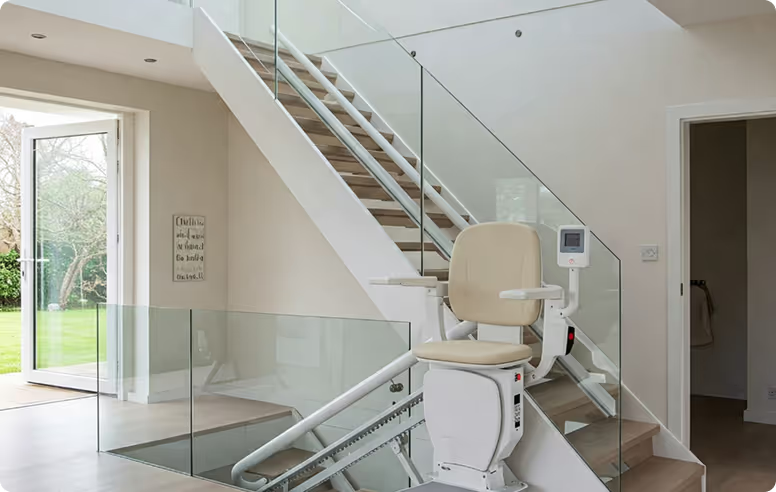
A stair lift does not represent giving up on the stairs — it represents giving up on the risk. Modern stair lifts are quiet, compact, and reliable. They allow people to continue living in their multi-level homes without the daily anxiety of a dangerous task. The decision to install one is almost universally followed by relief, not regret.
For a full comparison of stair lift types, costs, and options, see our Stair Lift Comparison Guide and our Stair Lift Cost Guide for 2026.
NJ-Specific Stair Considerations
New Jersey's older housing stock creates specific stair safety challenges worth addressing directly:
Narrow Staircases
Many pre-1970 NJ homes — particularly rowhouses and townhomes in Hudson, Essex, and Bergen Counties — have staircases as narrow as 26–28 inches. At this width, there is barely room for a standard handrail on each side and a person descending the centre of the staircase. Slimline handrail profiles and careful installation are needed, and a stair lift assessment should specifically address whether the staircase width can accommodate the rail system.
Steep Stair Angles
Older NJ homes often have steeper stair angles than modern building codes permit — risers of 8 inches or more are common. Steeper stairs require more lower body strength to descend safely and are higher risk for older adults. If the staircase is steeper than standard, the threshold for considering a stair lift assessment should be lower.
Split-Level Layouts
Split-level homes — extremely common in Bergen, Morris, and Passaic Counties — have multiple short stair runs rather than a single long staircase. Each short run has its own handrail requirements and each landing transition is a fall-risk point. All sections need to be assessed, not just the longest run.
Free stair safety assessments across Bergen, Essex, Passaic & Hudson County NJ — CAPS certified, no obligation.
Book Your Free Stair Assessment →Frequently Asked Questions
What is the most important stair safety improvement for seniors?
Handrails on both sides of the staircase, running the full length from bottom to top, firmly anchored and at the correct height. This single improvement provides the most significant reduction in stair fall risk for most seniors in most homes. If only one improvement can be made, this is it.
How do I know if my staircase handrail is secure enough?
Grip the rail firmly and apply sideways pressure — as if catching a fall. Any wobble, movement, or give indicates the anchoring is insufficient. A properly installed handrail should feel completely solid under significant force. If it moves, have it professionally secured before continuing to rely on it.
What type of non-slip tread is best for stairs?
For carpeted stairs with worn edges, adhesive non-slip nosing strips at the front of each tread are the simplest and most effective option. For hardwood stairs, full rubber tread covers or anti-slip coating are effective. The key is addressing the tread edge specifically — that is where the slip risk is highest.
Should a senior use a stair lift or move to a single-story home?
For most families, a stair lift is a significantly better option than relocating. Moving from a long-established home is disruptive, expensive, and often emotionally difficult — and it severs community and neighbourhood connections that are important for mental health and wellbeing. A stair lift resolves the safety issue at a fraction of the cost and disruption of relocation, allowing the person to remain in the home they know and love.
Can a stair lift be installed on any staircase in an NJ home?
Most staircases can accommodate a stair lift, including narrow NJ staircases with slimline rail systems. Curved, L-shaped, and split-level staircases require custom curved rail systems. An in-home assessment confirms which configuration is right for the specific staircase. We have installed stair lifts in some of NJ's oldest and most challenging staircase configurations across Bergen, Essex, Passaic, and Hudson County.