
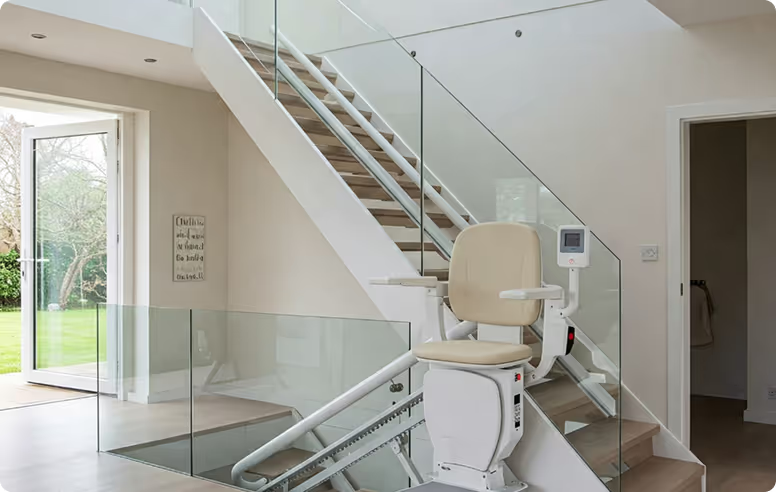
Choosing a stair lift involves more decisions than most people expect. Beyond the basic question of straight versus curved, there are significant differences in weight capacity, seat style, drive mechanism, safety features, and brand reliability — all of which affect both the daily experience of using the lift and its long-term cost of ownership.
This guide cuts through the noise and gives you a clear, honest comparison of every major stair lift type, the features that actually matter, and the brands worth considering in 2026. If you are helping a family member select a lift or evaluating options for yourself, this is the reference you need before making any purchase decision.
The First Decision: Straight vs. Curved vs. Outdoor
Before any other comparison, your staircase determines which type of stair lift is even possible. This is not a preference — it is a physical constraint.
| Stair Lift Type | Who It's For | Price Range (Installed) | Lead Time |
|---|---|---|---|
| Straight stair lift | Single straight staircase, no turns or landings | $3,500 – $5,500 | Same day – next day |
| Curved stair lift | Any staircase with a bend, turn, or intermediate landing | $8,000 – $13,000+ | 2–6 weeks (custom rail) |
| Outdoor stair lift | Exterior steps — front entry, deck, garden | $3,500 – $9,000 | 3–7 days |
| Perch / standing lift | Users who cannot bend knees to sit | $3,000 – $6,500 | 1–5 days |
| Heavy-duty stair lift | Users requiring 300–600 lb capacity | $3,500 – $7,000 | 1–5 days |
Quick test for curved vs. straight: Stand at the bottom of your staircase and look up. If the stairs run in a perfectly straight line from bottom to top with no turns, bends, or landings in the middle, you need a straight lift. Any deviation at all — a slight curve, a 90-degree turn, an intermediate landing — requires a curved lift with a custom rail.
Straight Stair Lifts: Types and Differences
Even within the straight lift category, there are meaningful differences between models. Here is what to compare:
Standard Straight Lift
The workhorse of the stair lift market. Runs on a straight aluminum rail mounted to the stair treads. The seat, footrest, and armrests fold flat when not in use, allowing other household members to use the stairs normally. Drive mechanism is typically a rack-and-pinion or cable system — both reliable when properly maintained.
Slimline Straight Lift
Designed for narrow staircases — those as narrow as 24–26 inches. Uses a thinner rail profile and a more compact seat folding mechanism. Slightly more expensive than a standard lift but the only viable option for older NJ homes with narrow stairways.
Standing / Perch Lift
For users who cannot bend their knees sufficiently to sit in a standard seat — typically after knee replacement surgery or with advanced arthritis. The user stands or leans against a padded platform rather than sitting. Less common but an important option for the right user.
Heavy-Duty Lift
Standard stair lift seats are rated for up to 300 lbs. Heavy-duty models support 400–600 lbs, with reinforced rails, stronger motors, and wider seat designs. The weight limit is a safety specification — never install a standard lift for a user who exceeds its rated capacity.
Curved Stair Lifts: What Makes Them Different
Curved stair lifts are fundamentally different products from straight lifts — not simply more expensive versions of the same thing. The key differences:
- Custom rail: Every curved rail is fabricated specifically for the exact geometry of your staircase — the angle, radius, and length of every section. This is why they cost more and take longer to produce.
- Cannot be reused: Unlike straight rails that can be cut to fit different staircases, a curved rail built for one home will not fit another. There is no viable refurbished curved lift market for this reason.
- Continuous travel: A good curved lift travels smoothly through bends and over landings without stopping. Cheaper curved lifts may jerk or pause at transition points — ask specifically about this during any demonstration.
- Outside vs. inside rail: The rail can be mounted on the outside or inside of the staircase curve. Outside mounting keeps the seat away from the wall on straight sections; inside mounting is often preferred for very tight staircases. Your installer will recommend the right option for your specific staircase.
Key Features to Compare Across All Lift Types
Powered Swivel Seat
One of the most valuable upgrades available. When the lift reaches the top landing, a powered swivel seat rotates the seat to face outward before the user stands — eliminating the need to stand up while still facing the stairs, which is a significant fall risk. For users with hip or knee problems, this feature is strongly recommended.
Seat Width and Padding
Standard seats are typically 17–19 inches wide. Wider options (22–24 inches) are available for comfort. Seat padding quality varies significantly between brands — firmer padding holds up better over years of use, while overly soft padding compresses and provides less support over time.
Armrests
Fixed vs. folding armrests — folding armrests allow the seat to fold more compactly when not in use, which is important on narrow staircases. Padded armrests are more comfortable for users who use the lift multiple times daily.
Footrest Design
Powered folding footrests fold automatically when not in use. Manual folding footrests require the user to fold them — which can be difficult for users with limited hand strength or dexterity. If the user has any hand or upper body limitations, specify a powered footrest.
Controls
All stair lifts come with a joystick or rocker switch on the armrest. Additionally, most include remote controls — typically one at the top and one at the bottom of the stairs — so family members can send the lift to the other floor when needed. Some models also offer a wall-mounted call/send station.
Battery Backup
Modern stair lifts run on rechargeable batteries that charge continuously when the lift is parked at the charging strip. This means the lift operates normally during power outages — typically providing enough charge for multiple complete trips. In New Jersey, where winter storms can cause extended power outages, this feature is essentially essential.
Safety Sensors
Obstruction sensors detect objects on the stairs and stop the lift automatically. Higher-end models have sensors on both the front and back of the carriage, as well as on the footrest. Budget models may have fewer sensors or slower sensor response — an important safety consideration for households with children or pets on the stairs.
Weight Limit
Always confirm the user's weight against the lift's rated capacity — and do not assume a standard 300 lb rating is sufficient without checking. If the user is close to the limit, consider a heavy-duty model with more headroom.
Rail Length and Speed
Longer staircases take more time to travel. Standard lift speeds run 18–25 feet per minute. Some users prefer slower speeds for a smoother, more controlled feel; others prefer faster operation. Speed is typically fixed on budget models and adjustable on premium models.
Brand Comparison: Straight Stair Lifts
| Brand | Country | Price Range (Installed) | Warranty | Standout Feature |
|---|---|---|---|---|
| Bruno | USA | $3,000 – $5,500 | 5 yr parts / 2 yr labor | Made in USA, longest warranty, wide dealer network |
| Acorn | UK | $2,500 – $4,500 | 2 yr parts & labor | Compact design, good for narrow stairs |
| Stannah | UK | $3,500 – $5,500 | 2 yr parts & labor | Premium build quality, strong service network |
| Harmar | USA | $2,800 – $4,800 | 3 yr parts / 1 yr labor | Good value, reliable motor |
| AmeriGlide | USA | $2,000 – $3,500 | 1–2 yr parts | Budget-friendly entry point |
Brand Comparison: Curved Stair Lifts
| Brand | Price Range (Installed) | Rail Fabrication Time | Standout Feature |
|---|---|---|---|
| Bruno Elite Curved | $10,000 – $16,000+ | 3–5 weeks | Smooth travel through bends, US-made rail |
| Stannah Curved | $10,000 – $15,000 | 4–6 weeks | Premium finish, quiet operation |
| Acorn Superglide | $9,000 – $14,000 | 2–4 weeks | Faster fabrication, compact rail |
| Handicare Freecurve | $9,500 – $14,500 | 3–5 weeks | Outside rail option, slim profile |
Stair Lift vs. Alternatives: When to Consider Something Different
A stair lift is not always the right solution. Here is when to consider alternatives:
Vertical Platform Lift (Porch Lift)
For users in wheelchairs who cannot transfer to a stair lift seat, a vertical platform lift provides a powered platform that rises vertically between floors. More expensive ($3,000–$8,000) and requires more space than a stair lift, but provides true wheelchair accessibility. Requires a permit in most NJ municipalities.
Home Elevator
For multi-story homes where a permanent, high-capacity solution is desired. Home elevators cost $15,000–$30,000+ and require significant structural work. Appropriate for new construction planning or major renovations — rarely cost-effective as a retrofit solution for aging-in-place needs.
Moving to One Floor
For some individuals, the simplest solution is relocating their primary living space to the ground floor — moving the bedroom downstairs and avoiding the upper floor entirely. This works when the ground floor has or can have a bathroom, and when the upper floor is used primarily for storage or occasional guest use.
The best stair lift is the one that fits your specific staircase, meets the user's weight and mobility needs, and comes with a local service team that will respond quickly when maintenance is needed. Brand loyalty is less important than fit and support.
What to Ask Before Buying: A Checklist
- Does the quoted price include the unit, rail, all hardware, and installation — or are any costs billed separately?
- What is the weight capacity, and does it provide sufficient headroom above the user's weight?
- Is the seat motorized to swivel at the top landing?
- Does the footrest fold automatically or manually?
- Does the lift operate on battery backup during power outages?
- What safety sensors are included, and are they front and rear?
- What is the manufacturer warranty, and what does the installer's labor warranty cover?
- Is there a local service team in NJ, and what is their typical response time for service calls?
- Can I see a demonstration or visit a showroom before purchasing?
Not sure which stair lift is right for your home? Our CAPS-certified team will assess your staircase and give you an honest recommendation — free, no obligation.
Get Your Free Assessment →Frequently Asked Questions
What is the difference between a straight and curved stair lift?
Straight stair lifts run on a standard rail along a staircase with no turns or bends. Curved stair lifts use a custom-fabricated rail built specifically for staircases with any bend, turn, or intermediate landing. Curved lifts cost significantly more ($9,000–$16,000 vs $2,500–$5,500) and take longer to install due to the custom rail fabrication time.
Which stair lift brand is the best?
Bruno is widely considered the strongest option for US buyers — made in America, longest warranty in the market, and the broadest dealer service network. Stannah and Acorn are strong UK-made alternatives with good track records. For most NJ homeowners, brand matters less than choosing a reputable local installer who will service the lift reliably after installation.
How long does a stair lift last?
A well-maintained stair lift from a quality brand should last 10–15 years. Annual servicing — checking the rail, drive system, battery, and safety sensors — extends the life significantly and catches minor issues before they become failures.
Can two people in the household use the same stair lift?
Yes. A single stair lift rail has remote controls at both the top and bottom of the stairs, allowing any household member to call the lift to their floor. Multiple family members can use the same lift throughout the day without any issues.
Is a stair lift or home elevator better?
For most aging-in-place applications, a stair lift is the better choice — significantly lower cost, faster installation, and no structural modifications required. A home elevator makes sense primarily for new construction, major renovations, or situations where a wheelchair user cannot transfer to a stair lift seat.
Can a stair lift be installed on any staircase?
Most staircases can accommodate a stair lift with the right configuration. Very narrow staircases (under 24 inches) may require a slimline rail. Very steep staircases may need specific seat angle adjustments. An in-home assessment identifies any constraints and confirms the right solution before purchase.