
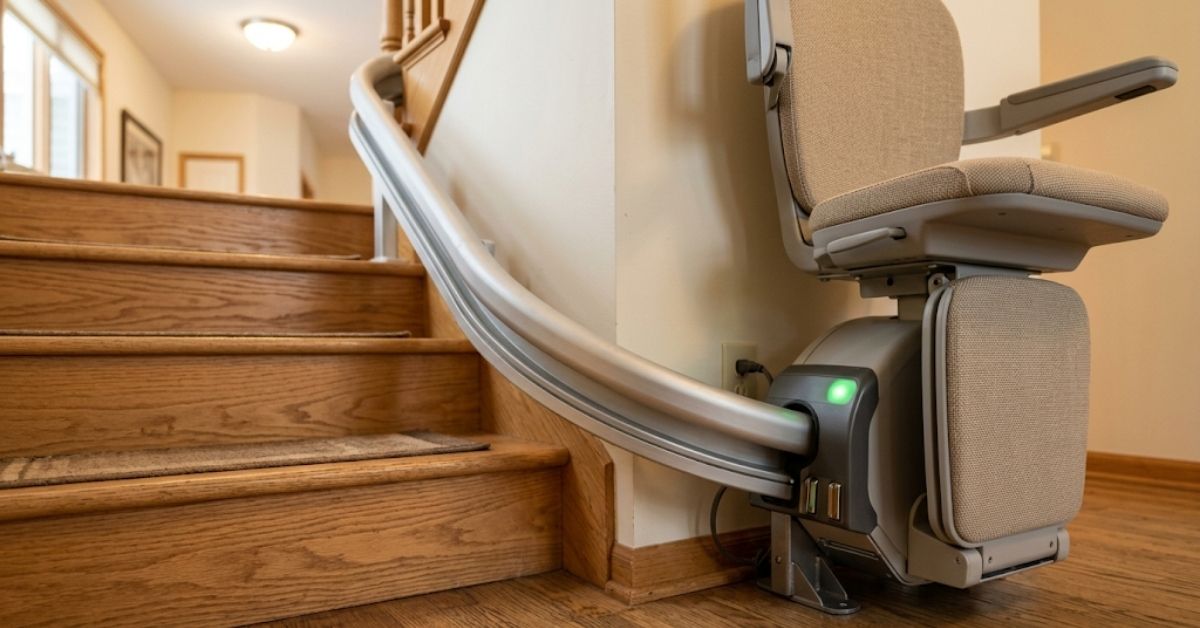
NJ homeowners considering a stair lift often raise a legitimate concern: what happens during a power outage? Northern New Jersey experiences its share of storms, hurricane remnants, and occasional multi-day outages — and being stranded upstairs or downstairs during an emergency is exactly what a stair lift is supposed to prevent. If the equipment itself stops working when the power goes out, the peace of mind it's supposed to deliver disappears.
The reassuring news: every modern residential stair lift is designed with this exact scenario in mind. Stair lifts do not run on wall power during operation — they run on internal batteries that continue to work during power outages. This guide explains how the battery backup system works, how many trips you can expect on battery alone, how long batteries last, and how to make sure your stair lift is always ready when a storm hits.
The Direct Answer
Yes — stair lifts work during power outages. Every modern residential stair lift runs on internal rechargeable batteries. The wall outlet only charges the battery; it does not power the equipment during use. When the power goes out, the stair lift continues working normally on battery reserves, typically providing 8–20 complete round trips depending on the specific model, battery age, and user weight. The batteries recharge automatically when power is restored.
How Stair Lift Battery Systems Actually Work
Understanding the electrical design of a stair lift makes the power outage question much clearer. Unlike home appliances that draw current directly from wall power during use, stair lifts operate more like electric wheelchairs or cordless power tools — they store energy in an onboard battery and use that stored energy to run the motor.
The Battery-Powered Design
Every residential stair lift includes a rechargeable battery pack — typically located under the seat or in the carriage housing — that powers the drive motor, safety sensors, and control systems. The battery is continuously trickle-charged whenever the seat is docked at either end of the staircase in contact with a charging strip.
The key implication: power outages do not stop the stair lift from operating, because the wall outlet isn't providing operational power in the first place. As long as the battery has charge, the stair lift works exactly as it does under normal conditions — same speed, same safety features, same smooth operation.
Charging Strips at Top and Bottom
Modern stair lifts include charging strips at both the top and bottom of the staircase. The seat docks against whichever strip it stops at, maintaining trickle charge whenever the equipment is not in use. This design means:
- The battery gets charged regardless of which end of the staircase the seat is parked at
- Users don't need to remember to "plug in" the stair lift — it charges automatically after every use
- If a storm knocks out power just as the seat arrives at the top, the equipment still has full battery available for future trips
How Many Trips Can a Stair Lift Do on Battery Alone?
Battery capacity varies by manufacturer and model, but typical residential stair lift battery reserves provide substantial usage between charges:
| Scenario | Typical Trips on Battery | Approximate Coverage |
|---|---|---|
| New battery, average user weight | 15–20 round trips | 2–3 days of normal use |
| Battery at 2 years, average use | 10–15 round trips | 1–2 days of normal use |
| Battery at 3–4 years, average use | 8–12 round trips | 1 day of normal use |
| Heavy-duty stair lift, heavier user | 8–15 round trips | 1–2 days of normal use |
| Battery near end of life (5+ years) | 4–8 round trips | Half day; replace soon |
For context, a "round trip" is one full ascent from bottom to top and one descent from top to bottom. Most NJ households use their stair lift 4–8 round trips per day for typical living activities. A fully charged new battery typically covers 2–3 days of ordinary use without any charging — more than enough for the vast majority of NJ power outages.
For NJ storm season specifically: Most NJ power outages from typical thunderstorms and winter weather last less than 24 hours. Even multi-day outages from hurricane remnants (like Sandy or Ida) typically don't exceed the battery reserves of a properly maintained stair lift. The scenarios where battery reserves become genuinely inadequate are unusual — sustained multi-day outages with heavy use, or equipment with badly degraded batteries that should have been replaced.
What Batteries Do Stair Lifts Use?
Most residential stair lifts use one of two battery types:
Sealed Lead-Acid (SLA) Batteries
The most common battery type in residential stair lifts. Two 12V SLA batteries wired in series to produce 24V total. Reliable, mature technology with predictable performance characteristics. Typical lifespan is 3–5 years with normal use. Cost to replace is generally $150–$350 including the batteries and labour.
Lithium-Ion Batteries
Increasingly common in newer premium stair lift models. Higher energy density, lighter weight, longer lifespan (5–8 years typical), and faster charging than SLA. More expensive to replace initially ($300–$600) but often offers better lifetime value.
What Happens If the Battery Runs Out Mid-Ride?
Modern stair lifts include multiple safety systems that prevent stranding the user if the battery reaches critically low levels. Understanding these systems helps address the specific fear of being stuck mid-staircase during an extended outage.
Low Battery Warnings
All modern stair lifts include visual and audible warnings when the battery reaches low levels. Users typically receive multiple warnings — LED indicators, beeps, or dashboard alerts — well before the battery becomes critical. This gives the user time to complete a final trip and dock the seat at the appropriate end of the staircase.
Emergency Manual Descent Systems
Most residential stair lifts include a manual override that allows the seat to descend safely even if the battery is fully depleted or the motor fails. The mechanism varies by manufacturer but typically involves:
- A hand crank or manual release lever accessible from the seat or nearby
- A controlled descent mode where the seat travels down using gravity with a mechanical brake
- Emergency stop buttons that halt movement instantly if needed
The intent is that no user should ever be permanently stranded on the staircase. If manual descent is required, an instruction sticker is typically placed near the seat with step-by-step directions for that specific model.
Battery Preservation Modes
Some stair lifts include intelligent battery management — for example, disabling non-essential features (LED lights, non-critical sensors) when battery is low to preserve remaining capacity for actual travel. The seat continues to work; auxiliary features do not.
The design philosophy behind residential stair lifts prioritises never leaving the user stranded. Between battery reserves lasting days rather than hours, low-battery warning systems giving ample notice, and emergency manual descent options for the worst case, being permanently stuck on the equipment during an outage is extremely unlikely.
Signs Your Stair Lift Battery Is Failing
Batteries degrade gradually over their 3–5 year (SLA) or 5–8 year (lithium-ion) lifespan. Recognising the signs of a failing battery lets you replace it proactively — before a real emergency reveals the problem.
- Reduced trip count between charges: If you're getting noticeably fewer trips than you did 6–12 months ago, the battery is degrading. Replace when trip count drops below 8 per full charge
- Slower travel speed on incline: Batteries losing capacity often show up first as slower ascent speed under load. A stair lift that used to climb briskly and now feels sluggish is often a battery issue rather than a motor problem
- Warning lights or error codes displayed: Modern stair lifts display battery health warnings well before failure. Do not dismiss these — they are the equipment telling you exactly what needs attention
- Longer charging time to full: A battery approaching end of life takes longer to fully charge and holds less charge overall
- Failure to hold charge overnight: If the seat shows partial charge in the morning after being docked overnight, the battery is failing
- Physical signs of battery age: Corrosion around terminals, swelling, or damage visible on the battery housing (typically only visible to a service technician during inspection)
Preventive replacement strategy: Rather than waiting for the battery to fail, most residential stair lift owners are best served by replacing SLA batteries proactively at year 4 and lithium-ion batteries proactively at year 6. Preventive replacement costs the same as reactive replacement but eliminates the risk of failure during a critical time. Discuss with your service provider during annual maintenance visits.
Battery Replacement: What to Expect
When batteries need replacement, the process is straightforward for a qualified stair lift service technician:
Typical Battery Replacement Process
- Technician arrives with correct replacement batteries for your specific model
- Disconnect and safely remove the existing batteries
- Install new batteries, ensuring proper polarity and secure connections
- Test the stair lift's full range of motion under load
- Verify charging indicator functions correctly at both charging strips
- Confirm safety systems (obstruction sensors, emergency stops) function normally
- Provide the customer with the new battery's expected lifespan and warranty details
Typical total time on site: 30–60 minutes. Typical total cost in NJ: $150–$350 for SLA batteries, $300–$600 for lithium-ion, including parts and labour. Batteries are the primary maintenance item for a stair lift and their cost is generally the largest recurring expense over the equipment's 10–15 year life.
Best Practices for Battery Longevity
Battery lifespan varies significantly based on how the equipment is used and maintained. Simple practices extend battery life meaningfully:
- Always dock the seat at either the top or bottom charging strip when not in use. Leaving the seat mid-staircase drains the battery without charging it and shortens battery life significantly
- Ensure both charging strips are working. If one strip has an issue, the battery only charges when the seat is at the other end — meaning the battery gets less charge time overall
- Do not disconnect the stair lift from wall power for extended periods. The trickle charge maintains battery health. Extended periods without charge can permanently damage SLA batteries
- Keep the charging strip clean and free of debris. A dusty or dirty charging strip may not make proper electrical contact, resulting in incomplete charging
- Address low-battery warnings promptly. Repeatedly running the battery to depletion accelerates capacity loss and shortens overall lifespan
- Schedule annual maintenance that includes battery health check and terminal cleaning
Following these practices commonly extends SLA battery life from 3 years to 5 years — meaningful savings across the equipment's lifetime.
Battery Backup vs Whole-House Generator
Some NJ homeowners with existing whole-house generators or portable generator systems ask whether they should be plugging the stair lift into generator power during outages. In most cases, this is unnecessary:
- The stair lift's internal battery provides sufficient capacity for most outages
- Plugging into generator power provides trickle charging but does not accelerate charging significantly
- Manufacturer specifications should be checked before connecting to generator power (some generators produce electrical waveforms that can affect sensitive charging circuits)
- Households with whole-house generators automatically maintain charging strip power without any action needed
For most families, the built-in battery backup is sufficient. If genuinely concerned about extended outage scenarios (rare in NJ), a portable battery pack sized to run a small appliance can be used to charge the stair lift's charging strip — but this is rarely necessary in practice.
Concerned about your stair lift's battery health or planning ahead for storm season? Everhome Mobility provides free battery health checks as part of annual maintenance visits across Northern NJ.
Schedule a Battery Health Check →Frequently Asked Questions
Do stair lifts work in a power outage?
Yes. Every modern residential stair lift runs on internal rechargeable batteries — the wall outlet only charges the battery, it does not power the equipment during use. Stair lifts continue working normally during power outages, typically providing 8–20 complete round trips on battery reserves depending on model, battery age, and user weight. The batteries recharge automatically when power is restored.
How long does a stair lift battery last?
Sealed lead-acid (SLA) batteries — the most common type — typically last 3–5 years with normal residential use. Lithium-ion batteries used in newer premium models typically last 5–8 years. Actual lifespan varies based on usage frequency, care practices (particularly proper docking at charging strips), and environmental conditions.
What happens if my stair lift battery dies during use?
Modern stair lifts include multiple safety systems to prevent stranding. Users receive low-battery warnings well before the battery becomes critical. If the battery does fully deplete, most models include emergency manual descent options — a hand crank, release lever, or controlled gravity descent — allowing the seat to reach the bottom safely. Detailed instructions for your specific model should be near the seat.
How much does a stair lift battery replacement cost?
Typical NJ cost for battery replacement is $150–$350 for standard sealed lead-acid batteries and $300–$600 for lithium-ion batteries, including both parts and labour. Battery replacement is generally the primary recurring maintenance expense for a stair lift and is straightforward for qualified service technicians to complete in 30–60 minutes.
Do I need a generator for my stair lift?
No. The stair lift's built-in battery backup provides sufficient capacity for most outages — typically 1–3 days of normal use on a full charge. A generator is not necessary for stair lift function during power outages. If you already have a whole-house generator, it will automatically maintain charging strip power without any additional setup.
How do I know if my stair lift battery is failing?
Common signs include noticeably fewer trips between charges, slower ascent speed under load, warning lights or error codes displayed, longer charging time to full, and failure to hold charge overnight. When trip count drops below 8 per full charge, replacement is recommended. Proactive replacement at year 4 (SLA) or year 6 (lithium-ion) is a common preventive strategy.